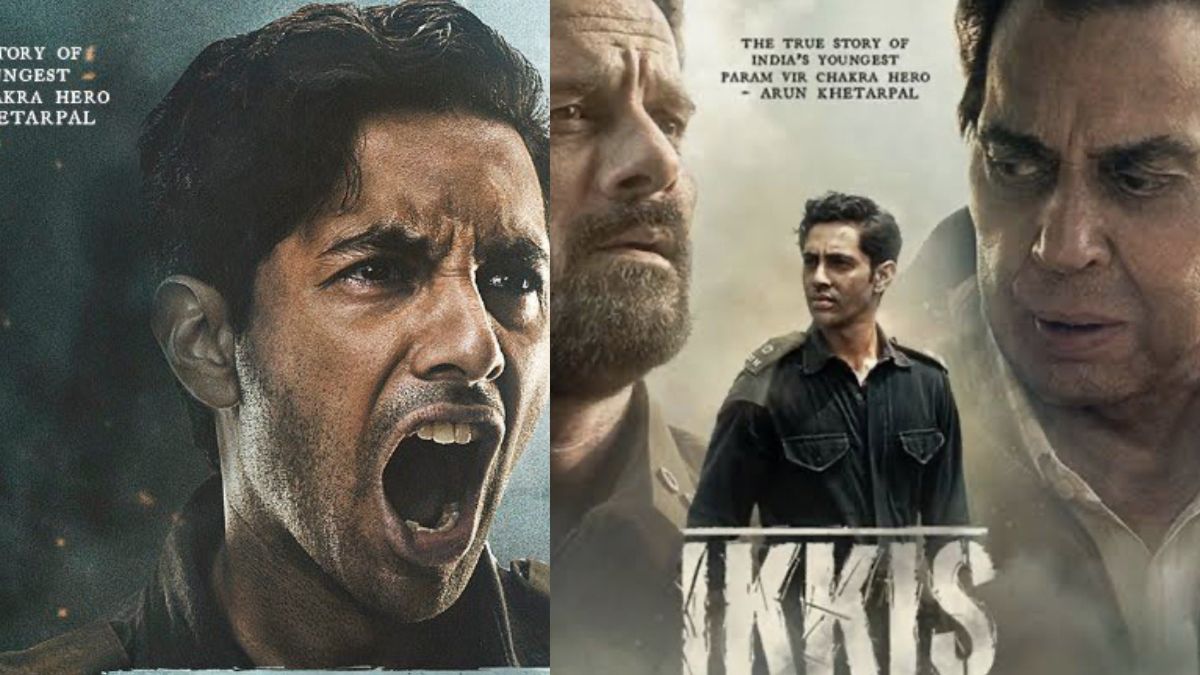
Ikkis: An introspective war drama and a far cry from Dhurandhar’s hyper nationalism

Director Sriram Raghavan successfully charts into a new territory with Ikkis. The film is successful in not just honoring the bravery of Arjun Khetarpal (a Param Vir Chakra hero): but it also explores the aftermath and the human cost of war. Above all though Ikkis is a perfect swan song for the late Dharmendra. The veteran actor brings in an emotional resonance especially in his monologue about the endless cycle of violence. His scenes with the ever-reliable Jaideep Ahlawat gives Ikkis its best moments

Starcast: Agastya Nanda, Dharmendra, Jaideep Ahlawat, Vivan Shah, Sikander Kher, Rahul Dev and others

Genre: Drama

Director and writer: Sriram Raghavan

Additional writers: Arjit Biswas and Pooja Ladha Surti

Producer: Dinesh Vijayan

Production Company: Maddock

Cinematography: Anil Mehta

Music: Sachin Jigar

Running time: 2 hours and 24 minutes

In today’s age of hyper nationalism, the term patriotism is often confused with demeaning our neighbor Pakistan or presenting Muslims in a certain way. Aditya Dhar’s films starting with Uri to Dhurandhar are a perfect example of making movies to please a certain political party. Nuanced depiction of war is hard to fine but Sriram Raghavan achieves a unique feat with his latest Ikkis. The broad story has the familiar tropes of sacrifice and a young man fighting against all odds in the direst of circumstances.

However, within this familiar palate Sriram Raghavan brings in something new. The newness comes from the characterization of Jaideep Ahlawat’s Brigadier Nissar. Nissar is a far cry from the stereotypical Pakistani commanders. There’s a humanness to him and this comes out wonderfully on numerous occasions. The storyline of Ikkis juggles with three different timelines. One timeline is about Agastya Nanda’s Arjun Khetarpal fighting in the war, two the romantic track and lastly the scenes between Brigadier Nissar and late Dharmendra’s M. L Khetarpal. Brigadier Nissar hosts M.L Khetarpal taking him to different places in Pakistan. There is a specific reason for Nissar doing it and this is something to be explored on screen rather than me saying.

The strongest aspect of Ikkis is undoubtedly the scenes between Dharmendra and Jaideep. The movie’s core themes is explored through them. Both these men have fought numerous wars for their respective nations, so they perfectly understand the emotional baggage that comes with it. The scars of a war are always there and this has been wonderfully explored in their conversations. The approach is refreshingly restrained without making it us versus them. M.L Khetarpal like the many partition refugees has his origins in Pakistan but eventually settles in India.

A major reason for Khetarpal’s Pakistan visit is seeing his ancestral home apart from a reunion party with former army mates. For a man who has seen a lot of emotional turmoil he has an upbeat nature brilliantly portrayed by Dharmendra. A special mention must be made of how Khetarpal reacts to Nissar’s confession. There is a remarkable restraint followed by an important monologue on the futility of war and the cycle of violence with its tragic aftermath. The beautiful bond shared between these characters in a short span of time is a delight to watch. In more ways than one Ikkis feels like a Sriram Raghavan’s version of Bajarangi Bhaijaan. Ikkis has a much-needed message of humanity, and this is very important especially in today’s politically divisive environment.

Apart from the late Dharmendra Jaideep Ahlawat is another strong pillar for Ikkis. The fantastic actor never overplays the guilt of Nissar. There is a grace to his overall demeanor and Jaideep nails the different shades especially when he has an important breakdown. Jaideep is truly one of the best actors that we have today, someone who is extremely versatile.

Agastya Nanda as Arjun Khetarpal turns out to be a good choice for the titular protagonist. The rough edges are still there in the scenes of drama nevertheless the young actor makes a good impression: its a performance which is far ahead of the OTT debut Archies. He brings in the right amount of enthusiasm and the required daredevil nature. The romantic scenes though act as a major speed breaker. They have been loosely written, and it doesn’t help that Simar Bhatia is rather flat with her expressions. The songs too by Sachin Jigar belong to a different movie and not this.

In the supporting cast Vivan Shah, Sikander Kher and Rahul are competent especially Vivan playing Arjun Khetarpal’s captain. Agastya and Vivan share a good camaraderie especially in the scene where Vivan advises Arjun on how firing alone doesn’t make someone a man.

Vivan Shah from Ikkis

In the technical department Anil Mehta’s work deserves a special mention. How he has captured the nature of war tanks with a gritty texture is praiseworthy. The action sequences have a different feel to them as you don’t have the usual template of action seen in war dramas.

Final word: Ikkis is a much-needed tale of patriotism without demeaning Pakistan. The thread of emotional baggage across borders makes Ikkis a poignant war drama.

Rocky Aur Rani Ki Prem Kahaani: Inclusivity In Karan Johar Style

The director subverts some of his own themes from his previous films; a case in point being how fear is looked upon as respect in our culture.

Karan Johar’s Rocky Aur Rani Ki Prem Kahaani is everything that you expect from the filmmaker. There are larger-than-life sets and exquisite costumes among other things.

At the same time, the director subverts some of his own themes from his previous films; a case in point being how fear is looked upon as respect in our culture.

The film also makes a strong case for inclusivity through Tota Roy Chowdhury’s character who loves Kathak which is looked upon as a female dance form. It also makes a strong case for inclusivity between two vastly different cultures — Punjabi and Bengali.

Synopsis

Rocky Aur Rani ki Prem Kahaani begins with the introduction of Rocky and Rani (Ranveer Singh and Alia Bhatt respectively).

Rocky is introduced through a dance number where he is surrounded by many women, including Janhvi Kapoor, Sara Ali Khan, and Ananya Pandey (in special appearances).

He is dancing his heart out; but as soon as his grandmother Dhanalakshmi (Jaya Bachchan) appears, he scampers away because he is afraid of her and also his father.

Dhanalakshmi is the owner of a sweet shop — Dhanalakshmi Group. Rocky is the future heir to this business venture.

After the introduction of Ranveer, we move to Alia Bhatt’s Rani Chatterjee. She is introduced as this firebrand journalist who isn’t afraid to take on the Jugular.

The viewers see her grilling a minister about the rising rape cases by uttering a powerful dialogue: “Nazare Kharab Aapki Parde Kare Hum” (You ever tease us and we have to hide behind the curtains).

This sets the base for the drama to follow.

Rocky’s grandfather Kanwal (Dharmendra) is bedridden most of the time because of paralysis. He suffers from memory loss, too.

He has half picture of a woman in one of his books and Rocky believes that this woman might be the key to his grandfather regaining his memory.

The woman turns out to be Rani Chatterjee’s grandmother Jamini Chatterjee (Shabana Azmi). She is a cultural icon known among her intellectual gatherings.

Rocky arranges a meeting between his grandfather and Jamini through Rani.

Real kahaani

Rani initially treats him in a patronising way. But after some flirtation and through some old Hindi songs, they both fall for each other.

Rani isn’t sure about getting into a relationship with Rocky, given the many differences. But she eventually gives in.

However, things are far from easy as both families are contrastingly different from each other.

While the Chatterjees are woke, the Randhawas are as rigid as you get.

Taking the Telugu film Bommarillu (2006) route, the couple decides to go for a swap. Rani starts living with the Randhawas and Rocky with the Chatterjees.

Rani initially treats him in a patronising way. But after some flirtation and through some old Hindi songs, they both fall for each other.

Rani isn’t sure about getting into a relationship with Rocky, given the many differences. But she eventually gives in.

However, things are far from easy as both families are contrastingly different from each other.

While the Chatterjees are woke, the Randhawas are as rigid as you get.

Taking the Telugu film Bommarillu (2006) route, the couple decides to go for a swap. Rani starts living with the Randhawas and Rocky with the Chatterjees.

Rani faces severe opposition from Dhanalakshmi as she doesn’t like her firebrand nature. on the other hand, Rocky faces cultural issues. In a hilarious scene, he thinks that Rabindranath Tagore is Rani’s grandfather because of his long beard.

Whiff of nostalgia

The best part of Rocky Aur Rani Ki Prem Kahaani is how the director uses old Hindi songs at important junctures.

For example, Dharmendra sings “Abhi Na Jao Chod Ke” for the first time when his character regains his memory.

Some of the other songs include “Yeh Shaam Mastani“, “O Saathi Chal“, and “Do Dil Mil Rahe Hai“. These old songs are a character in itself.

However, the best usage has to be “Dola Re Dola” from Sanjay Leela Bhansali’s Devdas (2002). The song starts off with Tota Roy Chowdhury performing in Durga Puja.

Ranveer’s Rocky joins him much to the delight of Alia Bhatt’s Rani and to the horror of Jaya Bachchan. Here the director is clearly subverting gender stereotypes.

Alia and Ranveer hold the fort

What also works for Rocky Aur Rani Ki Prem Kahaani is how Ranveer and Alia play off each other’s energies. Their contrasting personalities work for the film.

Ranveer Singh as Rocky brings the house down with his faulty English and uninhibited performance. The actor equally shines in the scenes showcasing Rocky’s fragile side.

The best example is the emotional moment that he shares with Alia’s father Chandon Chatterjee (Tota Roy Chowdary).

Alia Bhatt plays the firebrand journalist with the finesse that you expect from her. She more than holds her own opposite the veteran actors. She is first-rate in the dramatic bits like the showdown that happens between her and Rocky post the “Dhindora” song.

Veterans steal the show

Another thing that works for the film is the bonding between Dharmendra and Shabana Azmi. Their scenes bring a smile to the viewer’s face.

Dharmendra doesn’t have many dialogues, but the actor is still quite good. Shabana Azmi is a picture of grace and poise. Some of her dialogues are truly wonderful.

For instance, there is a scene where Jamini opens up about why she fell in love with Kanwal and how she doesn’t regret it.

Jamini also adds that she got more love from Kanwal in just seven days than she got from her husband in their entire marriage. Further, she talks about how her grandfather wasn’t as polished as Rani thinks him to be.

Tota Roy Chowdhury is in a wonderful form as the man who loves Kathak and takes pride in being a dancer. There is a heart-touching scene where he talks about how he was the only male student in his dance class.

Jaya Bachchan as Dhanalakshmi is more or less a personification of all patriarchal characters, including her husband. She seems to have taken revenge on behalf of all the women characters who have been subjugated by them — Sweet Vengence.

Technical crafts

Pritam’s music isn’t exactly a blockbuster but still, it works on the big screen. “Dhindora Baje Re” and “Ve Kamleya” are easily the best of the lot.

Dhindora Baje Re” is further enhanced by the intense scene which precedes the song.

What Jhumka” makes for a perfect Sangeet number. Alia’s dance moves in sarees particularly stand out.

The cinematography by Manush Nandan is appropriately glossy. He captures the wide canvas of the film well through his lens. Having said that, for some, the canvas may come across as too glossy.

Final take

Rocky Aur Rani Ki Prem Kahaani does remind you of 2 States (2014) and Bommarillu. However, this cultural and family clash is hugely enjoyable if you buy into Karan Johar’s world.

(Views expressed here are personal.)