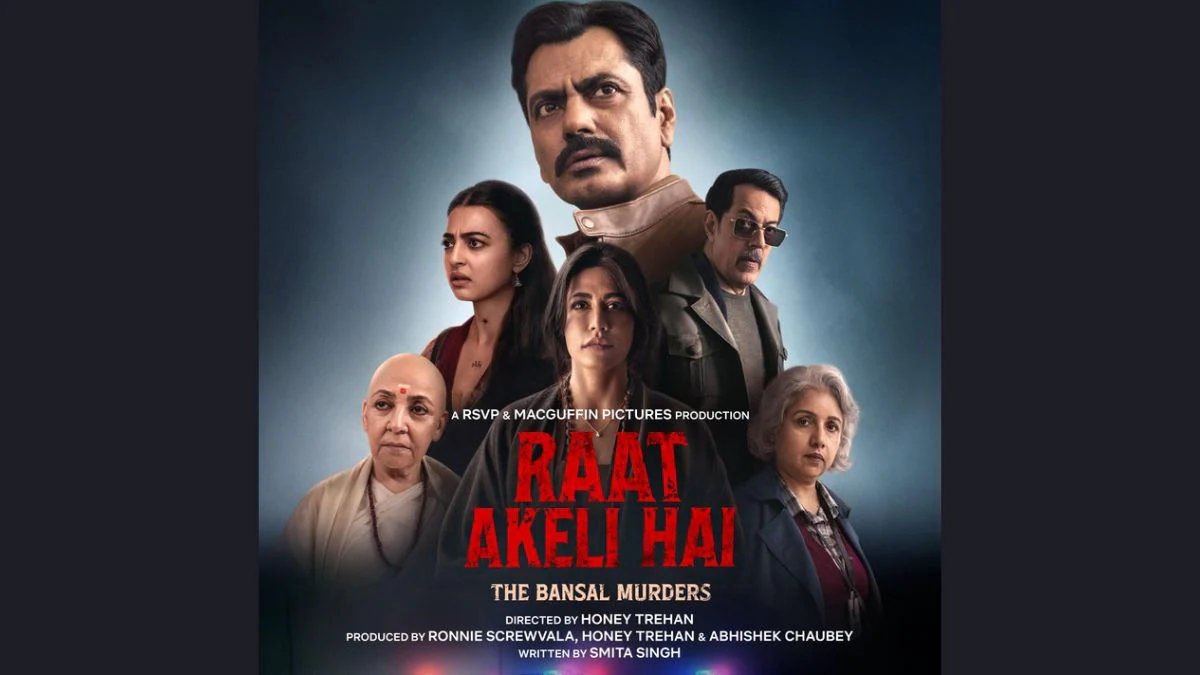
Honey Trehan’s second in the series doesn’t quite hit the high notes of the previous one: nevertheless, the movie is a gripping watch especially in its treatment of human greed and systemic corruption. Honey Trehan along with Smita Singh also touch upon on industrial pollution and a certain apathy for environment
Starcast: Nawazuddin Siddiqui, Chitragandha Singh, Deepti Naval, Revathy, Sanjay Kapoor and others
Genre: Thriller
Director: Honey Trehan
Writer: Smita Singh
Cinematography: Sirsha Ray
Producers: Abhishek Chaubey, Ronnie Screwala etc
Production companies: RVSP Movies and Macguffin Pictures
Running time: 2 hours and 29 minutes
The first Raat Akeli Hai released in 2020 was a compelling murder mystery as well as a social thriller. Through a murder mystery the plot explored the themes of women’s bodies controlled by patriarchy and how their autonomy both sexual and emotional are treated as sins: the institution of marriage being more of a transaction among others. Raat Akeli Hai (The Bansal Murders) follows a similar pattern in the way it combines a whodunit with social elements.

Raat Akeli Hai first part
The storyline of Raat Akeli Hai (The Bansal Murders) takes the viewers right into the thick of action. A wealthy and well-connected family is massacred to death. The crime is meant to be easily solved by the higher officers with a quick culprit fixed: however, Nawazuddin Siddiqui’s Jatil Yadav believes that there is more to what meets the eye. There are multiple skeltons in the closet. Secrets which are meant to be buried and not solved. The rest of the story is about the multiple suspects and the whys and how’s of the case.
A strong aspect of Raat Akeli Hai (The Bansal Murders) is its treatment of multiple layers. The suspects have been written with enough care. This particularly holds true of Chitragandha Singh. She is one of the four survivors. Chitragandha’s Meera is an ambiguous woman with deep bitterness. Meera covers this deep resentment under the guise of spirituality. Chitragandha aces the part with the required mysteriousness keeping the viewers guessing about her motivations.
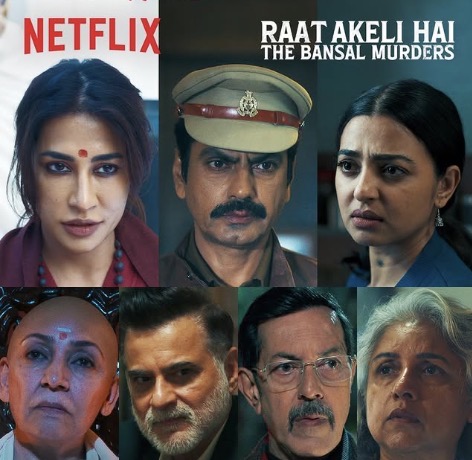
Deepti Naval plays a supposed preacher moddled on fake godmen. This character is reminiscent of movies and web featuring fake babas exploiting people’s vulnerabilities. There is nothing particularly new here, but the senior actress plays her role with the required charm.
Mention must also be made of Sanjay Kapoor as a relative. His eyes are set on the fortunes of Bansali family. Both the character and the actor don’t come across as a stereotypical villain. There is a casual entitlement wonderfully portrayed by the actor. His role and the track cover the theme of moral shortcuts justified in the name of lineage.
There is no denying that Raat Akeli Hai (The Bansal Murders) suffers somewhat on the pacing front. The first part had a tight structure with not much meandering. The second one though needed more crispness. The portions involving Rajat Kapoor and Akhilendra Mishra overstay their welcome. The same applies to the track involving the nitty gritty of forensics. Radhika Apte has an extended special appearance meant to show a personal side of Jatil Yadav. These scenes have some nice touches but in the bigger picture the track doesn’t contribute much. Proceedings stagnate for a while: thankfully though the movie regains lost ground when the focus shifts to environmental destruction.
The themes of industrial pollution and a certain apathy towards environment has come out well. It makes the viewers ponder about where we are heading. Most importantly Honey Trehan and Smita Singh do a good job in linking these portions with the main murder plot. Special mention must also be made of the scenes featuring Revathy as a forensic expert. She plays a moral counterpart to Jatil Yadav’s superiors. The scenes featuring her and Nawazuddin gives the movie some of its best moments.
As Jatil Yadav Nawazuddin Sidddiqui successfully takes off from the first movie. He plays the determined cop with his trademark gravity. He especially shines in the scenes of the character finding itself at crossroads torn between the pressures of institution while listening to his personal consciousness.
Among the technical departments Sirsha Ray’s cinematography is suitably eerie. The cinematography helps in building up a mysterious atmosphere.
Final word: Raat Akeli Hai (The Bansal Murders) is a competent follow up. For fans of murder mysteries with social angles its very much worth watching.


