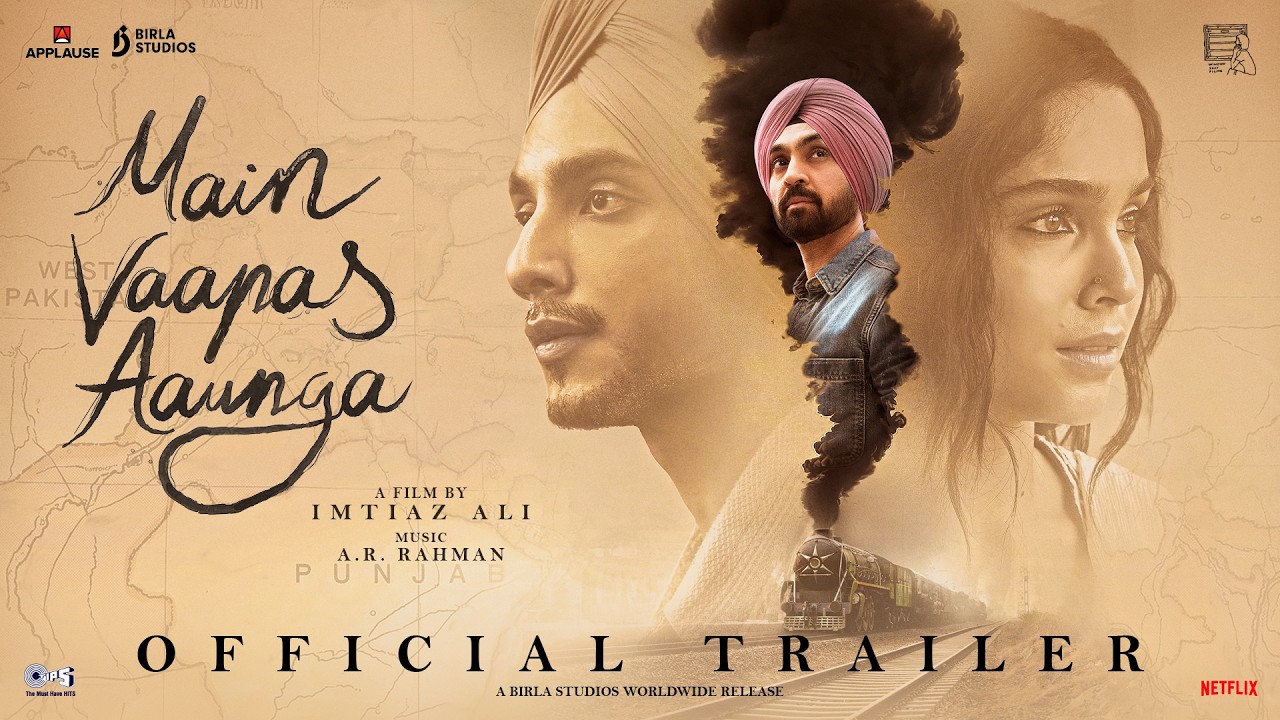
Main Vaapas Aaunga: A stirring tale of trauma and loss of humanity

Imtiaz Ali once again employs his favorite two timeline plot sequencing. More than the partition horrors the movie holds a mirror to today’s displaced homes due to bloodshed. The end montage song with the ever-charming Diljit Dosanjh hits hard. A strong aspect of Main Vaapas Aaunga are the scenes between Nasseerudin Shah and Diljit. The portions have a perfect blend of humor with emotional pathos. The pre partition romance though needed better writing

Starcast: Naseeruddin Shah, Diljit Dosanjh, Vedang Raina, Sharvari Wagh and others

Genre: Romance/drama

Director and writer: Imtiaz Ali

Additional writer: Nayanika Mahatani

Music: A R Rahman

Cinematography: Sylvester Fonseca

Producers: Sameer Nair, Deepak Segal etc

Production Companies: Window Seat Films, Applause Entertainment etc

Running time: 2 hours and 46 minutes

Stories of Partition and Bollywood go hand in hand; numerous filmmakers have depicted the horrors of partition in their own ways but still there is always something left to be explored. Imtiaz Ali’s latest Main Vaapas Aaunga is also about pre partition and the horrors following it. But the genre here makes a difference. Imtiaz packs in an intense tale of unrequited love, love so intense that our protagonist hasn’t forgotten his heroine though he is 95 years old. Naseeruddin Shah is Keenu. He falls in love with a Muslim girl Jiya/Afshana played by a radiant Sharvari Wagh. Vedang Raina plays the younger version in the flashbacks. Their blossoming romance hits a roadblock due to partition. He manages to make a living, but the scars haven’t completely left. Diljit Dosanjh plays the grandson Nirvair Grewal. Nirvair is going through his own hassles both professionally and personally. Nirvair becomes Keenu’s support system, and he is determined to fulfill his grandfather’s last wish and how that happens is the essence of MVA.
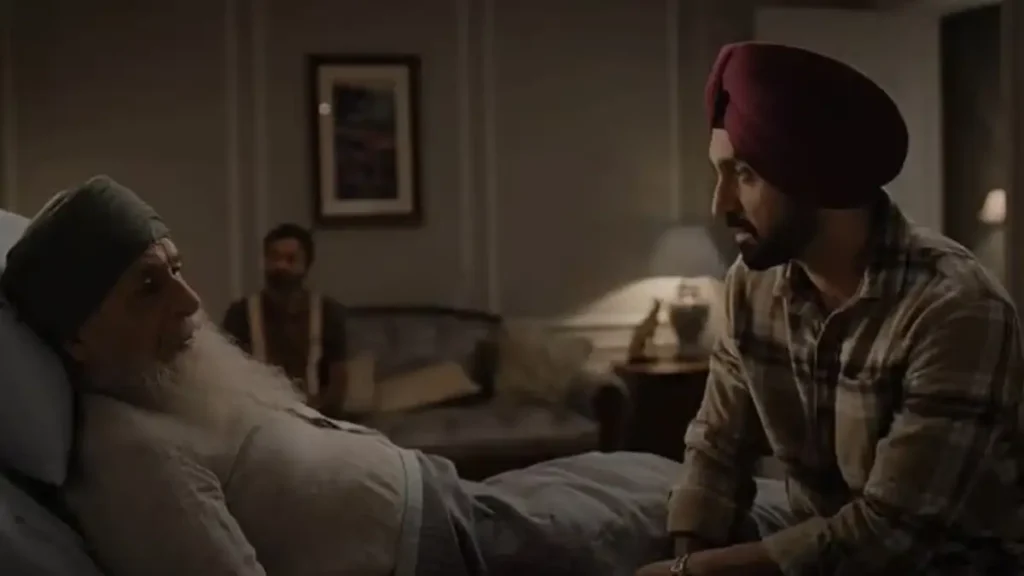
A strong aspect of MVA are the scenes between Nasseerudin Shah and Diljit. Their interactions have undertones of humor in the beginning especially the hospital ones. But as Nirvair becomes more emotionally involved the dynamics takes a different turn. The portions start to become emotionally poignant and the two feed off each other wonderfully. After a long time Naseeruddin Shah has gotten an author backed part and the veteran makes complete use of it. Whether its his intense love for Jiya/Afshana or the pain of leaving one’s home the actor tugs at your heartstrings. He also raises chuckles in his initial interactions with Diljit.

Diljit as the grandson gets his own arc and the dependable actor doesn’t disappoint. In spite of sharing screen space with an in form Naseeruddin Shah he more holds his own. From being curious and then the strong determination of making sure that the grandfather finds peace at least in death the actor doesn’t miss a single beat.

The pre partition romance also has his moments. Both Vedang and Sharvari look the part of bestowed lovers, but the writing could have been better. The love track could have been developed more; there is a hurried nature to the proceedings here. Having said that the conversations between young Keenu and Jiya have the right romantic spark. Vedang in particular impresses more so in the post partition scenes. The scenes of subtle pain and grief has been excellently portrayed by the young actor. Sharvari has much less to do in comparison, but she has a luminous presence and does a fine job in portraying a certain inner resilience.

The theme of humanity loss has a realistic feel to it as well. Human beings getting carried away in the cycle of violence and behaving in a barbarious manner has a contemporary feel. The post credit song Kya Kamaal Hai takes the audiences on a short tour of present horrors and the incredible spirit of fighting back. The tune coupled with Diljit voice is simply fantastic.

AR Rahman’s music jells perfectly with the movie’s tone capturing both the young love as well as the emotional undertones perfectly. The cinematography of Slylvester Fonseca particularly the pre partition romance has some nice frames. The proceedings have a lived-in feel

One of the things sticking out like a sore thumb is the subplot of Nirvair and his off/on relationship with Banita Sandhu’s Kaveri. It doesn’t add much substance to the movie. The subplot feels like more of a crutch to amplify Keenu’s deep love for Jiya. But this is a minor misstep in a mostly heartfelt drama on what it means to leave your home.

Jigra: A perfect mixture of an emotional drama and prison break

Director Vasan Bala does a good job in showcasing how sometimes anarchy is the best solution to fight against the system. Alia Bhatt perfectly embodies the tigress nature of Satya. Her actions aren’t always ethically right but the movie never judges her.

  • Starcast: Alia Bhatt, Vedang Raina, Manoj Pahwa, Rahul Ravindran, Vivek Gomber and others
  • Writer and director: Vasan Bala
  • Additional writer: Debashish Irengbam
  • Producers: Karan Johar, Apoorva Mehta, Alia Bhatt, Shaheen Bhatt and Soumen Mishra
  • Cinematography: Swanpil S. Sonawane
  • Music and background score: Achint Thakkar
  • Production Companies: Dharma Productions and Eternal Sunshine Productions
  • Running time: 2 hours and 35 minutes

Stories about sibling love are pretty much a genre in itself. But stories from the perspective of a sister are few. Vasan Bala’s Jigra is one such tale combining two different genres. On one hand it is about an extremely protective sister who from childhood has taken it upon herself to look after her younger brother. Jigra begins with a little boy Ankur complaining of bullying by some of his classmates to his sister Satya. She assures him that the situation won’t repeat. This is followed by the scene of the father jumping off the roof. Satya covers her brother’s eyes so that he need not face the trauma. This moment best describes their relationship. The movie is also a social commentary on the delayed justice system forcing innocent prisoners to take things into their own hands. Vasan Bala has combined these two elements wonderfully despite an over stretched climax.

In simple terms the story of Jigra focuses on the wrongful imprisonment of Vedang Raina’s Ankur in a foreign prison. The place is Hanshi Dao a fictional country reminiscent of North Korea. Ankur along with his cousin goes there to meet an investor but unknown to Ankur the cousin is in possession of drugs. They are caught by the police while driving speedily. Both of them are immediately jailed leading to a harrowing situation for Ankur. Punishment for possessing drugs in that country is death by electric execution. The cousin manages to get away in spite of being a habitual offender, but Ankur is sentenced to death. There are other people too who have been wrongfully accused. Alia Bhatt’s Satya takes it upon herself to free her brother, facing innumerable hardships along the way. In a way she is like a female Amitabh Bachchan standing tall against all odds.

Alia Bhatt as Satya who would go to any lengths to protect her brother

One of the strong aspects of Jigra is Vasan Bala’s seamless handling of emotional drama with high-octane action moments. The first half is mostly devoted to the world of Satya and Ankur. He establishes their bond in an impactful manner without wasting much time. Satya may come across as too dominant, but the movie reflects real life situations where protective sisters are a reality. Satya’s personality is shaped by the traumatic incident of seeing her father’s death.

The first half also has some light moments that makes viewers chuckle. For example, there is a scene where Satya stuffs lot of food out of stress. The quizzical look of the air hostess played by Akansha Ranjan adds to the humor.

Alia Bhatt eating scene in Jigra

The second half shifts gears by focusing on the big escape plan. Aiding Satya in this jail breakout are a former gangster and a former cop Manoj Pahwa and Rahul Ravindran respectively. Manoj Pahwa’s son is also in prison. The senior actor effortlessly combines humor with pathos making a strong impact. Rahul Ravindran in his Bollywood debut portrays an ex-cop battling his own scars. His character Muthu initially wants to stay away from Satya’s audacious plan but soon joins in due to certain events. Unknown to Satya Ankur and his inmates are also designing their own escape plan making the second half more thrilling. Yes, the scenarios do get complicated but there is no denying the thrill quotient. There is even a dialogue by Manoj Pahwa’s Bhatia that the escape plan is getting complicated, so let’s make it easy. Mithu replies that this isn’t a masala movie to simplify things leading to some chuckles.

The second half also benefits immensely from fantastic cinematography and well shot action sequences. A particular mention must be made of the scene where Alia Bhatt and Rahul Ravindran battle it out in a jungle. Before this fight an incident happens creating rift between them making it hard for the viewers whom to side with. The fight ends with a hugely poignant moment. The jailbreak scene at the end feels like a real-life prison riot. Swapnil S Sonawane’s cinematography is impressive especially in these two sequences. Mention must also be made of Achint Thakkar’s immersive background score; it enhances the scenes of Alia battling it out. The music is well placed with special mention of the two songs sung by Vedang: The Jigra title track and the recreated version of Phooloon Ka Taaron Ka…

What also makes Jigra a big winner is how the director has written Alia’s character and her towering performance. There is an emotional intensity to Satya which the actress pulls off. Satya doesn’t claim to be virtuous; an argument between her and Rahul Ravindran perfectly captures the grey shades of Satya. She is just a determined sister who wants to get her brother out whatever the method and Alia is successful in bringing out those nuances, The good thing here is that Vasan Bala never takes a stand on Satya’s morality leaving the viewers to interpret her actions in their own way.

There is an emotional intensity to Satya which the actress pulls off

As far Rahul Ravindran’s Bollywood debut he has a solid role, and he does a fine job in portraying Muthu’s moral dilemmas. The scenes between him and Alia are easily one of the best parts of Jigra. Lastly Vedang Raina is pitch perfect as a naive young man caught in a complex web. His portrayal of anguish in the torture scenes deserves a major kudos. The actor also shares a wonderful chemistry with Alia.

Rahul Ravindran does a fine job in portraying Mithu’s moral dilemmas
Vedang Raina is pitch perfect as the naive young man caught in a complex web

A slight issue with Jigra is the overstretched climax which takes place on international waters. It doesn’t add much other than extending the proceedings.

Archies: A Hollow Teenage Drama Led By Three Disappointing Star Kids

Zoya Akhtar’s launch pad for Suhana Khan, Khushi Kapoor, and Agastya Nanda is a major misfire. The musical format only adds to the woes.

Zoya Akhtar’s weakest work to date!

Archies (Hindi)

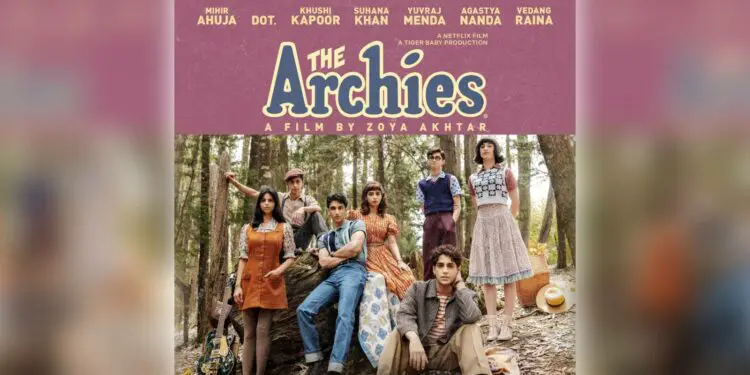
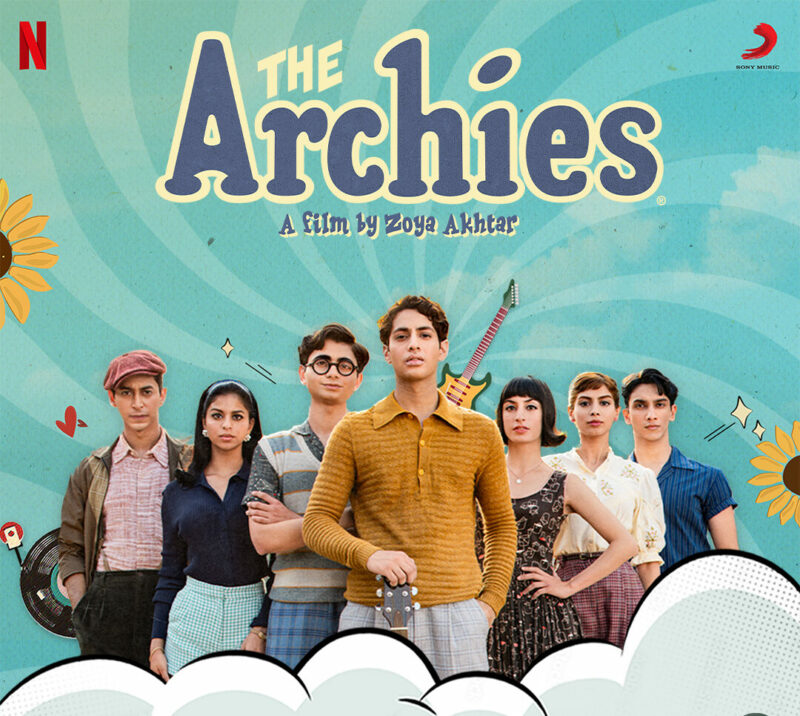
  • Cast: Suhana Khan, Khushi Kapoor, Agastya Nanda, Vedang Raina, Yuvraj Menda, and Aditi “Dot” Saigal
  • Director: Zoya Akhtar
  • Producer: Tiger Baby Productions
  • Music: Shankar-Ehsaan-Loy
  • Runtime: 2 hours 21 minutes
  • OTT Platform: Netflix

Archies is one of those movies that has created a significant buzz from its inception.

There are many reasons for this. One is the popularity of its source material Archie Comics. The characters in Archie Comics have appeared in numerous films and television programs among others.

Secondly, this movie is also a launch pad for three-star kids hailing from illustrious families. Agastya Nanda is the grandson of Bollywood Shahenshah Amitabh Bachchan, Khushi Kapoor is the younger daughter of the late Sridevi, and lastly, Suhana Khan is the daughter of Bollywood’s Badshah Shah Rukh Khan.

There is a general fascination that viewers have with star kids as much as we may hate nepotism.

Zoya Akhtar has created her own identity as a storyteller — be it is movies or the digital platform. This also has contributed to Archies being much anticipated.

Archies falls flat

However, this time, Zoya Akhtar falls flat in her attempt at combining a coming-of-age drama with social issues like development versus environmental good.

Archies directed by Zoya Akhtar
‘Archies’ directed by Zoya Akhtar. (X)

Among the cast, it is the non-star kids who fare much better, particularly Vedang Raina.

Karan Johar did a far superior job with his young cast in Student of The Year (2013).

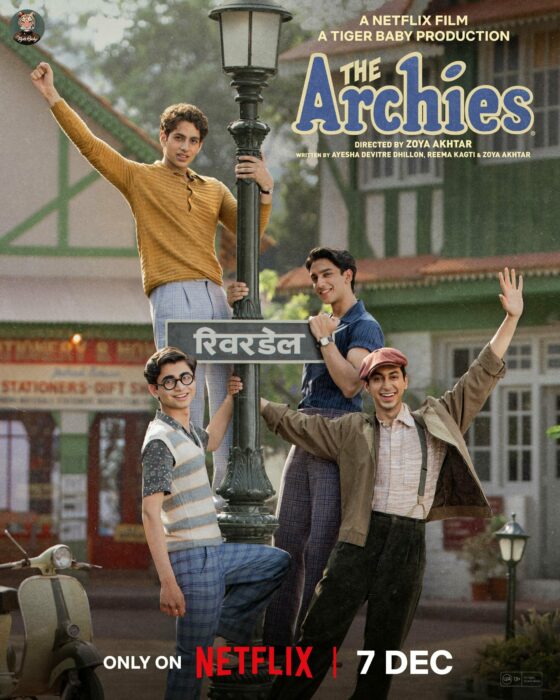
For those who are not familiar with the Archie comics, the story is set in a picturesque hill station called Riverdale.

Riverdale is home to many Anglo-Indians who chose to stay in India after independence. The viewers are first introduced to the constantly flirting Andrews aka Archie (Agastya Nanda). Andrews has a small band which he proclaims will soon become the best in the world after the Beatles.

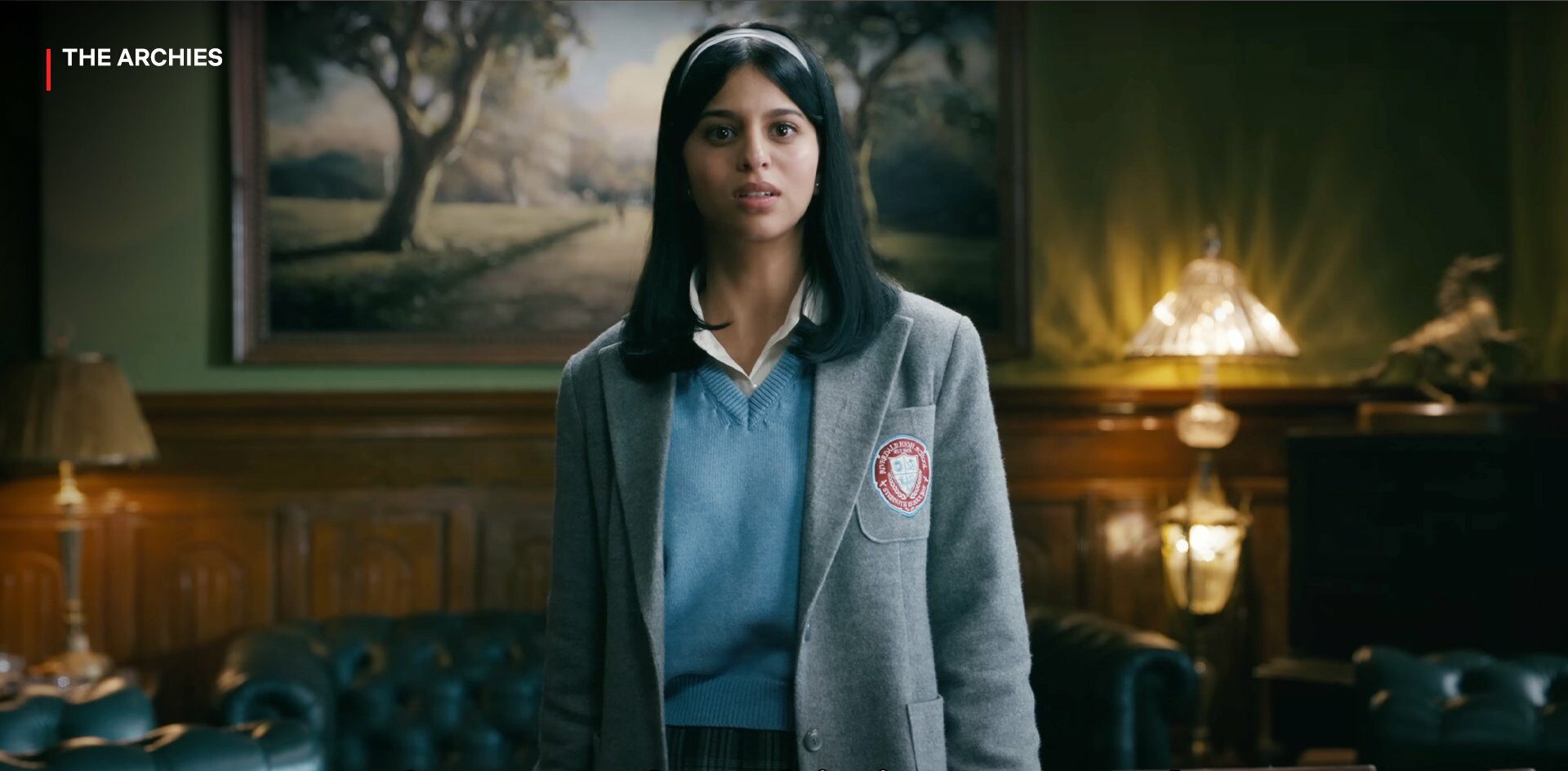
After this, we are introduced to the other important characters. Some of these are Betty (Khushi Kapoor) and Veronica (Suhana Khan). Veronica is a rich kid who constantly keeps pouting and generally comes across as annoying.

In simple terms, the story of Archies is about how Andrews and his seven friends navigate friendship, romance, and social responsibility.

Riverdale has a Green Park which holds a significant place in the local community.

Just like any other masala film you have Veronica’s businessman father who is hell-bent on destroying the park and wants to build a posh hostel in that place.

Performances

Before getting into the dissection of the movie, it is necessary to get done with the performances of the new cast.

Suhana Khan in Archies
Suhana Khan in ‘Archies’. (NetflixIndia/ X)

As mentioned above Suhana Khan was disappointing in her debut performance.

In places, Suhana tries to channel her father, particularly in the portions where Veronica has to show arrogance. But it comes across as too off-putting and doesn’t endear her to the audience in any way.

Alia Bhatt also played a rich girl (Shanaya Singhania) in Student of The Year but that was written far better despite the less screen time.

In Student of The Year, too, there were occasions where Shanaya came across as arrogant but director Karan Johar and Alia were successful in humanising her as well.

Unfortunately, nothing of that sort happens here. Suhana Khan overplays the snootiness and falters badly in the few emotional bits.

Khushi Kapoor is also very bland in her debut. In fact, Janhvi Kapoor was much better in her first film Dhadak (2018) despite the raw edges.

Agastya Nanda is suitably charming in the beginning but soon enough, his performance also becomes wooden.

It is the non-star kids who save the film from completely sinking. A particular mention must be made of Vedang Raina. He brings in the right amount of swag as the Rakish Reggie.

A special mention must be made of the scene between him and Dilton (Yuvraj Menda). It has the right mix of tenderness and vulnerability.

Flaws

Agatsya Nanda in Archies
Agatsya Nanda in ‘Archies’. (X)

Coming to the flaws, a big problem with Archies is the overdose of songs. Agree that the film is a musical but still, Zoya Akhtar overdoes the songs.

All the characters express their feelings through songs. This becomes too much after a point.

A good example of this is the scene where Andrew realises that politics is personal and that some causes are worth fighting for. This huge transformation happens through an incoherently staged “Everything is Political” song.

There is no denying that Archies looks visually colourful, thanks to Nikos Anaritsaksi’s cinematography and Suzanne Caplan Merwanji’s production design. However, soon enough, a sense of artificiality creeps in. This is because of the hollowness beneath the gloss.

The character of Suhana’s father (Ally Khan) is another big joke. The character has been poorly written and the way he praises his daughter after the Green Park has been saved comes across as a big joke.

The scenes between Varun Dhawan and his rich father in Student of The Year (Ram Kapoor) had much more of an impact despite the clichés.

Both Zindagi Na Milegi Dobara (2011) and Dil Dhadakne Do (2015), despite being about rich people, had genuine emotions and characters that viewers invested in.

However, the characters in Archies are cardboard cuts and the weak performances, particularly from Suhana, Khushi, and Agastya don’t help the cause either.

Final take

Archies is Zoya Akhtar’s weakest work to date. The acclaimed director has put more focus on how to present the star kids rather than making an impactful film.