
Director A R Sajeev does a fine job in capturing the soul of Jay Jaya Jaya Hey with the backdrop of Godavari. The biggest victory of OSSS is how it captures the different ways in which patriarchy continues to suffocate women. The subtle digs on the growing trend of Alpha male with a special mention to Sandeep Reddy Vanga’s problematic defense of Arjun Reddy is especially memorable.
Starcast: Tharun Bhascker, Esha Rebba, Bramhaji and others
Genre: Comedy/drama
Direction and screenplay: A R Sajeev
Dialogues: Nanda Kishore Emani
Original movie: Jaya Jaya Jaya Hey (Malayalam movie 2022)
Producers: Vivek Krishnani, Aditya Pitte, Naveen Sanivarapu etc
Production Companies: S Originals and Movie Verse Studios
Music: Jay Krish
Cinematography: Deepak Yaragera
Running time: 2 hours and 11 minutes
Remakes are always a tricky business especially stories taken from Tamil and Malayalam. The major reason for that is their distinctive style both in terms of narration and stories. If the reworking is frame to frame the director is called out for doing a copy paste job. On the other hand, adding certain things upsets the fans of the original hugely even if those changes are necessary. AR Sajeev’s interpretation of JJJH falls somewhere in between. The narrative structure is mostly similar with some scenes being more or less a copy paste: at the same time the movie does have some freshness too. This majorly comes from the Godavari setting along with some additional scenes. Om Shanti Shanti Shantihi uses humor as an effective tool. This particularly comes out in the combination scenes of Tharun Bhascker and Bramhaji playing a supposed well-wisher.

For those who haven’t seen JJJH this Telugu adaptation focuses on an arranged marriage between Esha Rebba’s Prashanthi and Tharun Bhascker’s Omkar Naidu. Both of them belong to the same social space but vary significantly in terms of marriage expectations. Omkar Naidu comes with major temper issues revealed gradually. How Prashanthi goes from a vulnerable young woman to taking things heads on forms the core of Om Shanti Shanti Shantihi.
A strong aspect of OSSS is the depiction of power dynamics. The scenes are reminiscent of most patriarchal households. This includes both the paternal and maternal. Elders camouflaging dominance in the name of concern has a realistic feel. This starts from the beginning itself and continues to be an underlying theme.
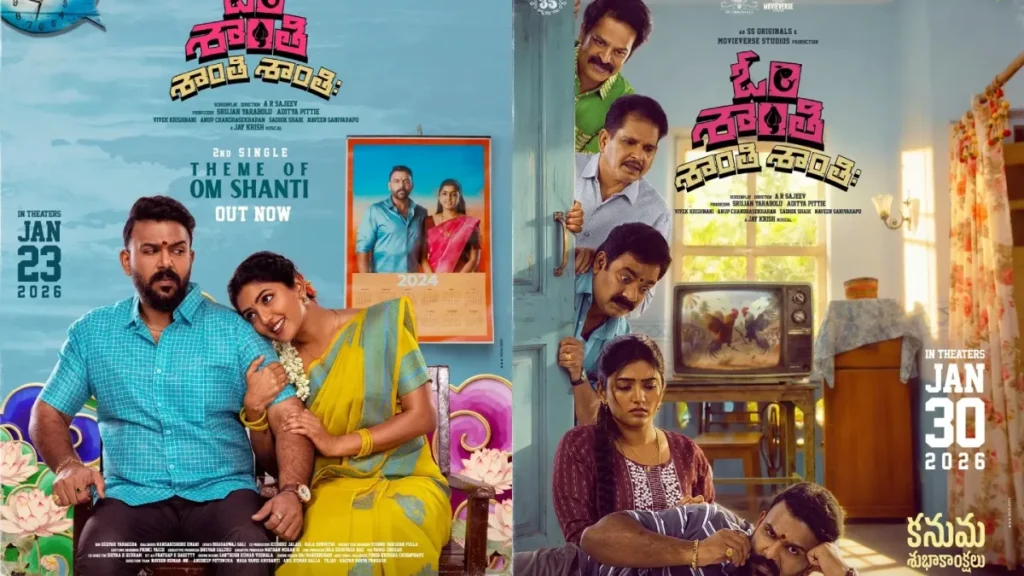
The characterization of Omkar Naidu is another plus. His entitled nature as earlier said comes out gradually. In the marriage meet up Omkar Naidu comes across as a progressive person when he talks about not having a problem in Prashanthi finishing her studies. There is also a first night sequence where Prashanthi says that she needs more time to get physically intimate. Omkar Naidu agrees with zero protest.
However, things gradually change when Prashanthi does some experiments in cooking. He has a set eating style like having Idli with Chutney for daily breakfast. Omkar Naidu reluctantly goes through Prashanthi’s cooking experiments but one day loses patience throwing away the plate and also slapping her.
Even his attempts to pacify after every slap is reflective of his entitled nature. Prashanthi ends up ordering the food in accordance with her husband and not her liking. This constant cycle has a repetitive nature but soon things reach a boiling point. It doesn’t help that Prashanthi’s mother and father show a casual attitude to their daughter’s sufferings.
As expected, things reach a saturation point and Prashanti gives Omkar a taste of his own medicine. Again, the pre interval twist won’t be new for those who have seen the original. Nevertheless, it sets a solid base for Prashanthi’s transformation.
Another major asset of OSSS are the portions featuring Bramhaji and Tharun. Bramhaji’s satirical comments especially his dialogue on Godavari people’s nature of being humorous does raise some chuckles. Bramhaji’s character is also casually misogynistic, this comes out clearly in the way he gives advises Omkar Naidu on how to control his wife by pretending to have changed and then making her pregnant.
The dialogues written by Nanda Kishore Emani are also wonderful whether its the satirical humor or the scenes questioning patriarchy. A mention here must be made of how he uses Sandeep Reddy Vanga’s extremely problematic defense of Arjun Reddy. The expression on Esha Rebba’s face with the mother defending the son’s in law beating through the director’s defense on how physical violence is an expression of love paints a disturbing picture. Nanda Kishore Emani through his dialogues successfully brings out how fellow women enable patriarchy as well. Nanda Kishore Emani is also there in a short but an important role, a college professor who makes big claims of being a liberal but is actually hollow.
The biggest asset of OSSS though is the lead pair of Tharun and Esha Rebba. In spite of most scenes being familiar the two actors stand tall. They are a big reason for the movie being compelling even for those who have watched the original. Tharun Bhascker embodies Omkar’s causal entitlement without any over the top theatrics. Tharun along with director and writer make Omkar a relatable character without coming across as a caricature. The particular slang used by Tharun adds to the entertainment quotient too. Tharun’s performance in the comic portions like trying to be a Alpha male by learning Karate with disastrous results is a laugh riot. Esha Rebba is also solid in portraying the transformation. She strikes the perfect balance between vulnerability and strong inner strength. The Karate sequences have been well executed too.
Having said that the use of karate as a give back in both the original and the remake isn’t quite practical. The reason is not all women have the physical strength. Coming back to OSSS the humor in some places lingers more than necessary. This is particularly true of the court room scene featuring veteran actor Bramhanandam.
The atmospherics of Godavari become a character in itself, and the locations are colorful well captured by Deepak Yaragera. Jay Krishna’s music goes well with the flow of movie without any unnecessary numbers.
Final word: Om Shanti Shanti Shanthi is a good adaptation with its own pluses. In one way this can be called The Girlfriend in a slice of life zone.


