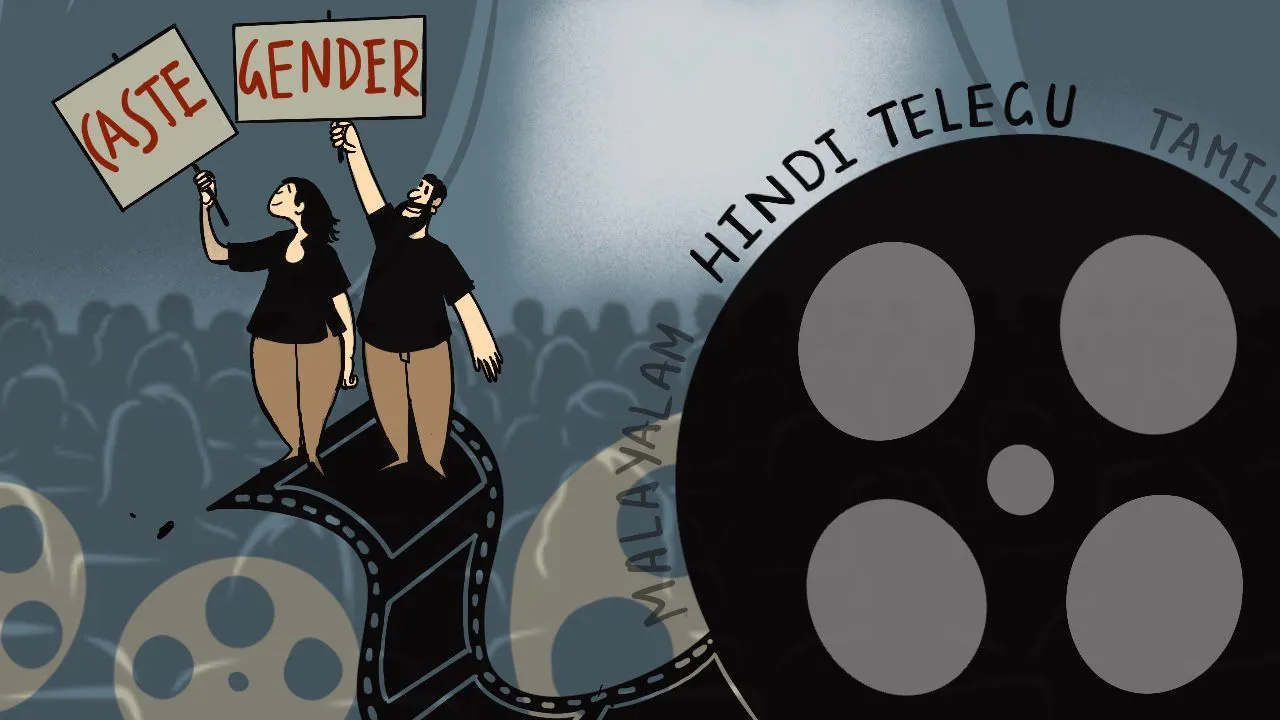
This is an overview of Hindi, Telugu and a few Tamil and Malayalam movies, released in 2025, with gender and caste sensibilities.
Synopsis: Caste and gender-based plots are not alien to Tamil and Malayalam movies. The year 2025 saw Hindi and Telugu movie industries, too, realistically portraying caste and gender issues that we come across in present-day life. While some movies explicitly presented the issues, others were covert, often delegated to subplots. Though women were mainly used as props — to fall in love with the male protagonist — a few movies had women-centric narratives. There were female superheroes, too, in ‘Lokah Chapter 1: Chandra’ (Malayalam) and ‘Thamma’ (Hindi). Overall, the year promised better, more realistic cinema in future.
Caste-based storylines are not new in Tamil and Malayalam cinema. Surprisingly, cinemas in 2025 saw strong caste sensibilities reflected in Hindi and Telugu also. Dhadak 2, Homebound, Phule, Court, Uppu Kappurambu and 23 Iravai Moodu are some examples.
In Uppu Kappurambu, the caste angle is farcically comic, while other movies treat it seriously, apart from raising pertinent questions. They make the viewers ponder caste inequalities, which exist years after the country gained independence.
In ‘serious films’ like Homebound, Phule and Dhadak 2, the caste, gender and religious discriminations are explicit, but in ‘slice of life’ and ‘light-hearted entertainers’ — such as Little Hearts (Telugu) and Aap Jaisa Koi (Hindi) — they are obliquely presented.
Little Hearts is essentially a teenage romcom with an interesting plot. A laudable twist in the movie is when the female protagonist, Akula Khathyayani (played by Shivani Nagaram), displays her underlying strength while standing up for her love and career choice.
In Aap Jaisa Koi, director Vivek Soni looks at society’s double standards in dealing with women’s desires in an arranged marriage set up. Finding the female perspective in these films is more challenging. One has to go beyond the first look to see the gender dimension.
Sadly, in the increasing age of pan-Indian cinema, strong female characters are few and far between, as female leads are mostly used as either damsels in distress or glam dolls. The sexual gaze in films like Devara and War 2 is apparent.
In Devara, Janhvi Kapoor’s character Thangam’s role is to lust after the hero. In War 2, Wing Commander Kavya Luthra (Kiara Advani) is supposed to be a tough soldier, but her role’s highlight turned out in a bikini.
Even in the latest blockbuster, Dhurandhar, the college-going heroine, Yalina Jamali (Sara Arjun), does nothing other than fall for the hero. Seeing all these movies, one is tempted to say that smaller films have more gender sensibilities.
Earlier, the assumption was that gender and caste sensitivities were strictly confined to ‘arthouse’ movies because the politics presented were stark and in your face. However, this scenario has changed with some mainstream movies also questioning the oppressive practices regarding caste and women.
The emergence of new voices, both behind and in front of the camera, makes this scenario more refreshing. For instance, movies like Court, Dhadak 2 and Little Hearts have debutant directors. Similarly, the casts of these movies don’t always boast of big names. This trend is good for the industry it could present more novel stories.
Following is a peek into the movies that have both caste and gender, either separately or together.
Serious films
Shazia Iqbal’s Dhadak 2 (Hindi), a remake of the Tamil film Pariyerum Perumal, presents a solid combination of caste and gender. Dhadak-2 primarily focuses on the evolution of Neelesh ‘Neel’ Ahirwar (Siddhant Chaturvedi), a timid young man, growing up to one fighting for self-respect.
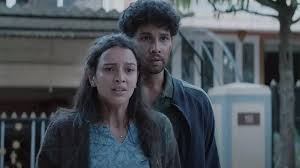
Through Neel, the film depicts latter-day caste discrimination, whether it is in a city or a rural setting. The import of caste is apparent in the constant jibes, including on the reservation, fired at Neelesh. He bears the insults for long, but his character undergoes a change by the middle of the second half, and he is forced to stand up against those taunting him.
Tripti Dimri’s Vidhi Bharadwaj, on the other hand, is an upper-caste Brahmin, more privileged than Neelesh, but has her own battles to fight. Her biggest battle involves a truly despicable cousin, Ronnie Bharadwaj (Saad Bilgrami). He believes that Vidhi is bringing dishonour to the family by falling in love with a Dalit.
Ronnie comes with a huge sense of entitlement. One of the standout scenes in Dhadak 2 is Vidhi’s showdown with Ronnie. She tears into his patriarchal mindset. In her journey with Neelesh, Vidhi also becomes more aware of the caste realities, making their romantic relationship a political rebellion.
Neeraj Ghaywan’s sophomore feature Homebound (Hindi) is a highly impactful film. Shortlisted for Best International Feature Film at the 98th Academy Awards, it makes the viewers contemplate the everyday struggles of the marginalised — in this case, a Dalit and a Muslim.
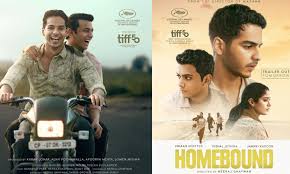
The movie has many scenes depicting the main characters getting taunted over their religion and caste, all of which are familiar, but most Indians prefer to ignore them without responding. Vishal Jetwa’s Chandan Kumar Valmiki tries to hide his caste identity till the movie’s end. His caste identity is revealed only after his death.
Homebound also features a couple of strong women. Sudha Bharti (Janhvi Kapoor), as a more empowered Dalit, has striking dialogues when she talks about Ambedkar’s philosophy of education, organisation and agitation.
In one scene with Chandan, she encourages him to complete his education, which will help him overcome the caste barriers. Chandan’s sister, Vaishali (Harshika Parmar), has a brief but important role. There is strength to the character, especially when she reminds her brother about why she couldn’t attend college like him.
Anant Narayan Mahadevan’s Phule (Hindi) is another movie that blends caste with gender. The movie is a biopic about two social revolutionaries, Jyotirao Phule and Savitribai Phule.
The husband and wife duo fought relentlessly for girls’ education and against the horrific caste discrimination. Jyotiba (portrayed in the biopic by Pratik Gandhi) himself went against his family by educating his wife.

One of the standout scenes in Phule involves Patralekha’s Savitribai holding her ground when threatened by a man from a ‘dominant’ caste. Throughout the movie, Savitribai is presented as an equal to her husband, even involved in more social work than him.
At every step, Jyotiba acknowledges his wife’s contribution, making Phule a solid tale of companionship.
23 Iravai Moodu (Telugu), directed by Raj Rachakonda, is about two poverty-ridden lower-caste men trying to rob a group of bus passengers. In an unfortunate turn of events, the bus catches fire, killing 23 people.
The actions of these two men are horrible, and the movie does not absolve them of their wrongdoings. But at the same time, there are intentional crimes committed by men of higher social strata.

However, they don’t toil in jail like these two men because of their standing in the social hierarchy. Even in jail, some of the works assigned to these two men reflect their caste.
The gender angle is represented with the female character Suseela, played by Tanmai. Suseela is facing the stigma of becoming a mother before marriage. Despite the numerous difficulties, there is an inner strength to the character. Suseela manages to make a living while fighting her own battles.
Ram Jagadeesh’s Court (Telugu) looks at the misuse of the POCSO Act through a teenage love story. Caste is an important part of the movie, but is not directly implied.

However, in two scenes, viewers get an idea of the hero’s caste background. The character Mangapathi (Shivaji) holds a mirror to numerous family patriarchs with a false sense of honour regarding young women. The defeat of a despicable man like him, both a casteist and misogynist, feels satisfying.

Santosh (Hindi), written and directed by Sandhya Suri, mixes caste with gender in an excellent manner. The story is about Santosh Saini, a widowed housewife-turned-police constable. Sandhya has added the systematic oppression of the Dalit community through a khap panchayat in the movie, which has been banned in India.
An important part of Santosh — banned in India — is the friendship between two women, a constable and an officer. Their scenes together have given the movie some of its best moments.
Mari Selvaraj’s Bison Kaalamaadan (Tamil) is based on the life of legendary kabaddi player Manti P Ganesan, nicknamed Bison. The film is a rousing tale of breaking numerous societal shackles.

A predominant barrier is caste. The caste name is not exactly specified, but we can easily make out that Dhruv Vikram’s ‘Vanaththi’ Kittan belongs to the marginalised section. Some of the conversations and also the obstacles he faces reflect his caste background.
The film also has a brief gender angle involving Anupama Parameswaran’s Raani. Raani is seven years older than the hero, but is clear about marrying him. This, too, came out in an impactful manner, especially in the temple sequence with Raani defying her brother.
Women-centric narratives
Rahul Ravindran’s The Girlfriend (Telugu) is a well-made feminist story questioning toxic masculinity. The movie focuses on a young woman’s battle to leave a dominating relationship.

Rahul, who has also written the story, does a smart job in using the Arjun Reddy (Dir: Sandeep Reddy Vanga, 2017) space but from a female perspective.
Unlike Shalini Pandey in Arjun Reddy, Rashmika Mandanna’s Bhooma Devi doesn’t remain a passive partner, but grows into an assertive woman, amply revealed in the break-up scene showing her perspective on why she doesn’t want a guy like Vikram alias Vicky (Dheekshith Shetty). The Ma Durga symbolism in the climax, with Rashmika letting it all out, represents the female rage.
Suparn Verma’s Haq (Hindi) is a gripping tale of perseverance and battle for one’s rights. It is inspired by the landmark 1985 Shah Bano case. The Supreme Court judgement reshaped the concept of legal rights for divorced Muslim women.

The movie is about society conveniently normalising abuse and twisting laws to silence women. The core theme of Haq is wonderfully captured in an important conversation between Yami Gautam’s Shazia Bano and her husband’s second wife, Saira Jahan (Vartika Singh).
It goes like this: “Kabhi kabhi mohabbat kafi nahi hoti, izzat bhi zaruri hoti hai” (Sometimes love isn’t enough, respect is also necessary). The statement sums up the battle of both the real and fictional Shah Bano.
Aarti Kadav’s remake of the acclaimed Malayalam movie, The Great Indian Kitchen, as Mrs (Hindi) is shinier but projects the same issues. A housewife’s daily grind is the movie’s central theme. Sanya Malhotra’s Richa Sharma wants to do something with her life, but is caught in a depressing cycle of feeding her husband and father-in-law.
Richa’s routine almost wears her down, but in a crucial turn of events, she decides to take matters into her hands. Richa’s graph — from a lively young girl to almost succumbing to patriarchy — is both well-written and portrayed.
Songs of Paradise (Hindi) by Danish Rezu is a relevant take on the resilience and rebellion against social norms. Through the tale of Kashmir’s first female singer, Padma Shri Raj Begum, the movie focuses on pursuing one’s interests without giving in to societal oppression.

The film does a fine job of celebrating the singer’s defiance. One of the most impactful dialogues in Songs of Paradise involves Saba Azad (as young Zeba Akhtar/Noor Begum) and a male character.
The dialogue, relatable to most Indian women, goes, “You’re a man; you look for an opportunity to showcase your talent. We, women, seek excuses to pursue our hobbies.”
Praveen Kandregula directed two important women-sensitive stories in Telugu, viz., Paradha and Subham. Paradha is a social drama, questioning archaic traditions along with the depiction of a strong bond of sisterhood between the three main characters. It also delves into how women should be more open-minded and inclusive.

Subham is a whacky ride filled with laughs and a strong feminist message. Critiquing the regressive content of TV serials and the alpha male concept is Shubham’s main theme.
The ultimate message of Subham is understanding and empathising with the women in our lives. The film doesn’t shy away from taking digs at the presentation of our mainstream protagonists through an important scene of the three women questioning the serial hero on his clichéd perception of women.
Bad Girl (Tamil), directed by Varsha Bharath, is a well-made coming-of-age story from a female perspective. It shows the process a young, freedom-yearning woman, Ramya (Anjali Sivaraman), from an orthodox family, undergoes to find liberation through a series of bad relationships.

Anjali does a good job in showcasing the emotional journey of the titular protagonist — how she grapples with societal expectations, personal aspirations and of course, her romantic relationships.
Another highlight of Bad Girl is the track of the mother and daughter. Through this subplot, the movie delves into generational differences. The ups and downs of heated arguments are relatable for many modern young women. The celebration of female friendships also enriched the movie.

Janaki V v/s State of Kerala (Malayalam), directed by Pravin Narayan, is about a woman exercising her right over her body. It is about a sexual assault survivor’s choice of keeping the baby or opting for abortion. The movie questions the failure of the state and the law in supporting the fundamental rights of a sexual assault survivor.
It does a fair job in portraying the emotional trauma faced by Anupama Parameswaran’s Janaki Vidhyadharan, both from the assault and the legal system. Pertinent points are raised about protecting fundamental rights.
Chhorii 2 (Hindi), directed by Vishal Furia, features a mother’s fight against a dangerous cult. More than the paranormal entities, the ghost here is patriarchal, justified in the name of tradition.
An important aspect of Chhorii 2 is the imagery of a narrow tunnel. This tunnel becomes an allegory for the representation of social structures suffocating multiple generations of women.

A Mention must also be made about the director’s use of Soha Ali Khan as Daasi Maa. She is both a villain and a victim. It is very satisfying to see Daasi Ma joining hands with the protagonist (Nushrratt Bharuccha’s Sakshi). The two women standing together against the patriarchal cult is a powerful symbol of female power.
Jayant Digambar Somalkar’s Marathi movie Sthal is a strong critique of forced arranged marriages, where a girl is treated as a commodity. Unlike using the usual arranged marriage setup as a prelude to romance, this film reflects how families consider a girl as a financial burden, who must be “packed off” at the earliest.

The irony here is the juxtaposition of Savitribai Phule’s birth anniversary with the ritual of the female protagonist getting decked up as a doll. The movie ends on a powerful note with the girl standing up and breaking the fourth wall like the other impactful Marathi movie, Fandry.
Chandu Mondeti’s Thandel (Telugu) draws inspiration from a real-life incident involving a group of Indian fishermen. The film features a strong female protagonist, Sathya (Sai Pallavi). In the second half, she becomes an important pillar of support for the fishing community.

There is a deep strength in the way Sathya combats her inner dilemmas while at the same time doing her best to free the men from a Pakistani jail. She succeeds in making sure that the households don’t go hungry. At one point, Sathya is also called Thandel Rani. She is someone who is seen as a leader in her own right rather than just being a love interest of Naga Chaitanya’s Raju.
Light-hearted and slice of life
On the surface, Anil I.V. Sasi’s Uppu Kappurambu (Telugu) looks like a farcical comedy, but in essence, it is about a woman sarpanch, Apoorva (Keerthy Suresh), finding her feet.

The very thought of a woman sarpanch frustrates the dominant caste. As the story progresses, Apoorva transforms from naïve and under-confident to eventually taking things head-on.
The caste politics come from a lack of space in a graveyard. There are scenes of two dominant castes fighting for more space based on lineage.
Little Hearts (Telugu), directed and written by Sai Marthand, revolves around two not-so-bright students and their coming of age. The movie has some important passages, elevating it from just being a fun ride.

One of these includes the agency given to Shivani Nagaram’s Akula Khathyayani in the movie’s latter half. Even the interval point with Kathyayani slapping Nalli Akhil Kumar (Mouli Tanuj Prasanth) as he addresses her as ‘aunty’ is a reflection of her strong-willed nature.
There is an understated strength to her character. This reflects in her taking charge of the relationship and quietly assuming responsibility to work it out. All this combined makes her hard as steel, as Akhil comments in the end. The age gap of three years, with the heroine being older than the hero, also makes Little Hearts an unconventional love story.

Anupam Kher’s second directorial venture, Tanvi the Great (Hindi), is an important tale of inclusivity with a strong female lead. Shubhangi Dutt’s Tanvi suffers from autism, but her passion for joining the army makes her overcome the challenges.
The movie’s core theme is perseverance and fighting against all odds. In spite of some unbelievable leaps, the viewers root for her.

Aap Jaisa Koi (Hindi), directed by Vivek Soni, is a feminist movie under the guise of a romantic comedy. The director used a familiar arranged marriage setup to deliver stinging lessons on patriarchy, especially on the society’s double standards on women’s desires and sexuality.
The most important subplot is connected to Kusum Tripathi (Ayesha Raza), an emotionally neglected housewife. She is often a victim of casual sexism. How the character breaks out of conventions by following her heart is a major highlight.

Anurag Basu’s Metro… In Dino (Hindi) features an important subplot with Neena Gupta’s Shibani Ghosh breaking out of a self-imposed rut in her twilight years. The movie gives an empowering message to women of taking life into their hands. The same can be seen in Konkana Sen Sharma’s Kajal Ghosh Sisodiya, also. Her strong attitude comes out well in dealing with her husband’s infidelity.

In 3 BHK Flat (Tamil), Meera Raghunath’s Aarti Vasudevan puts up with an unhappy marriage for a long time. But she never shares her woes with her family to avoid burdening them. However, a particular incident makes her snap, and she breaks out of it.
There is a poignant dialogue where Aarthi asks ‘Is abuse just physical?’ going beyond the traditional definition. How Aarti starts life afresh is inspiring for numerous women who go through marital abuse but may not have the strength to come out of it.
Mythical/Folklore
Both Dominic Arun’s Lokah Chapter 1: Chandra (Malayalam) and Aditya Sarpotdar’s Thamma (Hindi) feature mythical women defying the general trope of the knight in shining armour.

Both are women-centric superhero movies. While Lokah is a fantasy film dealing with real-world issues, Thamma is about a half-vampire/half-human breaking out of her tribe to fulfil her love.
In Lokah, Police Inspector Nachiyappa Gowda (Sandy) doesn’t like women with a modern outlook, and it is visible on more than one occasion. The female protagonist, representing a superwoman, Chandra aka Neeli (Kalyani Priyadarshan), takes on patriarchal structures while also standing up against an organ-trafficking racket.

Thamma, on the other hand, features a strong woman protagonist, Taraka/Tarika, portrayed by Rashmika Mandanna. Taraka is half-vampire and half-human. She goes against her tribe by following her heart. The character has a good mix of emotional vulnerability and ferociousness.
Oftentimes, it is Taraka who saves Ayushmann Khurrana’s Alok Goyal. This movie, for the most part, reverses the knight in shining armour trope.
A year ending on a strong footing
From the above-listed movies, we can see a growing trend of telling stories about different social realities: the new-age directors are taking up fresh themes, especially relating to caste and gender.
In these movies, the aspect of exercising choice comes out strongly. Also, the protagonists, whether it is the hero or heroine, are not rebels by design.
For example, in Paradha Anupama Parameswaran’s character, Subbalakshmi aka Subbu, does not make a statement about oppressive practices. She is a firm believer in traditions, but her perspective changes significantly due to her exposure to the outside world and her interactions with other women she comes across.
In Bison, too, the hero’s love for Kabaddi is what drives him to break the societal shackles. He was not born with a rebellious streak.
Another interesting aspect about these movies is the social milieu in which they are set. Small towns and rustic village atmosphere provide a fresh vibe. Apart from these movies having new-age actors, even the established commercial actors are experimenting with newer roles, like Janhvi Kapoor playing a Dalit in Homebound — and it is refreshing.
(Edited by Majnu Babu).