
The one liners coupled with a committed cast especially Ayushmann Khurrana and the stunning Wamiqa Gabbi keep the movie afloat. An interesting aspect of PPAWD is the angle of casteism. Actor and filmmaker Tigmanshu Dhulia plays a regressive politician with certain notions of so-called social boundaries. His role sets the base for the ensuing chaos spilling out of hand.
Starcast: Ayushmann Khurrana, Wamiqa Gabbi, Rakul Preet Singh, Sara Ali Khan, Tigmanshu Dhulia, Ayesha Raza, Vijay Raaz and others
Genre: Comedy
Direction, writing and screenplay: Mudassar Aziz
Additional screenplay: Ravi Kumar
Music: Rochak Kohli, Taniskh Bagchi etc
Cinematography: Jishnu Bhattachatterjee
Producers: Krishan Kumar, Ravi Chopra etc
Production Companies: T- Series Films and BR studios
Running time: 2 hours and 2 minutes
Before dissecting PPAWD it’s necessary to get an important matter out of the way. The film is not about Ayushmann Khurrana’s Prajapati Pandey having an extra marital affair behind the wife’s back. Mudazar Azis steers clear of that angle even though the scenarios are tailor made for a film like Masti franchise. Prajapati Pandey is a green flag husband and a solid friend. In the process of helping Sara Ali Khan’s Chanchal Prajapati’s life turns upside down. The root cause of the chaos is Tigmanshu Dhulia’s Gajraj Tiwari. Gajraj has strict boundaries of what he thinks is acceptable, Chanchal and Gajraj’s son Sunny are in deep love, however things take a dramatic turn thanks to a leaked photo of Sunny with a burqa clad woman. Of course, the one under the burqa is Chanchal and this pic reaches Gajraj. This photo is clicked by no other than Prajapati’s wife Aparna (Wamiqa Gabbi looking absolutely stunning as well as delivering a solid act). Aparna is a journalist with an ambition of opening her own news channel. What follows is a major comedy of chaos with a pile of misunderstandings and a frantic climax.
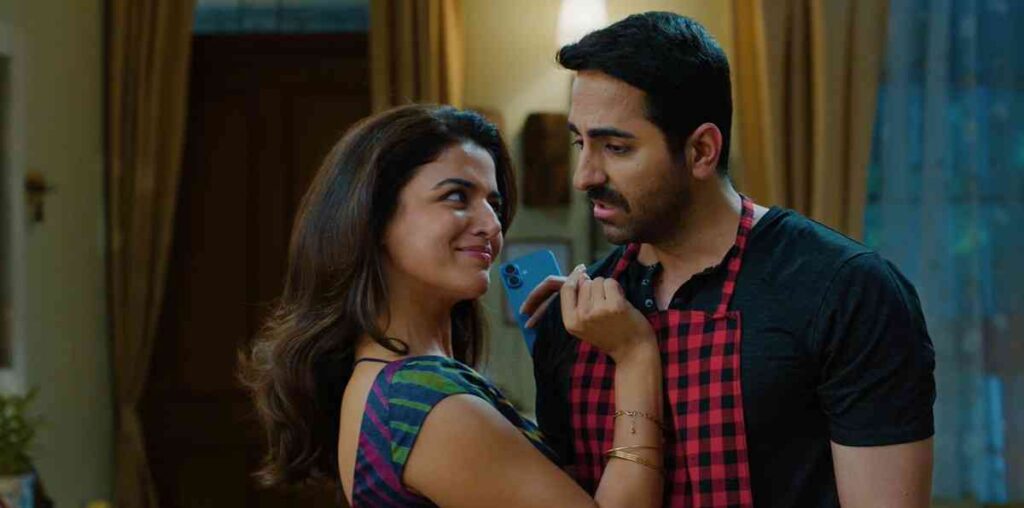

A strong aspect of PPAWD are the tricky scenarios in which our protagonist finds himself in. There is a scene in the cafe where Prajapati decides to act like Chanchal’s boyfriend to keep her safe from Gajraj and his men. He promises to help Chanchal until her boyfriend makes arrangements for the two to get away. Initially Prajapati plans to take Aparna too in confidence however a crucial revelation lands our protagonist in a messy situation. Still Prajapati goes ahead as Chanchal’s life is in danger. There are portions of Chanchal play acting like a girlfriend and Prajapati feeling hapless but playing along. This leads to numerous entertaining moments.

What elevates these screwball situations is Ayushmann Khurrana’s performance. Ayushmann’s facial expressions itself generate humor. The actor is in solid form playing to the gallery in an uninhibited manner. Apart from the comic situations Ayushmann also does a fine job in the vulnerable moments. An example of the vulnerable portion is Prajapati feeling anxious on hurting Aparna. The scenes of the protagonist’s frustration with his married life spilling out of control has been excellently portrayed by the actor.
A mention must also be made of the caste subplot. Yes, it doesn’t go too deep but the threat of Gajraj Tiwari can be definitely felt especially in an early scene of Chanchal describing her prospective father-in-law. There is an explicit emphasis from Chanchal on her coming from a lower caste and how this a major hurdle. This lifts PPAWD beyond the comedy of errors. There is also a monologue on rumors being perceived as truth when repeated often
Mudassar Aziz also deserves credit for the strong woman characters he has written. Wamiqa Gabbi’s Aparna has the least comical role among the three, but the actress brings in an emotional depth. Whether it’s her journalistic ambitions or the hurt of her husband supposed cheating Wamiqa is very good besides looking breadth takingly beautiful. Rakul Preet Singh plays Aparna and Prajapati’s best friend Nilofer Khan. Rakul is suitably feisty especially in the scene where she warns Prajapati on not hurting her best friend. Her scenes with Ayushmann especially in the one where she mocks him have nice comic touches. The two share a good camaraderie, lastly Sara Ali Khan as Chanchal does a fine job too in bringing out the character’s desperation.

The supporting cast led by Tigmanshu Dhulia and Ayesha Razia also lift the movie. Tigmanshu Dhulia plays the casteist politician with the right amount of authority, Ayesha Raza on the other hand is absolutely hilarious as Chanchal’s Buaji. The way she speaks with the speed of a Rajdhani express with a poker face leads to some chuckles. Vijay Raaz as a corrupt policeman is also competent with his dead pan humor.
Coming to the flaws Pati Patni Aur Woh do does suffer from scenes of excess. The second half in particular feels stretched in spite of the crisp running time. The pile of misunderstandings goes out of control. Also, a dream song featuring Ayushmann and Rakul doesn’t add much value to the proceedings. The songs in itself are a mixed bag with Roop Di Rani being the best of the lot. There is also a rather unnecessary character of an effeminate office boy speaking in a highly theatrical zone.
Final word: Pati Patni Aur Woh Do makes for an engaging screwball comedy especially if you are in the mood for some lighthearted fun.