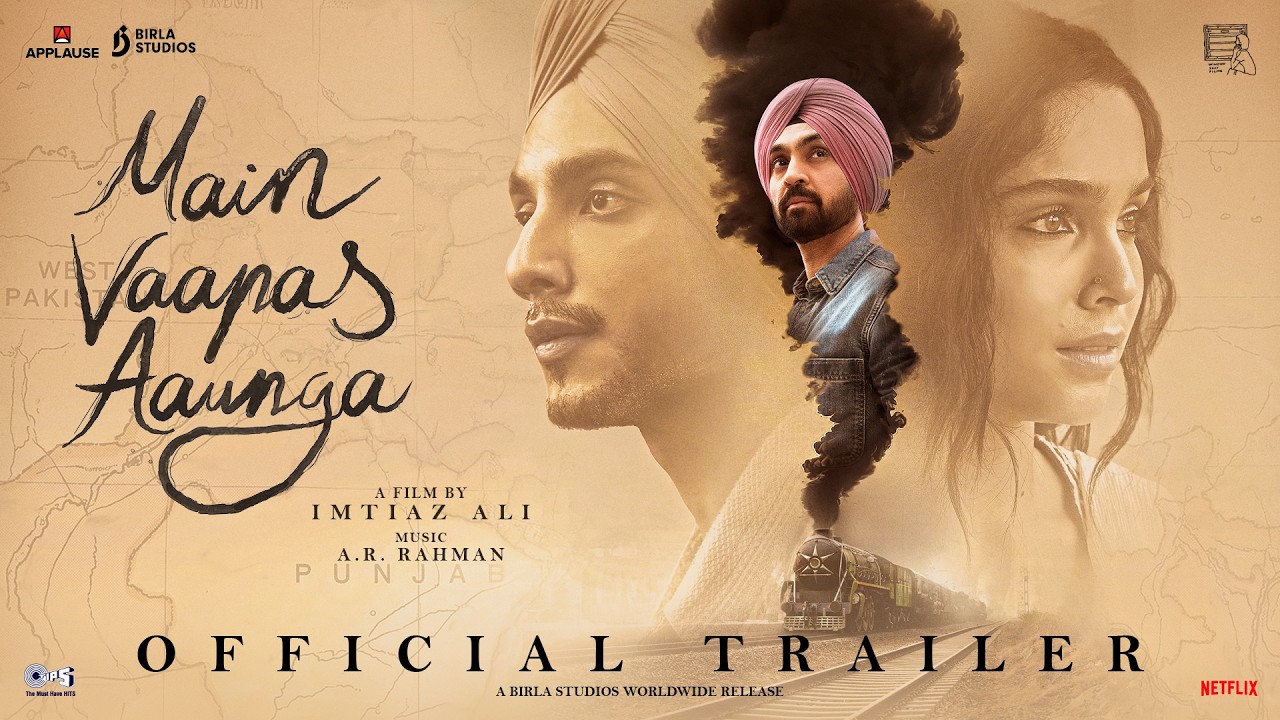
Imtiaz Ali once again employs his favorite two timeline plot sequencing. More than the partition horrors the movie holds a mirror to today’s displaced homes due to bloodshed. The end montage song with the ever-charming Diljit Dosanjh hits hard. A strong aspect of Main Vaapas Aaunga are the scenes between Nasseerudin Shah and Diljit. The portions have a perfect blend of humor with emotional pathos. The pre partition romance though needed better writing
Starcast: Naseeruddin Shah, Diljit Dosanjh, Vedang Raina, Sharvari Wagh and others
Genre: Romance/drama
Director and writer: Imtiaz Ali
Additional writer: Nayanika Mahatani
Music: A R Rahman
Cinematography: Sylvester Fonseca
Producers: Sameer Nair, Deepak Segal etc
Production Companies: Window Seat Films, Applause Entertainment etc
Running time: 2 hours and 46 minutes
Stories of Partition and Bollywood go hand in hand; numerous filmmakers have depicted the horrors of partition in their own ways but still there is always something left to be explored. Imtiaz Ali’s latest Main Vaapas Aaunga is also about pre partition and the horrors following it. But the genre here makes a difference. Imtiaz packs in an intense tale of unrequited love, love so intense that our protagonist hasn’t forgotten his heroine though he is 95 years old. Naseeruddin Shah is Keenu. He falls in love with a Muslim girl Jiya/Afshana played by a radiant Sharvari Wagh. Vedang Raina plays the younger version in the flashbacks. Their blossoming romance hits a roadblock due to partition. He manages to make a living, but the scars haven’t completely left. Diljit Dosanjh plays the grandson Nirvair Grewal. Nirvair is going through his own hassles both professionally and personally. Nirvair becomes Keenu’s support system, and he is determined to fulfill his grandfather’s last wish and how that happens is the essence of MVA.
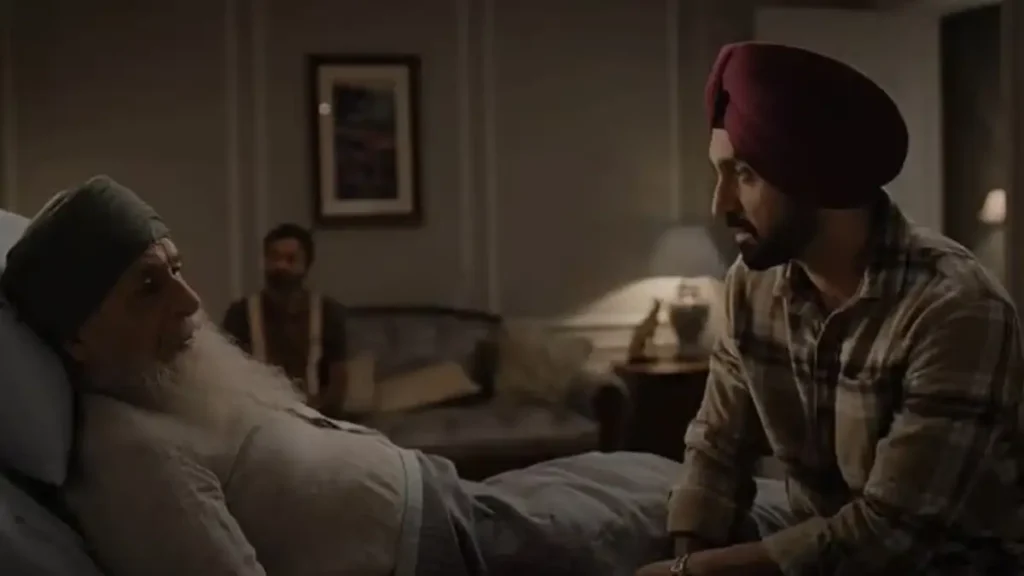

A strong aspect of MVA are the scenes between Nasseerudin Shah and Diljit. Their interactions have undertones of humor in the beginning especially the hospital ones. But as Nirvair becomes more emotionally involved the dynamics takes a different turn. The portions start to become emotionally poignant and the two feed off each other wonderfully. After a long time Naseeruddin Shah has gotten an author backed part and the veteran makes complete use of it. Whether its his intense love for Jiya/Afshana or the pain of leaving one’s home the actor tugs at your heartstrings. He also raises chuckles in his initial interactions with Diljit.
Diljit as the grandson gets his own arc and the dependable actor doesn’t disappoint. In spite of sharing screen space with an in form Naseeruddin Shah he more holds his own. From being curious and then the strong determination of making sure that the grandfather finds peace at least in death the actor doesn’t miss a single beat.
The pre partition romance also has his moments. Both Vedang and Sharvari look the part of bestowed lovers, but the writing could have been better. The love track could have been developed more; there is a hurried nature to the proceedings here. Having said that the conversations between young Keenu and Jiya have the right romantic spark. Vedang in particular impresses more so in the post partition scenes. The scenes of subtle pain and grief has been excellently portrayed by the young actor. Sharvari has much less to do in comparison, but she has a luminous presence and does a fine job in portraying a certain inner resilience.
The theme of humanity loss has a realistic feel to it as well. Human beings getting carried away in the cycle of violence and behaving in a barbarious manner has a contemporary feel. The post credit song Kya Kamaal Hai takes the audiences on a short tour of present horrors and the incredible spirit of fighting back. The tune coupled with Diljit voice is simply fantastic.
AR Rahman’s music jells perfectly with the movie’s tone capturing both the young love as well as the emotional undertones perfectly. The cinematography of Slylvester Fonseca particularly the pre partition romance has some nice frames. The proceedings have a lived-in feel
One of the things sticking out like a sore thumb is the subplot of Nirvair and his off/on relationship with Banita Sandhu’s Kaveri. It doesn’t add much substance to the movie. The subplot feels like more of a crutch to amplify Keenu’s deep love for Jiya. But this is a minor misstep in a mostly heartfelt drama on what it means to leave your home.