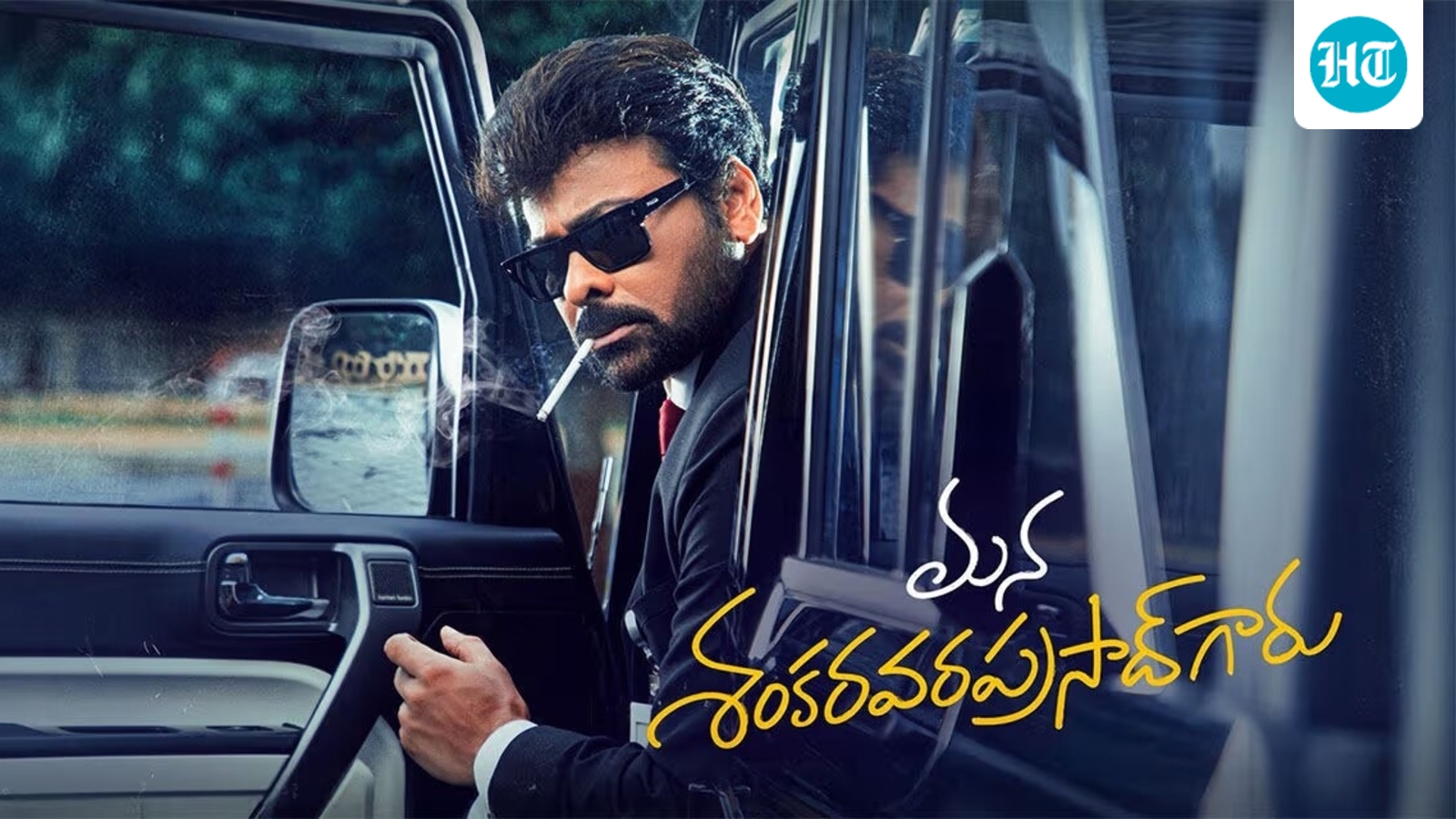
Mana Shankara Vara Prasad Garu: The return of vintage Chiranjeevi in a perfect commercial package

Director Anil Ravipudi takes a simple husband and wife reconcilation plot but packs it with the right garnishing. The self-deprecation associated with his heroes is in full flow here as well. Chiranjeevi puts up an all-around show embracing the zone of Anil Ravipudi with gay abandon. Daggubati Venkatesh in an extended cameo is an absolute riot too. The scenes between the two senior actors is high on fun.

Starcast: Chiranjeevi, Nayanathara, Sachin Khedakar, Abhinav Gomatam, Harshavardan, Daggubati Venkatesh and others

Genre: Comedy

Story, screenplay, dialogues and direction: Anil Ravipudi

Producers: Sushmita Konidela and Sahu Garipati

Production Company: Shine screens

Music: Bheems Ceciroleo

Cinematography: Sameer Reddy

Running time: 2 hours and 42 minutes

Among the young crop of directors Anil Ravipudi has the highest success rate delivering hits back-to-back. One of Anil’s biggest strengths has been his handling of stars whether its Venkatesh, Nandamuri Balakrishna, Mahesh Babu and now Chiranjeevi. The plots are often outlandish and not high on political correctness: Bhagavanth Kesari is somewhat of an exception to this with the strong message of female empowerment.
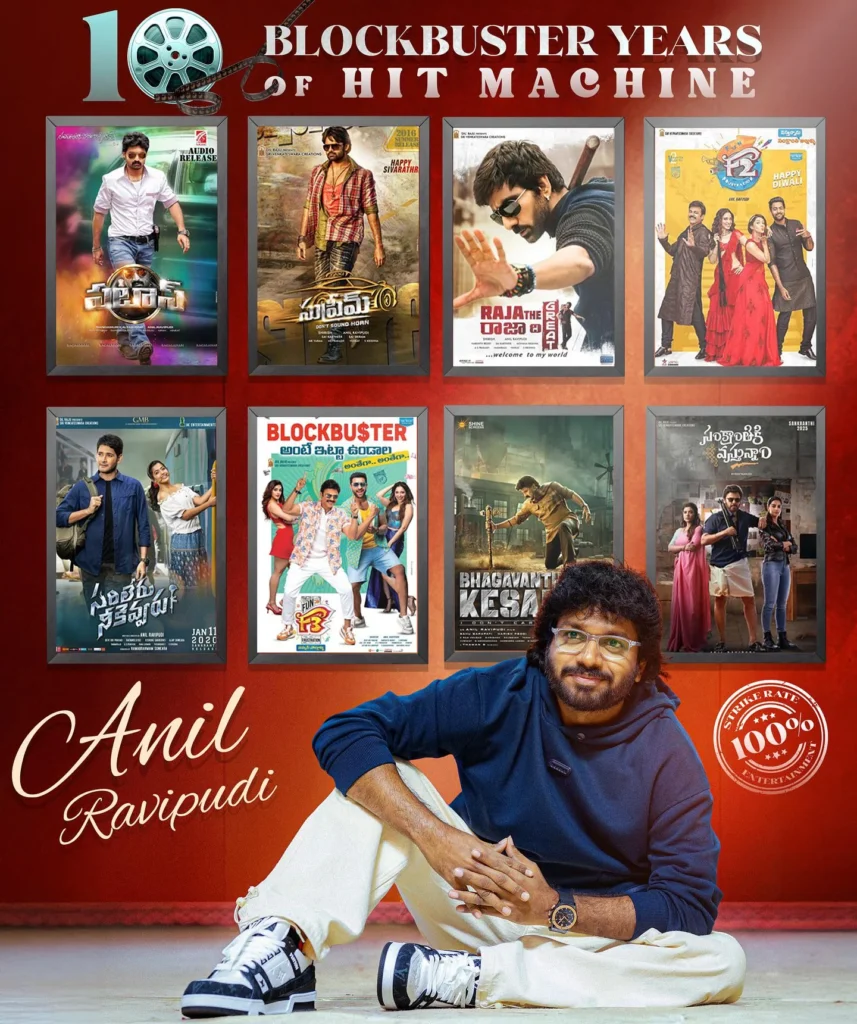
But what makes Anil Ravipudi tick is his strong conviction in narrating these outlandish stories. In a short span of time Anil Ravipudi has emerged as a successful commercial filmmaker with shades of late E. V. V Satyanarayana and Krishna Reddy. His latest Mana Shankara Vara Prasad Garu perfectly fits the typical template of an Anil Ravipudi entertainer. The story is wafer thin and sometimes stretched too but the presentation makes it an ideal Sankranti entertainer.

The plot in simple terms is about a middle-class man and NSG officer played by Chiranjeevi. Nayanathara’s Sasirekha is an extremely successful businesswoman with consecutive awards. The two were happily married once upon a time but in the present separated. After many years their lives are intertwined again due to a life threat to Sachin Khedekar’s JVR (he is the father of Sasirekha). How the reconciliation happens forms the spine of Mana Shankara Vara Prasad Garu.

A strong aspect of Mana Shankara Vara Prasad Garu is undoubtedly the return of vintage Chiranjeevi. The character has ample shades of comedy, romance, action and drama and Chiranjeevi attacks the part with relish. There are numerous scenes of self-deprecation in typical Anil Ravipudi style and Chiranjeevi raises many chuckles.

His interactions with the team members played by Harshvardhan, Abhinav Gomatam and Catherine Teresa are very funny to say the least. For example, there is a scene of Shankara Vara Prasad trying to reconnect with the two children by introducing himself as PT Teacher first and then taking things forward. The members in the team caution Shankara Vara Prasad saying that they need to make a proper plan. An overconfident Shankara Vara Prasad is dismissive resulting in a jeopardy.

Similarly, the second half portions of trying to woo back Sasirekha also results in many laughs. As far as the emotional scenes there are moments of pain when Shankara Vara Prasad talks about missing his family while seeing happy family gatherings, Chiranjeevi aces this as well with understated acting. This especially comes out when the daughter unaware of Chiranjeevi being the father talks about how he was a bad example of being a parent. For a moment there is a visible pain masked quickly by Shankara Vara Prasad.

The love story has its moments too like the scenes where the characters are seen communicating with just facial expressions and hand gestures. Both Chiranjeevi and Nayanthara bring in the required charm even though there is a hurried nature to how they fall in love.
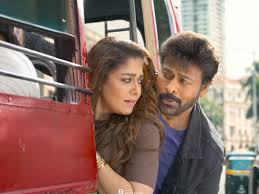
Daggubati Venkatesh appears as a third angle adding to the fun element. The two senior actors share a fun camaraderie. Venkatesh as Venky Gowda has lot of fun especially in the scene of describing Sasirekha’s beauty much to the discomfort of Shankara Vara Prasad. The use of songs with Venkatesh dancing to Chiranjeevi’s tunes and Chiranjeevi to Venkatesh is also exciting to watch especially for the fans.
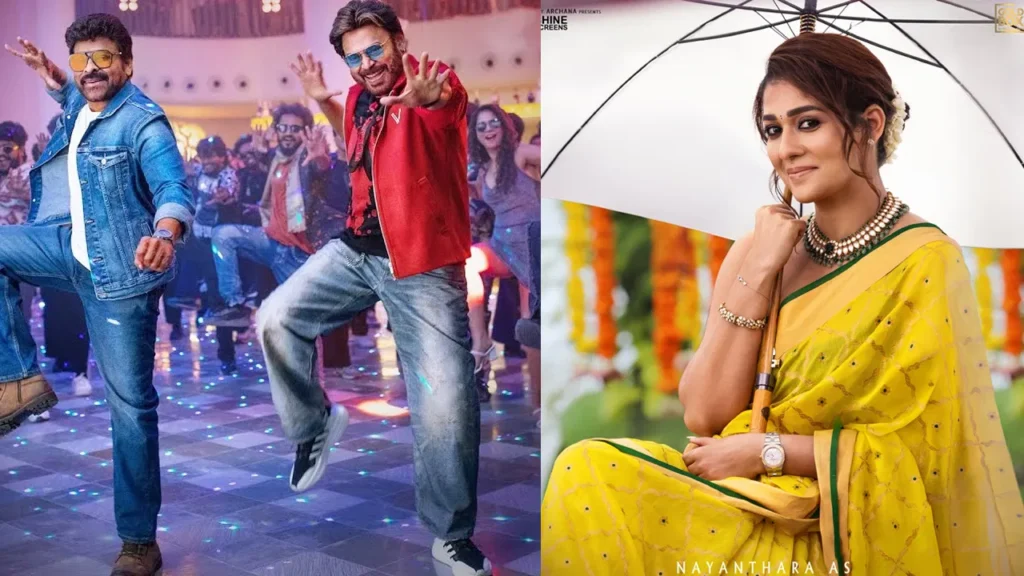
Nayanathara as Sasirekha plays the self-assured woman with grace even though the writing needed to be much better. How she becomes a very successful businesswoman is hardly explored. Also, the end suggesting that she has left business altogether and has become a traditional wife is quite problematic. Nevertheless, Nayanthara is solid in bringing out the tough attitude and a certain feistiness in living life on her own terms. Sachin Khedakar in a semi negative role is impressive as well in spite of the caricaturist portrayal. The actual villain track though is rather flat. It would have been much better if Anil Ravipudi skipped it altogether.

Gender politics has mostly been a problem with Anil Ravipudi’s movies, and this too isn’t an exception. A scene involving divorce laws caters to a stereotypical mindset painting women in a certain way. There is also a portion of Zarina Wahab as Shankara Vara Prasad’s mother talking about her husband slap and she immediately leaving him in anger. She later talks about coming back and the two having a heart-to-heart conversation. A thing like slapping a partner is a serious thing but Anil Ravipudi treats it in a casual manner making it appear as normal. Having said that it’s refreshing to watch the mother not requesting the former daughter in law to come back: as she rightly says marriage is a personal thing and Sasirekha has every right to go out. Zarina Wahab lends in a quiet dignity in spite of the less screen time.

The music of Bheems Ceciroleo gels perfectly with the movie’s Sankranti vibe. Both Sasirekha and ‘Meesala Pilla’ have been well integrated. The cinematography of Sameer Reddy is suitably lavish.

Final word: Mana Shankara Vara Prasad is an absolute treat for Chiranjeevi fans and those looking for a festive entertainer. The gender politics though is a different matter

Nenu Mee Bramhanandam: A Breezy Read For Both His Fans And Movie Buffs In General

The inner workings of the industry are kept to a bare minimum which is surprising given that he has a career span of almost four decades.

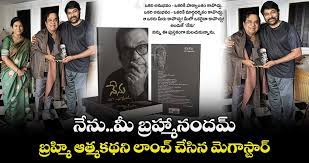
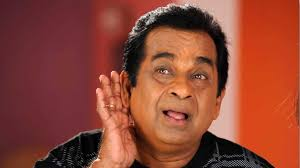
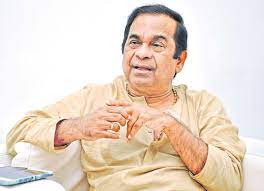
Comedy is a difficult art to master. Apart from timing spontaneous reactions to situations are also necessary. Bramhanandam has enthralled the audiences of different generations and has managed to stay relevant. The relevancy of Bramhanandam is easily visible in how his expressions are used as emojis in different situations of everyday life. Naturally there is lot of curiosity and excitement surrounding his autobiography. It recently came out both in Telugu and English as ‘Nenu mee brahmanandam’ and ‘Me Brahmanandam’ respectively.

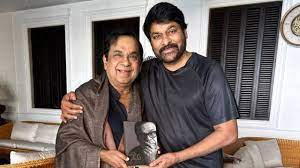
Brahmanandam presenting his autobiography to Chiranjeevi

We all know that a comedian’s life need not be full of humour. It is never so. Nenu Mee Bramhanandam is no exception. The book covers different stages of Bramhanandam’s personal and professional life starting off from his life in poverty as a young child.

A significant incident in Bramhanandam’s childhood concerns the festival of Diwali. His father Nagalingachary could not afford to buy crackers for his children. But on one occasion when Bramhanandam was persistent about them his father took him along to borrow money from the local landlord. The observant child that he is he noticed his father’s hesitancy while asking for money. This incident made the young child understand the real meaning of poverty along with how to value money.

Bramhanandam’s bonding with his mother Lakshminarasamma also comes out strongly in the way the actor describes her. In one of the pages she gives an important advice to her son about how it is all right even if he doesn’t achieve anything significant in life; but don’t get into the wrong path, don’t get addicted to cigarettes and alcohol. He promised her never to touch them in life and kept it to this day. We are reminded of Gandhi’s mother here. Maybe most mothers give their sons the same advice but not all sons keep their word.

The other engaging chapters in the book are about the time of his studies and his period as lecturer. He recounts how different people helped him at different junctures and doesn’t forget to acknowledge them. Before becoming an actor Bramhanandam had participated in many mimicry shows. There was constant juggling that took a toll on his professional life as his fellow lecturers weren’t very understanding.

Coming to the acting career the chapters that particularly stand out are the ones related to the shooting of Kshana Kshanam and Money. He gives a good description about how the late Sridevi couldn’t control her laughter while shooting with him.

In the comedy thriller Money, Bramhanadam talks about how he was not very sure about playing Khan Dada in the film but still went ahead with it. Apparently the first copy of Money did not receive an encouraging response but the film went on to do big business along with immense appreciation.

Bramhanadam’s special love for late Jandhyala and EVV Satyanarayana can be seen on more than one occasion in the way he remembers them.

As for the disappointments –

One expected more insights into the treatment of comedy in Telugu Cinema. He could have shared his views on the use of slapstick comedy that often tilted towards the vulgar side. The inner workings of the industry are kept to a bare minimum which is surprising given that he has a career span of almost four decades.

Even about his latest film Rangamarthanda which brought him many accolades he touches about it only very briefly. After acting as a comedian in 1200 films he was doing a serious role for almost the first time. He himself said many people are referring his career now as before and after Rangamarthanda. Still he did not elaborate much on such an important shift in his career.  

His belief in God was expressed in almost every sentence. Of course belief in god is an individual choice but to attribute every incident to the almighty was a little overdoing. A crisper edit would have made the book more readable. 

Waltair Veerayya: A Routine Vendetta Saga With All Style And No Substance

Summary

Waltair Veerayya (Telugu) 2 out of 5
Cast: Chiranjeevi, Ravi Teja, Prakash Raj, Bobby Simha, Rajendra Prasad, Shruti Hassan, Catherine Teresa, Vennela Kishore and others
Director: Bobby Kohli
Producers: Naveen Yerneni and Y Ravi Shankar
Music: Devi Sri Prasad
Running time: 2 hours and 35 minutes
Genre: Action drama/comedy

Chiranjeevi is an actor who came with no background but emerged as a megastar with his hard work. There is a huge fan base that Chiranjeevi enjoys. But of late the actor has been struggling big time ever since he made a comeback to cinema.

Apart from Khaidi No 150, nothing has clicked for the actor.

Waltair Veerayya is thus an important film to him as neither Acharya nor Godfather set the box office on fire, although the latter had good reviews.

The promos of Waltair promised Chiranjeevi at his massy best and the addition of Ravi Teja had made the audiences excited.

Chiru has a blast

There is no denying that Chiranjeevi had a blast playing Waltair and his energy at the age of 67 is indeed commendable, but the end result is still hugely underwhelming.

Chiranjeevi is a smuggler of luxury goods and liquor along with being a fisherman. In spite of having a criminal record, there is a certain respect that Waltair enjoys. He is so respected that even the Coast Guard takes his help when in dire need.

Even a police officer like Seethapathi (Rajendra Prasad) approaches Waltair to help him bring back a notorious drug dealer Solomon Caesar (Bobby Simha) from Malaysia. Waltair and co go to Malaysia to kidnap Solomon.

Here Veerayya’s path crosses with that of Solomon’s brother Michael Caesar (Prakash Raj in another routine villain role). Waltair and Michael have a past that is connected to ACP Vikram Sagar (Ravi Teja). Vikram Sagar and Veerayya are step brothers.

Commercial package

What follows is a template commercial package where the elder brother takes revenge on the enemies and restores honour to his dead younger brother.

The story of Waltair doesn’t make any bones of being different and the fan appeasement is very clear from the moment Chiranjeevi is introduced.

The first half is sporadically engaging, all thanks to the comic timing of Chiranjeevi. His fear of heights generates some chuckles. There is a particular slang that the actor uses and this leads to some entertaining moments.

The other members of the gang that include Srinivasa Reddy and Saptagiri don’t get to do much in spite of their proven comic skills.

Sruthi Hassan’s character has an interesting twist when she is revealed to be a RAW officer, but as in most big ticket vehicles, she is relegated to the background soon.

Things take a turn for the better at the interval point and the interval bang is where the real story begins.

Ravi Teja factor

Ravi Teja’s entry and his scenes with Chiranjeevi are easily the best part of the second half.

The scenes where both the actors reference each other’s films do bring a smile to your face. There is big friction between them but at the same time there is also an undercurrent of emotion.

In spite of knowing where the story is going to head, you are involved as long as Ravi Teja is there.

As ACP Sagar, Ravi Teja brings a certain intensity to his part. A particular mention must be made of Ravi Teja’s death scene and the one final conversation that he has with his brother.

But once the flashback ends, the film starts becoming a big slog with endless action scenes and the pre-climax involving vigilante justice leaves the audiences with a sour taste.

Both Prakash Raj and Bobby Simha are earnest in their parts, but these are roles that they can play even in sleep.

As in most Telugu films, there is a huge set of supporting actors; but, with the exception of Rajendra Prasad, none have anything much to contribute.

The music by Devi Sri Prasad is apt for those who enjoy mass entertainers.

Chiru needs better scripts!

As Waltair, Chiranjeevi undoubtedly has a blast. His performance in both the comic and emotional bits is a delight to watch.

But it is high time that the actor understands the changing tastes of audiences and chooses scripts accordingly.

It would be good if the senior actor takes the route of an Amitabh Bachchan or a Mammooty.

Godfather: The Return Of Chiranjeevi

Prithviraj Sukumaran’s Lucifer was a competent political thriller within the realms of what is considered mainstream in Malayalam. Mohanlal’s charisma was one of the primary reasons that the film worked. Vivek Oberoi was also terrific as the bad guy. Prithviraj Sukumaran’s direction wasn’t flawless but still the actor director did a good job in capturing the socio-political scenario.

Mohan Raja’s Godfather on the other hand is a massier version of Lucifer. There are ample slow mo shots of Chiranjeevi accompanied by a thundering background score of S. Thaman. There are punch dialogues which are aimed to make the fans happy. But at the same time Mohan Raja makes sure that the film hasn’t got any unnecessary subplots like a forced romantic track or a crude comic subplot.

Much like Lucifer here too the political drama keeps you invested. It also immensely helps that young actor Satyadev makes for more than a worthy antagonist to Chiranjeevi, this is something which I will elaborate on later.

Godfather begins at an Interpol facility in France where a high- ranking agent hands over a confidential case of an elusive mastermind Abraham Quershi to another agent. From here we move to India where PKR, the supreme leader of a political party is no more. The death of PKR has sent the state into a crisis and a new leader must be elected. The key players in this musical game of chairs are introduced by director Puri Jagannadh making his acting debut as investigative journalist Govardhan.

Brahma (played by Chiranjeevi) is an intelligent and popular leader among the masses and is also the backbone of the deceased CM. This ideally should make him the perfect candidate. However senior leader Narayana Varma (Murali Sharma) and PKR’s son-in-law Jaidev (Satyadev Kancharana) have other plans. Additionally PKR’s daughter Satyapriya (Nayanathara) is also thrown into the mix. There is also Salman Khan in a swashbuckling extended cameo as Masoom Bai, although there is nothing masoom that the actor is doing here.

The best thing about Godfather is how director Mohan Raja sets up the plot. It keeps you hooked. There are many unexpected twists and turns regarding the supporting characters that keep you glued to the screen. The best examples of these are the characters essayed by Sunil and Shafi. Initially we see that Sunil and Shafi are working for Chiranjeevi and Satyadev respectively. However there is a twist in a tale that you don’t see coming.

The director also deserves credit for how he showcases Chiranjeevi as a mature politician. Chiranjeevi hasn’t got many dialogues but the actor still packs a punch with his eyes. His screen presence and settled performance is a treat to watch.

NAYANTHARA BRINGS A CERTAIN DEPTH TO HER ROLE.

The emotional bits featuring Chiranjeevi and Nayanathara will also move you. Nayanthara brings a certain depth to her role. It is not a part with a wide arch but it is to the credit of Nayanthara’s acting talent that you root for Satyapriya.

However the biggest strength of Godfather is easily Satyadev as the antagonist. The way he holds his own opposite Chiranjeevi is remarkable to say the least. He is the major reason why this political tussle never feels one sided.

The interactions between Chiranjeevi and Satyadev are terrific to watch. The best example of this is the jail episode where Satyadev taunts Brahma. This film should ideally open new doors for this talented actor.

AS MASOOM BHAI THE ACTOR CLEARLY HAS A BALL, EVEN THOUGH HIS FACE HAS BEEN CLEARLY DE-AGED.

The entry of Salman Khan is also perfectly timed. As Masoom Bhai the actor clearly has a ball, even though his face has been clearly de-aged. The climax fight where Chiranjeevi and Salman take on baddies is a treat for the fans.

The film has also got some well written political moments particularly in the first half. Puri Jagannadh as the investigative journalist is successful in representing those who are frustrated with corrupt politicians.

Godfather isn’t without its flaws. The second half is comparatively less interesting and the likes of Murali Sharma etc could have been used better. Also the music of Thaman is a big downer. The background score is definitely a banger but there are times where it swells too much.

Final word: Godfather is a welcome return to form for Chiranjeevi after the debacle of Acharya. It is an enjoyable political ride even if you have seen Lucifer.

Acharya: This Time Koratala Siva Misses The Bus

Koratala Siva is a director who is known for taking social backdrops and giving them a commercial garnishing. It is a formula that paid rich diligence in films like Mirchi and Janata Garage. Here too you have the trademark Koratala Siva elements. There is naxalism and uranium mining among other aspects. The fights and the dances are also there but the missing link here is a solid base that binds the story together. The first half in particular is a big drag where nothing much happens. The second half is definitely far better but that is not enough to salvage the film.

The plot of Acharya revolves around a town with a mythical past. You have two settlements Dharmasthali and Paadaghattam. Both of them are surrounded by dense forests and a sparkling river. Mahesh Babu’s voice over at the start gives the audience an understanding of the town’s past. Now Dharmasthali has become Adharmasthali after Ramcharan’s Siddha disappeared from there.

ACHARYA HAS THE ELEMENTS BUT THE MIXING HAS GONE TERRIBLY WRONG. IT IS HIGH TIME THAT FILMMAKERS RETHINK ON WHAT THEY ARE MAKING IN THE NAME OF TWO HERO CINEMA.

Sonu Sood is once again the dreaded antagonist. But it is hard to imagine him as a villain particularly after the humanitarian work that he did during the first wave of COVID.

Jisshu Sengupta plays another forgettable part after last year’s Shyam Singha Roy.

Coming back to the story the people of Dharmasthali are waiting for a savior who will restore dharma. It is at this juncture that Chiranjeevi’s Acharya enters the town. The rest of the plot is about what the connection between Acharya and Siddha is, and how dharma is restored.

THE SCENES FEATURING THESE TWO ARE GOOD TO WATCH. THEY ARE IN PERFECT SYNC WITH EACH OTHER.

The lifeline of Acharya is without a doubt the back-story of Ramcharan and his connection with Acharya. The scenes featuring these two are good to watch. They are in perfect sync with each other, whether it is the stunt sequences or the dance number Bhale bhale Banjara. The song is no Natu Natu but still it is fun to watch them shaking a leg.
There are certain moments in the film where you can see Chiranjeevi’s eyes swell with pride. This happens particularly in the scenes where Ramcharan’s Siddha holds forth on what is right and wrong, and goes to any length to save someone of his ilk. Putrotsaaham.

As Siddha Ramcharan once again delivers a formidable performance, his growth from a boy in Gurukul to the eventual transformation is well etched. There is a scene towards the end of the flashback regarding Ramcharan’s character. It is a moment that will make you feel emotional.

As Acharya Chiranjeevi shows that he has still got it in him to play a leading man. The intensity and the screen presence are still very much there. His dance moves are also fluid.
The sets of Dharmastali are visually grand. The art work and the cinematography are a feast to the eyes.

THE BIGGEST MINUS OF ACHARYA IS THE LACKLUSTER FIRST HALF.

The biggest minus of Acharya is the lackluster first half. Nothing much happens after setting up the plot. Acharya’s interactions with the people are nothing great.

The characters of the town people on either side has been hardly explored by the director, they are used as props to elevate Chiranjeevi.

As a result it is difficult to feel any emotion for the suffering that they are undergoing. This is sad because you have a bunch of talented actors like Tanikella Bharani and Ajay but they are wasted.

POOJA HEDGE PLAYS AN EXTENDED VERSION OF WHAT ALIA BHATT DID IN RRR.

The love story between Ramcharan and Pooja Hegde is also done in a haphazard manner. The chemistry is good but you don’t root for the couple.

Pooja Hedge plays an extended version of what Alia Bhatt did in RRR. She is beautiful to look at but you will forget her character as soon as the movie is finished.

The villains are poorly etched; they are no match for the mega duo.

In a nutshell Acharya has the elements but the mixing has gone terribly wrong. It is high time that filmmakers rethink on what they are making in the name of two hero cinema.