Sannapureddy Venkatarami Reddy’s novel Konda Polam is a hugely acclaimed novel for many reasons. It addressed many significant topics, one of which is the need for coexistence between man and nature. It was also about the protagonist getting rid of his inner demons and facing life with confidence.
Director Krish retains the spirit of the novel and adds his own touch to it. At the same time he removes certain unnecessary chapters from the novel like the smuggling one. Krish’s touch can be seen in the way he builds up the love story between Vaishnav Tej’s Ravi and Rakul Preet Singh’s Obu. The character of Obulamma is a creation of the director but it never feels unnecessary or unwanted. Through the characters of both Rakul Preet Singh and Hema Krish gives a feministic touch.
THE BIGGEST ACHIEVEMENT OF KRISH IS HOW HE SETS UP THE TALE WITH THE HELP OF A FANTASTIC TECHNICAL TEAM.
The movie begins off with Ravi attending an interview at the UPSC board. His aim is to become a forest officer. Though he is fluent in English he requests Nassar along with the other officers to conduct the interview in Telugu, highlighting the right to speak in one’s own mother tongue. From there we move to a flashback that tells you about the journey of the protagonist from Nallamala forest to this current interview.
The biggest achievement of Krish is how he sets up the tale with the help of a fantastic technical team. Gnana Sekhar’s cinematography beautifully captures the locales. Although the film was shot in Vikarabad forests and Anantagiri, it has the authentic feel of Nallamala forests. They are a treat to watch. The art direction is another department that deserves full marks. Rajkumar Gibson creates an authentic milieu that has a lived in feel. You never feel any sense of artificiality.
ANOTHER THING THAT KRISH GETS RIGHT IS THE CHARACTER GROWTH OF RAVI.
Another thing that Krish gets right is the character growth of Ravi. Initially we see him in a perpetual state of fear whether it is in the boardroom or back home in village. He is jerky whenever he is asked why he hasn’t got a job yet. The transformative journey begins when he is sent by his grandfather to Konda Polam. If his biggest fear in forest is tiger, his biggest fear in life is not getting a job. Krish combines both these aspects and shows how Ravi overcomes both.
Rakul Preet Singh’s Obulamma is a character that will be remembered for a long time just like Samantha’s role in Rangasthalam. While Ravi might look more knowledgeable in the outside world, but it is Obulamma who is superior to him in terms of sheep rearing and the ways of the forest. She turns into a guru for Ravi and teaches him the ropes of the forest. The way the love story has been weaved into the bigger picture is very appreciable.
RAKUL PREET SINGH IS A REVELATION IN HER PART. SHE PORTRAYS THE DE-GLAM ROLE WITH ABSOLUTE CONVICTION.
Rakul Preet Singh is a revelation in her part. She portrays the de-glam role with absolute conviction. Vaishnav Tej is earnest and delivers a sincere performance.
One of my other favorite characters is of Ravi Prakash. There is a brilliant monologue scene where he speaks to his wife over the phone and breaks down. It is a highly emotional scene that moves us to tears. Ravi Prakash is absolutely brilliant. Sai Chand also deserves appreciation for his wonderful acting. After Uppena it is the second time that Vaishnav Tej and Sai Chand are acting together as father and son and the comfort level shows. Kota Srinivasa Rao has a small role but the veteran actor is a delight to watch.
AFTER UPPENA IT IS THE SECOND TIME THAT VAISHNAV TEJ AND SAI CHAND ARE ACTING TOGETHER AS FATHER AND SON AND THE COMFORT LEVEL SHOWS.
The use of Rayalaseema dialect is also pretty impressive. The accent never comes across as odd. However there are certain heavy dialogues by some characters that seem strange given their background.
The songs and the background score by Keeravani is definitely a minus. Except for the Obulamma song nothing really works. Couple of romantic songs also act as speed breakers. The background score is too loud and it distracts you somewhat from the watching experience.
Watch Konda Polam for the authentic performances and the realistic background.
‘Lady Doctors’ written by Kavita Rao is much more than just a book about six lady doctors. Above everything else she brings how these women had to struggle to carve out their careers irrespective of where they came from. Upper or lower caste doesn’t really matter. This particularly comes out in the case of Kadambini Ganguly, who is a Bengali Brahmin. In spite of decent support from husband and society she still had her fair share of struggles.
‘Lady Doctors’ begins off with the story of Anandibai Joshi. She is also a Bramhin who became the first Indian woman to cross the seas and travel to Philadelphia to study medicine. Her life was cut short by illness, malnutrition and lack of adequate health care. Her life ended before she could practice medicine but Anandibai still remains an inspiration.
Some of the other important women include Rukhmabai Raut. Rukhmabai is born in a Suthar (viswakarma community) caste in Bombay. She was the first to try and legally break her marriage. In her lifetime Rukhmabai smashed every rule of Hindu society. She also faced the wrath of activists like Bala Gangadhar Tilak. In spite of him being a freedom fighter he was not able to accept women’s equality.
The stories of the other women also make for a fascinating read. These are Muthulakshmi Reddy and Mary Poonen Lukose. Muthulakshmi Reddy is an important personality for many reasons. Chief most reason being that she was the first member of the women’s Indian association. Muthulakshmi was a doctor and a feminist who battled against caste-based misogyny. Her mother was a devadasi called Chandrammal. Her father was ostracized from the family for marrying a devadasi. In her childhood she developed a close bond with the maternal side of her family. That closeness made her aware about the Devadasi community and their issues.
Mary Poonen Lukose is also an important personality as she was the first surgeon general of Tranvancore. The most admirable thing about her is the fact that she wanted to make a difference to the womenfolk of her land. After finishing medical education she decided to come to Travancore rather than pursuing a career in England.
A major highlight of the book is how Kavita Rao intertwines the politics of their times along with the stories of the women. For example in the introduction of Kadambini Ganguly there is a telling sentence. “In 1891, the conservative Bangabasi paper departed from its usual subjects to call Kadambini Ganguly – a matronly lady doctor- a whore.”
Out of the six stories some are taken from the briefest material available, others are backed by personal accounts. Out of the personal accounts the most heart rendering one is that of Haimabati Sen. This can be seen in the following words. “During the day, she and her husband’s daughters would play with dolls. At night, she would make excuses to avoid her husband’s advances. Haimabati would lie on the bed, silent and stiff as a piece of wood. When she fell asleep, someone would remove her clothes; she would wake up and wrap herself in a blanket.”
Kavita Rao also does a good job in binding all these stories together. Her excellence can be seen in the way that she places them in a context. Because of this you are able to appreciate the force of their will to succeed in their goals. In spite of the different backgrounds and methods the commonality is their desire to snip the patriarchal practices.
In a nutshell ‘Lady Doctors’ gives an important message about how the future generations should remember the efforts of our predecessors.
Aditya KV’s “Unheard” is a series which packs in a lot. It addresses many issues like the ideological standoffs between the revolutionaries, differences centred on the rule of Nizam, varied opinions on the British rule and Indians who supported them as well as the dichotomy of individuals who are against the mighty empire. It is a lot to focus on but to the credit of the director he goes a good job of keeping you invested.
The series starts off with an idealistic young Gandhian Padma (Chandini Chowdary). She seeks help for an injured comrade played by Priyadarshi. Padma takes the help of doctor Chalapati (Bala Aditya). The night passes with Padma and Chalpati debating the benefits and banes of Nizam rule along with the price of freedom. The next episode is about a heated argument between two revolutionaries with different ideologies. Apart from Priyadarshi this episode also features Ajay who plays a blacksmith called Mallesh. Both of them want freedom for the country but the approaches are different. The rest of the episodes mostly bring back the familiar characters. Through the six episodes you have six different themes being talked about.
The biggest USP of Unheard is the way it introduces the struggle in Hyderabad on the eve of Indian independence. The director refers to many aspects of that time which aren’t really talked about. For example you have the topic of Vetti Chakiri (bonded labour), a system which exploited the poor peasant. The angst in the populace comes out perfectly in a scene when Padma questions how the killing of an Archbishop in Europe concern India.
The history of Hyderabad is something which is important at this stage. The reason being the BJP are trying to make their way in the southern state with their own lopsided version of events. Unheard makes an honest attempt at presenting different points of view: This includes the aristocracy which wants the status quo and the young rebels demanding freedom.
The makers also deserve praise in the way they present the conversations. The series is heavy on dialogues as the characters are frequently in the midst of letting out their points of view. The dialogues by Aditya KV and Anirudh are powerful. These dialogues aid the performances of the actors and also the script.
All the cast members are in good form led by Baladitya. His character is the most interesting of the lot. Technically also Unheard is a pretty solid product with particular mention to the background score. The background score lends in the right amount of emotion.
Where the show suffers somewhat is the stage like atmosphere. It takes some time to get used to this kind of presentation. Also the handling of the diverse plotlines could have been better at some places.
Unheard is a good watch particularly for those who are interested in history.
Sekhar Kammula is a director who has created a niche for himself within a short span of time. Most of his movies have had a touch of feminist streak. For example in Anand, Kamalinee Mukherjee’s character Roopa is a woman with self respect, she is someone who places importance on her freedom and individuality. Roopa walks out of her marriage with a guy called Rahul when she realizes that her freedom and individuality are not being respected by him. In the film Godavari too the female character is a career oriented woman who is determined to become a successful business woman. The above mentioned films along with Fida dealt with these issues in a feel good manner and had immense repeat value. With Love story director Sekhar Kammula takes up a romantic film with serious undertones of caste and gender. While the film is a brave attempt within the format of a mainstream Telugu film but it had the potential to be better. Two things act as a huge deterrent. One is the length, at two hours and forty five minutes, the film feels too long. It could have been easily cut short by twenty to thirty minutes. Another issue is that the narration which reminds you of films like Highway and Sairat.
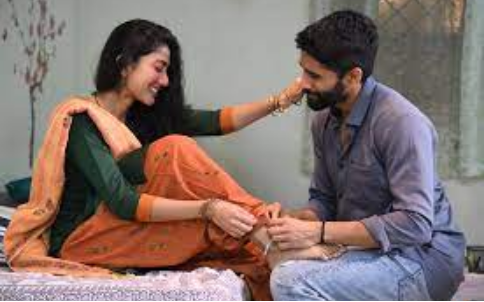
Sai Pallavi and Naga Chaitanya
The film begins off with the introduction of Naga Chaitanya’s Revanth, he comes from a lower caste in Armoor, Telangana. He has grown up listening to his mother about how it’s always better to be in a position where you can give financial assistance rather than having to receive it. Revanth is settled in Hyderabad, he runs a small Zumba centre. There are challenges but he is in a position where he can employ someone. Revanth has a dream of expanding the Zumba centre. Sai Pallavi’s Mounica on the other hand is a girl from an upper-caste family. Her family has acres of land but still she has to fight for her rights- financial and otherwise. Mounica finds her wings by partnering with Revanth but she is living in a constant fear, Mounica’s fear is regarding her family and what will they say if they find out about her work. She is particularly scared of her babai (uncle) played by Rajeev Kanakala. Mounica has a condition of trembling if anyone touches her. In fact her condition for joining with Revanth is that two feet distance must always be maintained. This problem has nothing to do with caste as we come to know later on.
Sekhar Kammula is most successful with how he develops the character of Revanth. It has been dealt with utmost sensitivity. Sekhar doesn’t resort to unnecessary commercial elements to prop up the character. Revanth is someone who tries to avoid conflicts as much as possible. He tries to solve problems through peace. There is only one scene towards the end where Revanth feels that enough is enough and decides to fight back. However this action scene works because of the context behind it. It is also refreshing to see Naga Chaintanya come out of his comfort zone playing a character like this. Naga Chaintanya delivers a career defining act. He gets the nuances of the role spot on starting from the accent.
The caste disparities have also been portrayed well. Although these scenes remind you of Sairat they still work. For example there is a scene where Revanth and her mother are looked down upon by the household of Mounica. Revanth is mocked by Mounica’s mother based on his attire and she doesn’t think twice before offering him second- hand shirts.
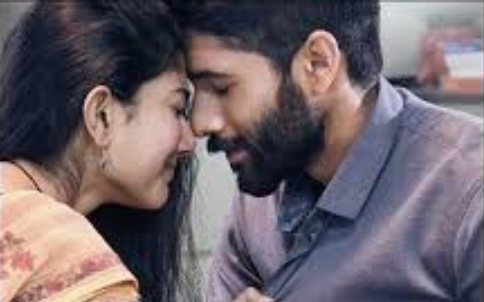
Sai Pallavi and Naga Chaitanya
Sekhar Kammula also does a good job in portraying Mounica’s psychological condition. The reason why she asks to maintain two feet distance has been well explained.
Lastly the scenes between Naga Chaitanya and Easwari Rao who plays the mother are a delight to watch. Her character is someone who is the moral centre of the film. Their relationship is one of the most satisfying aspects of the film. Eshwari Rao is very good in her role.
The biggest issue with Love Story is that Sekhar Kammula takes too much time in building up the love. There are too many Zumba dances which take half of the screen time. Too much time is also spent on the hero and hero’s introduction. As a result there are times when you feel that some scenes have been added without any purpose.
While Sai Pallavi is good in her role elements of Fida are very glaring. The Telangana accent and the dances are straight out of Fida. The crying scenes towards the end are too melodramatic and it acts as a hindrance for the audiences in completely sympathizing with the character.
Logically also there are some glaring loopholes. Uttej’s character is supposed to be an important role but he disappears when the hero needs him the most. The character of Sai Pallavi’s sister is also left midway.
The hangover of Sairat and Highway also compound the issues. This hangover will be particularly felt for those who have seen the above mentioned ones.
Love Story isn’t a bad film but it doesn’t have the repeat value of Sekhar Kammula’s Anand, Godavari and Fida.
The horrors of 26/11 are something that has a deep emotional impact even today. Not surprisingly various filmmakers have chosen this topic and have weaved films or in this case a web series around it. For example there is Ramgopal Varma’s 26/11 which dealt with how the terrorists travelled and launched several attacks at various places in South Mumbai. There is also Hotel Mumbai which was about a hotel staff risking their lives to save the frightened guests from the terrorist’s attacks. Out of these two Hotel Mumbai fared better in dealing with the subject.
Directors Nikhil Advani and Nikhil Gonsalves pen a fictional story around the real incidents and place it in a crowded, chaotic and low- on resources government hospital. The doctors and the nurses here are stretched to their limits as victims of gunshots are wheeled in one after another on the night of November 26. However Mumbai Diaries is much more than just a medical thriller.
Yes medical professionals are at the core of the story but they are not the only people under the spotlight. Mumbai Diaries is about the spirit that the people showed on that particular day. It was a night where the city didn’t have the option of dozing off. It had to be on its toes to fight this unexpected attack.
Nikhil Advani and Gonsalves are successful in making a thriller that is both heartbreaking and heart stopping. It is a series which hits you in the guts and makes you applaud the courage and determination that both men and women showed in the face of death.
The series begins off with the introduction of surgeon Kaushik Oberoi (Mohit Raina). He is a workaholic professional who loves taking on challenges but with the tendency of flaunting rules and regulations in the line of duty. The hospital’s chief played by Prakash Belawadi has issues with Kaushik but he still supports him as Kaushik is a highly efficient doctor. The second most important character in the hospital is that of Chitra Das (Konkana Sen Sharma). She is someone who has had a bad marriage; Chitra is struggling to get rid of scars that have left an impact both in her mind and heart. But she isn’t someone who let’s that come in her way of duty. Chitra does her job with utmost seriousness and never shies away from fighting for what she believes is right.
On that fateful day three trainers come to work under Kaushik Oberoi. These are Divya Parek (Natasha Bardhwaj), Sujata Ajawale (Mrunmayee Deshpande) and Ahan Mirza (Satyajit Dubey). Out of these three Divya Parek comes from a privileged section as her grandfather had funded a key wing of the hospital. Alongside the hospital there is also a five star hotel under attack.
An important part of Mumbai Diaries is how the directors deal with the media’s ethically questionable choices. This is presented through the character of Mansi Hirani ( Shreya Dhanwarthy). Mansi is someone with a single minded agenda of chasing scoops. In order to achieve her goal she puts herself and also others at risk. Through her character the directors make some valid points, the redemption arc of Mansi has also been done well.
Another good thing about the series is the restraint that has been shown. The series never pits one nation against another or one religion against other. It is about terror versus humanity. Mumbai Diaries never loses sight of the emotions that are at play.
The female characters of the show are something that can easily have a show of their own. The two female characters that particularly stand out are that of Konkana Sen Sharma and Nitya Bardhwaj.
The etching of the characters is another applause worthy point. There are no superheroes here. All of them come with their own inner demons and are forced to confront them. They all have their backs to the walls both professionally and personally.
Mumbai Diaries is crowded with lot of actors and each of them have their moment. The ones who stand out are Mohit Raina, Konkana Sen Sharma, Nitya Bardhwaj and Satyajit Dubey. Mumbai Diaries is a web show which should been on the top of your list.
Delhi Prasad Deenadayalan’s Tughlaq Durbar is an interesting political satire which looks at what if our politicians had a conscience and it stopped them from doing something wrong. It is this twist which makes Tughlaq Durbar different from other ones of this genre. The debut director is in control for most part in the way he handles the subject, it also helps that Vijay Sethupati is in good form after some indifferent performances in Uppena and the recently released anthology Navarasa.
Vijay Sethupati plays Singaravelan aka Singam. He aspires to be the next counsellor of his area. Singam is born during a political rally and he grows up thinking that he’s destined to be a politician. He does everything in his power to win the trust of Rayappan (Parthiban). Singam slowly rises in the ranks of the party and goes on to become the trusted aide of Rayappan. The twist comes in when Singam has an unfortunate accident which leaves him with an unusual condition. Singam starts experiencing events where his conscience takes control, as a result he is not able to do anything wrong. As the story progresses we see him Singam fighting with his split personality and struggling to take control of his life. What makes Tughlaq Durbar work is how the director uses the theme of the dual personalities in Singam. He uses this theme to look at the inner battle of Singam and how Singam eventually grows a conscience. Politics here isn’t that important. Another good thing is that it doesn’t use Singam’s condition to mock him or have easy laughs out of it.
Parthiban as Rayappan is another character that makes Tughlaq Durbar an entertaining watch. The scenes between Vijay Sethupati and him are a major highlight of Tughlaq Durbar.
Out of the subplots the track of Singam’s friend Vasu (Karunakaran) works well. The friendship between these two comes as natural on screen.
Lastly Sathyraj’s cameo towards the end is well placed. Satyaraj’s cameo helps the film to end on a high.
What would have made the film better though is the treatment of the female characters. Rashi Khanna as Kamatchi is just there for sake of it. The love story could have been far better etched; however one good thing about the love story is that Kamatchi doesn’t return back to Singam just because he develops a conscience. The sister played by Manjimma Mohan also had the potential to be better. She is mostly there to ponder on what the hell is going on.
Watch Tuglaq Durbar for the duo of Vijay Sethupati and Parthiban.
There is no denying that Agni Sridhar has led a fascinating life. He had studied law in Bangalore and was keen on entering The Indian Civil service but circumstances took such a turn that he had to join crime. Starting from early 1980’s he found himself stuck in middle of a gang war that shaped modern Bangalore. Later on he also turned into a journalist apart from becoming a filmmaker.
Gangs of Bangalore is much more than just a tale of murder and blood, it is also about a system that runs parallel to the world that ordinary people inhabit. It is an universe with its own force and laws. It is a difficult to pen down such a detailed life and strain of it shows more than once. Gangs of Bangalore is very much readable but at the same time it is exhausting too given the number of details. It is like the author had assumed that everyone is familiar with the names. The book could have done with some serious editing.
The thing which I liked most about the book was his observations on the underworld and how this parallel system ran. He gives some nice insights into his associates, police officers and others. Although we have seen in films like Satya and Shiva about the connection of politicians and the underworld it still makes for an interesting read as this is an firsthand account of someone who has been in that place.
There are references to how the politicians pampered the underworld, the reason being they were of use during the elections. How the police are used by the politicians has also been vividly presented.
Towards the end of his time in the underworld Sridhar had a brush with Bombay dons and their boys. There is an interesting comment that he makes about the difference between the Bangalore and Bombay criminals. He says that people in Bombay do not fight for personal revenge like they do in Bangalore. These kinds of reflections elevate the book.
Another thing which I liked was how Agni Sridhar didn’t hide his faults and presented an objective picture of himself. At no point does he glorify what he is doing.
The biggest drawback of the book is the number of characters and their inter-relationships. While Sridhar’s memory in remembering the episodes is truly remarkable but at the same time it is exhausting for the readers too. For those who are familiar with 80’s Bangalore may have an easier time but for others it is going to be an arduous task.
Read Gangs of Bangalore if you are in the mood for some history but also be prepared to have some patience.