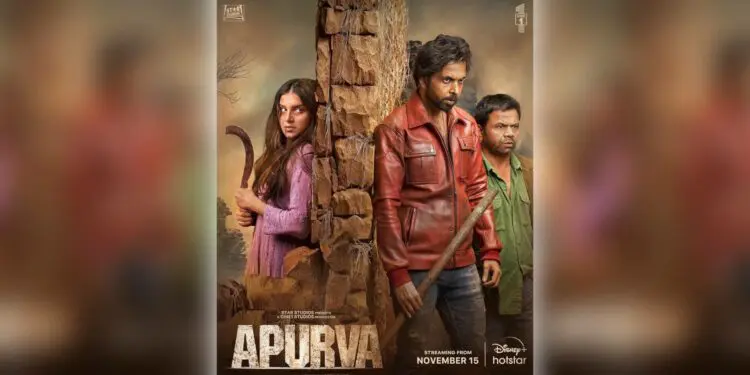
Apurva : Tara Sutaria Delivers A Knockout Punch In This Predictable Yet Gritty Survival Drama

Keeps you hooked.

Apurva (Hindi)

  • Cast: Tara Sutaria, Abhishek Banerjee, Rajpal Yadav, and Dhairya Karwa
  • Director: Nikhil Nagesh Bhat
  • Producer: Murad Khetani
  • Music: Vishal Mishra
  • Runtime: 1 hour 35 minutes
  • OTT platform: Disney+ Hotstar

Nikhil Nagesh Bhat’s Apurva is based on an extraordinary real-life story of a girl named Apurva who was kidnapped by some goons in the Chambal area.

With no substantial help, Apurva fought them all alone and emerged as a victor.

The film begins by establishing the extreme cruelty of the four bad guys.

The main antagonists among these are Abhishek Banerjee and Rajpal Yadav. From there, we see how Apurva’s (Tara Sutaria) path crosses with these four local dacoits.

Excellent characterisation

Tara Sutaria in Apurva
Tara Sutaria in ‘Apurva’. (X)

To put it briefly, the story of Apurva is about how a city girl transforms herself into goddess Durga and kills the bad guys, of course, not literally.

The big area where Apurva scores is the gritty atmosphere that pulls the viewers into the story.

Despite tonal similarities with NH10 (2015), director Nikhil Nagesh Bhat and his technical team stage the Chambal area with authenticity. There is no artificiality whatsoever.

What also works for the film is a sense of dread that the director creates among the viewers with the help of the background score.

The characterisations of the dacoits are another major plus for the film.

Abhishek Banerjee and Co are truly scary as psychopaths. As a result, the viewers anxiously wait for Tara Sutaria’s Apurva to come out safe.

The characterisation of Apurva from a city girl to finding herself in a life-threatening situation has been written well. Her love story with Sid (Dhairya Karwa) gives some much-needed light moments. Both actors share good chemistry.

A brilliant Tara Sutaria

Tara Sutaria debuted with the sequel of Student of The Year 2 in 2019. Since then, she faltered in the selection of roles.

But here, the actress has an author-backed part, and Tara delivers a commendable performance. It is a juicy role with different shades, and Tara doesn’t miss a single beat.

Dhairya Karwa also does well as the supportive fiancée. He succeeds in portraying the love and desperation of Sid.

Coming to the local dacoits, Rajpal Yadav and Abhishek Banerjee successfully make the audiences hate them, particularly Abhishek, who plays an unhinged man with a lot of glee.

The major problem with Apurva is the excessive bloodshed and cuss words that won’t go down well with all. The serious hangover of NH10 also acts as a deterrent in some parts.

The police characters feel cardboard, more like an add-on, and don’t serve any purpose.

Same case with Apurva’s parents. They are hardly there.

Final take

To sum it up, watch Apurva if you are a fan of gritty dramas and real-life stories.

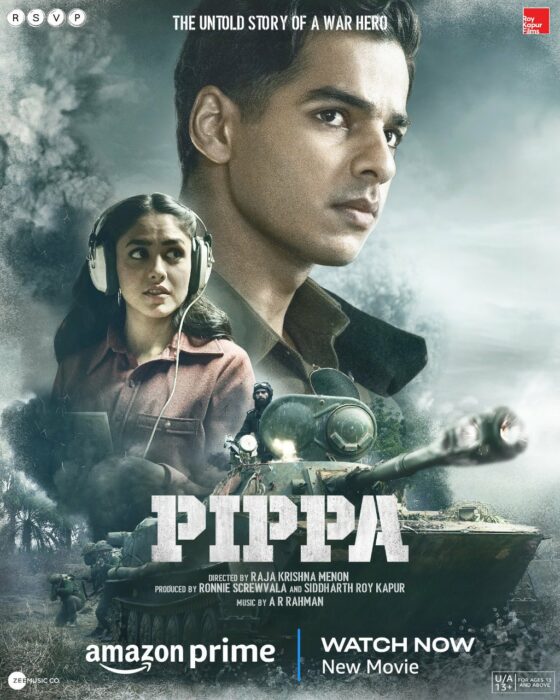
Pippa: An Engrossing War Drama That Throws Light On A Significant Chapter In Indian History

An impactful war film meant for theatres!

Pippa (Hindi)

  • Cast: Ishaan Khattar, Priyanshu Painyuli, Mrunal Thakur, and Soni Razdan
  • Director: Raja Krishna Menon
  • Producers: Ronnie Screwvala and Siddarth Roy Kapur
  • Music: AR Rahman
  • Runtime: 2 hours 19 minutes
  • OTT Platform: Amazon Prime Video

The significance of the 1971 Bangladesh War goes beyond winning the battle against Pakistan. It is more about liberating the large number of refugees who have faced many atrocities.

In a scene in Pippa, Ishaan Khattar’s character talks about how this is the first military battle fought to free the helpless.

For those who are not aware, Pippa is based on the book titled “Burning Chaffees“. Ishaan Khattar plays Brigadier Balram Singh Mehta (the author) aka Balli.

Ram Mehta (Priyanshu Painyuli), an army officer, is the elder brother of Balli. Ram’s personality is different from that of Balli. Not surprisingly, both brothers often find themselves at odds.

Their sister Radha (Mrunal Thakur) is an expert at cryptography and quite rebellious, too. This comes out well in a scene where we see her participating in a college protest.

Mrs Mehta (Soni Razdan) is their mother.

Balli’s family is a refugee family from Rawalpindi, West Pakistan. There is a brilliant scene when Mrs Mehta talks about how people don’t become refugees by choice.

As the story progresses, all three siblings play a vital role in the Indian victory.

Analysis

The first feeling that comes to viewers’ minds after watching Pippa is why it was not released in theatres. The war sequences have been brilliantly shot, and if seen on the big screen, the impact would have been tenfold.

Pippa has all the elements needed for a big theatrical experience. However, there is no point in dwelling on that now.

So, let’s go into the analysis. Raja Krishna Menon does not waste any time in setting up the plot.

There is a graphic representative story at the start that shows many people in East Pakistan being gunned down. This disturbs us, and you will instantly empathise with Bangladeshis.

After that, the director establishes the relationship dynamics of these siblings, which adds to the human drama when Ram becomes a war prisoner.

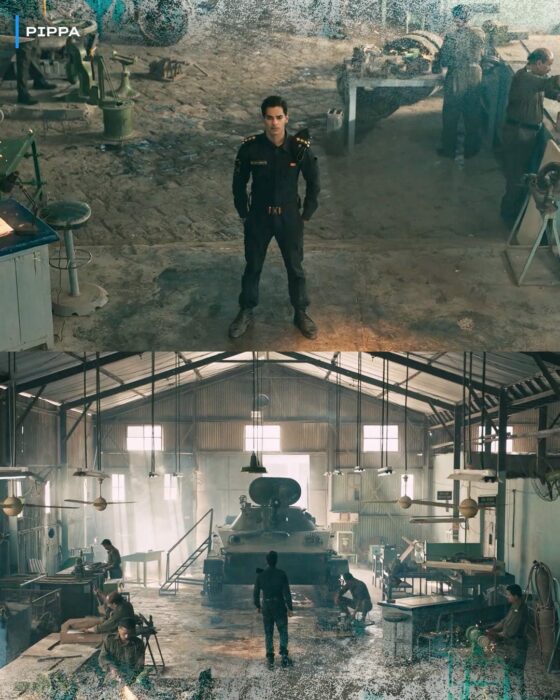
For those who don’t know, Pippa is a nickname given to the army tank PT 76 that Balli operates. The scenes of Ishaan Khattar leading this tank are a sight to behold.

The camaraderie between the members of Balli’s squadron has some amusing moments, like the scene where the mutton is cooked when the war preparations are going on.

Ishaan cements his place in Bollywood

Mrunal Thakur and Ishan Khattar in Pippa
Mrunal Thakur and Ishan Khattar in ‘Pippa’. (X)

On the performance front, Ishaan Khattar leads the show with his impeccable act. His character starts as a constantly flirting captain. From there, we see him as an unhappy officer who notes down maintenance reports to finally being a brave commander.

Ishaan strongly pulls all these shades. With this film, the actor cements his place as a young talent who is versatile with his choices.

Priyanshu Painyuli is also equally good as the elder brother. His confrontational scenes with Ishaan give some powerful moments.

Mrunal Thakur does well both as a caring young sister and a cryptographer who helps the nation.

Soni Razdan has a brief presence, but the actress is impactful in her scenes, particularly the one where she talks about refugees.

Rahman’s music & BGM do wonders

Ishan Khattar in Pippa
Ishan Khattar ‘in Pippa’. (X)

AR Rahman’s music and background score complement the film.

The soundtrack is diverse, starting with “Main Parwaana“. This song brings out the playful side of Balram. The choreography and the tune go perfectly well with the setting.

On the other hand, you have the more intense “Jazbaat” that gives an adrenaline rush.

The background score is also chilling and enhances many of the war scenes.

Director Raja Krishna Menon also deserves appreciation for how he gives equal importance to the character arcs of Ram Mehta and Radha. They are blended seamlessly into the narrative.

An area where the film could have been better is the visual effects. Also, 10 minutes could have been edited.

Verdict

Not many stories about the Bangladesh war are made into films. Let’s hope Pippa will rekindle interest in that glorious chapter in Indian history for the new generation.

Khufiya : Vishal Bharadwaj-Tabu’s brand new release is a weak espionage drama,

The first half of ‘Khufiya’ has some good moments, but it is in the second half that the film completely nosedives.

Vishal Bhardwaj’s Khufiya is based on the espionage novel “Escape to Nowhere” written by Amar Bhushan.

It starts in Dhaka with the death of an undercover spy Hina Rehman (Azmeri Haque Badhon). Hina’s death sends shockwaves to the R&AW office in Delhi.

An investigation leads to the discovery of a mole, Ravi (Ali Fazal) who leaks sensitive information about India to other countries. Charu (Wamiqa Gabbi) is Ravi’s wife.

Tabu plays a raw agent named Krishna Mehra. KM Jeev (Ashish Vidyarthi) is her boss. He gives her the responsibility of catching Ravi.

For Krishna, this mission is not just professional but also personal because she had an intimate relationship with Hina.

The rest of the story is about whether Krishna is able to stop Ravi and what happens when Charu comes to know about the actual identity of her husband.

Second half falls flat

Before getting into the negatives of Khufiya, it is necessary to point out a few positive things.

The scenes between Tabu and Azmeri Haque Badhon are limited. But still, they give the film some of its best moments as they have so much warmth.

It also helps that Azmeri has a striking screen presence. The viewers wish that she had more screen time.

The first half of Khufiya has some good moments, but it is in the second half that the film completely nosedives.

The chief reason for that is the characterisation of Ali Fazal. The actor does a decent job in the first half. But in the second half, both the character and the actor lose the sheen.

Another issue with Khufiya is the serious hangover of both Kurbaan and Raazi. The scenes of Charu spying for Krishna Mehra are distinctly reminiscent of how Alia’s Sehmat communicates with Jaideep Ahlawat’s Khalid Mir in Raazi (2018). This déjà vu doesn’t help in any way.

The pre-climax and the climax are another sore point. Here again, the viewers are heavily reminded of Uri: The Surgical Strike (2019).

Performances

Tabu’s character has many layers. Apart from being a shrewd officer, she also deals with her own inner demons.

These include a failed marriage with Shashank (Atul Kulkarni) who has a brief appearance. She also has a troubled relationship with her son. Tabu portrays all these shades with her usual excellence.

Wamiqa Gabbi also gets a good arc. She starts off as this innocent housewife who presents a certain façade in front of her husband and mother-in-law. When neither of them is there, she is seen dancing with gay abandon and also smoking.

Once Charu gets to know about the real identity of her husband, she undergoes a transformation. The actress does a good job of showcasing those nuances.

Final take

To sum it up, the audiences have many expectations from this Netflix film, given that it was a reunion of Tabu and Vishal Bhardwaj. However, this reunion leaves the viewers with a bitter aftertaste!

(Views expressed here are personal.)

Jaane Jaan: Another Compelling Thriller From Sujoy Ghosh

Jaane Jaan (Hindi)                 

Starcast: Kareena Kapoor, Jaideep Ahlawat, Vijay Varma, Saurabh Sachdeva and others

Director and writer: Sujoy Ghosh

Additional writer and dialogues: Raj Vasant

Based on: The Devotion of Suspect X by Keigo Higashino

Producers: Ekta Kapoor, Shobha Kapoor, Akshai Puri and others

Production Companies: Balaji Motion Pictures 12th Street Entertainment etc.

Streaming site: Netflix

Genre: Mystery/drama

Running time: 2 hours and 19 minutes

For those who are not aware Sujoy Ghosh’s  Jaane Jaan is based on the famous Japanese novel ‘The Devotion of Suspect X’ by Keigo Higashino. This novel has seen many adaptations. In fact the Drishyam films are supposed to be inspired from this novel.

Jaane Jaan has been an eagerly awaited film for two reasons. One is its director Sujoy Ghosh who has established his credentials as a thriller specialist with Kahaani and Badla. Two is the diverse star cast featuring Kareena Kapoor Khan, Jaideep Ahlawat and Vijay Varma. Jaane Jaan is not in the same league as Kahaani but there is a lot to like here too.

Jaane Jaan primarily revolves around three characters. The setting of this film is a misty hill station called Kalimpong in West Bengal. Maya D’ Souza (Kareena Kapoor) is a single mother who works at the local café. Naren Vyas (Jaideep Ahlawat) is a mathematics teacher at a local school. Naren is also Maya’s neighbour. He is socially awkward but is besotted with Maya. Maya comes with a dark past which is connected to her ex husband Ajit Mhatre (Saurabh Sachdeva). Her new life is shaken up by his re entry but in an accidental scuffle husband dies. She buries him with the help of her neighbour.

Vijay Varma is a police Inspector who is assigned the task of finding Ajit Mhatre. For a change his character Karan Anand is not a deranged psycho (like in Darlings, Dahaad and Pink). What follows is a survival thriller of a determined single mother in the style of Drishyam films. In this case she also has the help of her besotted neighbour .

First and foremost Jaane Jaan is not about who the culprit is. So it is not a story of whodunit in the classical sense. It is more about how the culprit evades the authorities. Sujoy Ghosh takes his own sweet time to establish the daily routine of Maya and how Naren secretly loves her. For some the slow pace might be a hindrance but these portions are necessary in the overall scheme of things.

A big plus for Jaane Jaan is the technical department headed by Avik Mukhopadhyay. He captures the different colour pallets brilliantly through his lens. His cinematography is such that the hill station becomes a character in itself.

The background music composed by the band of Shor Police is in complete sync with the mood of the film. There is no scope for songs in a film like this but the title number pictured on Kareena Kapoor makes for a good watch and listen.

Kareena Kapoor Khan successfully takes off from where she left in Laal Singh Chaddha.  Her Maya D’ Souza is a mixture of steely resilience, vulnerability and charm among other things. Kareena delivers a knock out in her debut digital project.

The way Jaideep Ahlawat who played Naren is smitten by Maya brings a smile to the viewer’s face. His love for Maya and the extent to which he helps her makes you wish that Maya had ended up with him. He was terrific in bringing out the various nuances of his character.

Vijay Varma for a change is a charming cop and the actor plays it with the required coolness. It is refreshing to see Vijay in this avatar. The scenes between Vijay and Kareena are good to watch. During the investigation Karan also falls in love with Maya and the scenes where he flirts with her are adorable. Saurabh Sachdeva is pitch perfect as the abusive husband in his brief screen time.

Jaane Jaan does suffer from editing issues. The film could have been cut short by fifteen minutes. The climax has the typical shock value of a Sujoy Ghosh thriller although it might not be everyone’s cup of tea.

Bawaal: This Mix Of World War II And Relationship Drama Has Its Moments And Flaws

Weak writing, morose tone of storytelling, and Janhvi Kapoor’s ineffective performance make things worse for the movie.

A downfall for Nitesh Tiwari!
Bawaal (Hindi)
  • Cast: Varun Dhawan, Janhvi Kapoor, Mukesh Tiwari, Manoj Pahwa, and Anjuman Saxena
  • Director: Nitesh Tiwari
  • Producers: Sajid Nadiadwala and Ashwiny Iyer Tiwari
  • Music: Mithoon, Tanishk Bagchi, and Akashdeep Sengupta
  • Runtime: 2 hours 2 minutes
  • OTT platform: Amazon Prime

Nitesh Tiwari is a director who created a strong niche for himself with the likes of Dangal (2016) and Chhichhore (2019). Both films were not only box office hits but also got rave reviews. As a result, a lot was expected from Bawaal.

Unfortunately, his latest directorial doesn’t quite reach expectations in spite of a solid set-up.

Synopsis

The film begins in Lucknow with the heroic entry of the protagonist Ajay Dixit fondly called Ajju (Varun Dhawan). Looking at his swag and the adoration of the locals, viewers think that Ajju is doing a high-profile job.

But actually, he is a history teacher. However, it is quite a mystery how he got the job, given his ignorance of the subject and his lack of interest.

Ajay Dixit has a fake aura that he himself builds over a period of time. For him, image is everything.

In reality, Ajju is just a man-child and also a big liar. He marries Nisha (Janhvi Kapoor) but keeps away from her.

Nisha was a strong independent woman before the rushed marriage. She is now patiently waiting for her husband to accept her even after nine months of marriage.

Ajju never accepts Nisha as a wife because of her epileptic fits.

The self-made image of Ajju comes crashing down when he slaps a student in the class for asking a question about World War II. The student turns out to be the son of an MLA (Mukesh Tiwari).

Expectedly, all hell breaks loose and Ajju is temporarily suspended.

He comes up with a plan of travelling to the various locations in Europe which were ravaged by World War II and teach the students about the tragedy live.

In order to convince his father (Manoj Pahwa), Ajju plans to take Nisha along and paints a picture of wanting to repair his relationship.

His parents fall for this and give him the required money. The rest of Bawaal is about how Ajju undergoes a transformation and learns some important life lessons.

Positives

Before getting into the negatives, Nitesh Tiwari needs to be appreciated for how he uses World War II as a narrative tool.

He uses the horrors to make some important points. For example, in a scene, there is a clear message about the futility of war.

Similarly, in another scene, Nisha talks about the greed of Hitler and explains how not being content with oneself leads to disastrous consequences. 

The scene depicting the gas chamber incident is also quite poignant.

Mitesh Mirchandani’s cinematography in the World War II portions is successful in bringing alive the horrors of those times.

Performances

Of the two leads, Varun Dhawan is the clear winner. His character Ajju shares more than one similarity with Badri in Badrinath Ki Dulhania (2017).

In spite of the similarities, Varun does a terrific job of portraying the different shades. In fact, on many occasions, he seems to be acting on behalf of Janhvi Kapoor as well.

Janhvi Kapoor seems to have walked straight out of the sets of Mili (2022) and Good Luck Jerry (2022). It is puzzling how a supposedly strong woman would stay with a husband for nine months who insults her on every occasion.

Alia’s Vaidehi in Badrinath Ki Dulhania had far more spine, though she eventually ends up with Badri. But that was only after he changes, and becomes a better person.

Janhvi’s expressions hardly change. It looks as if she is forced to act.

Flaws

The biggest issue with Bawaal is the lack of a strong foundation for the love story between Nisha and Ajju.

The combination of weak writing coupled with Janhvi Kapoor’s ineffective performance makes things worse for the movie.

Bawaal also suffers from a morose tone of storytelling. There aren’t many light moments that make your heart flutter.

The lovey-dovey moments can be counted on the tip of the fingers.

The music composed by Mithoon and others isn’t bad but could have been much better, given the genre of the film. The need is for more soulful songs.

Final take

In a nutshell, Bawaal is a huge downfall for Nitesh Tiwari.

(Views expressed are personal.)

Blind: A ‘Sightless’ Thriller

One of the biggest issues with the film is the lacklustre cat-and-mouse game between Sonam Kapoor and Purab Kohli.

Dull direction!
Blind (Hindi)
  • Cast: Sonam Kapoor, Purab Kohli, Vinay Pathak and Lillete Dubey
  • Director: Shome Makhija
  • Producers: Sujoy Ghosh, Avishek Ghosh, and Pinkesh Nahar
  • Music: Clinton Cerejo and Brianca Gomes
  • Runtime: 2 hours 4 minutes
  • OTT platform: Jio Cinema

Shome Makhjia’s Blind is a bland remake of the Tamil thriller Netrikann (2021) which, in turn, was based on the Korean film Blind (2011).

Netrikann also had its issues with the slightly overlong runtime, but it kept the viewers at the edge of their seats for the most part.

Director Milind Rau gave a solid emotional arc that made you sympathise with its visually impaired protagonist Durga (Nayanthara).

The cat-and-mouse game between her and the psychopath (Ajmal Ameer) was filled with many tense moments which makes the viewers root for Nayanthara’s Durga.

On the other hand, Shome Makhija’s Blind is mostly devoid of these elements.

Synopsis

For those who haven’t seen Netrikann, Gia Singh (Sonam Kapoor) in Blind is a police officer in Scotland.

One day a severe argument happens between Gia and her younger brother in a car and Gia handcuffs him to the handle of the car.

Meanwhile, an accident happens and Gia crashes on the road with great force. At that exact moment, another car charges into the already wrecked car which takes her brother’s life.

She recovers but loses her sight and also her job. Her efforts to retain her job don’t succeed.

Meanwhile, several girls in the city go missing. One night, a stranger (Purab Kohli), disguised as a cab driver, offers to drop Gia home. But she soon finds something is amiss about the driver.

The ride becomes mysterious when a few knocks are heard from the trunk of the car. Gia manages to escape from the cab after some fight.

She suspects the cab driver is behind the kidnapping of the girls. The rest of the story is about whether Gia, with the help of the police force, is able to find the psychopath and the dangers she faces along the way.

Positives

Before getting into the negatives, it is necessary to mention the very few redeeming features of Blind.

Purab Kohli, as the serial killer surprises you big with his sadistic portrayal. He is someone who is generally associated with soft characters. But here, the actor successfully transforms into a cold-blooded psychopath.

Vinay Pathak, the police officer helping Gia, is also in good form. He provides some much-needed lighter moments.

A mention must also be made of the chase sequence involving Sonam Kapoor and Purab Kohli. It is one of the few moments in the film where you root for Gia.

Coming to Sonam Kapoor, the actress makes a sincere effort, but her limited acting abilities are terribly exposed here. Sonam doesn’t even hold a candle to what Nayanthara did in Netrikann.

Flaws

One of the biggest issues with Blind is the lacklustre cat-and-mouse game between Sonam Kapoor and Purab Kohli. The issue here is not just about Sonam’s acting, but it is also the dull direction of Shome Makijha.

Though Shome Makijha has been an assistant director for films like Sujoy Ghosh’s Kahaani (2012), it is clear that he has not learnt anything from those films.

An example of his dull direction is the telephonic conversation, that Sonam has for the first time with the psychopath. It is so dull that the audience goes into a slumber.

Another major problem with Blind is the lack of a back story explaining why Purab Kohli’s character abducts young women and tortures them to death.

Not a single explanation is given about his psychotic behaviour. This angle was much better explored in Netrikann.

Lillete Dubey, as Aunty Maria gets very little to do, and her scenes with Sonam don’t add much value to the narrative.

Her estranged relationship with her mother just doesn’t make any sense. The police officials, with the exception of Vinay Pathak, come across more as buffoons than anything else.

Final take

Blind’s cat-and-mouse game falters despite the few strong performances.

(Views expressed here are personal.)

Lust Stories 2: An Engrossing Anthology About Love, Sex, And Desire

Much like its predecessor ‘Lust Stories’ (released in 2018), ‘Lust Stories 2’ also offers a fresh perspective on female desires.

Lust Stories (2018) — directed by Zoya Akhtar, Dibakar Banerjee, Anurag Kashyap, and Karan Johar — was a well-made anthology about female desire.

The protagonists in these segments belong to different generations, socio-economic statuses, and upbringings. But the common aspect that bound them was sex and lust.

The standout story in Lust Stories was the short directed by Zoya Akhtar. Her story was about a domestic worker and her boss. Zoya expertly tackled the issue of a class divide through the lens of lust.

Now, after a gap of five years, you have Lust Stories 2. Much like its predecessor, this also offers a fresh perspective on female desire.

Made For Each Other

Lust Stories 2 begins with R Balki short Made For Each Other. This short primarily looks at checking sexual compatibility before marriage. It opens with Veda (Mrunal Thakur) and Arjun (Angad Bedi).

You have both families discussing when their marriage should take place. At that exact moment, Veda’s  daadi (grandmother, played by Neena Gupta) asks Veda whether she and Arjun had pre-marital sex.

As expected, this leads to a complete silence in the room. Daadi also adds that checking sexual compatibility before marriage is as important as doing a test drive before buying a car.

In the hands of a lesser actor, daadi’s dialogue may have sounded awkward. However, Neena Gupta makes the cool daadi work with her natural performance. Her scenes with Mrunal in particular are very good to watch.

Mrunal Thakur and Angad Bedi don’t have a lot to work with. Nevertheless, they make for a good lovey-dovey couple.

The Mirror

The Mirror, directed by Konkana Sen Sharma, is more intense than Balki’s short.

Isheeta (Tillotama Shome) is an individual leading a mundane life. She has repressed sexual desires.

But one day, things take a significant turn when she accidentally sees her domestic help (Amruta Subhash) engaging in a sexual act with her husband in her house (Isheeta’s).

Instead of confronting the domestic help, Isheeta gets drawn to the scene. She gets a lot of pleasure from watching them.

This segment primarily looks at the inner desires of Isheeta and the complexities that arise from her voyeurism. This short also shows that lust knows no caste, colour or gender.

Both Tillotama and Amruta Subhash are in wonderful form with their uninhibited performances. Though it reminds you of Zoya Akhtar’s short in Lust Stories, Konkana adds many more layers.

Sex With Ex

Sujoy Ghosh’s Sex With Ex is a thriller in typical Sujoy Ghosh’s style. This segment of Lust Stories 2 doesn’t completely draw you in, but it isn’t a complete waste either.

David Chauhan (Vijay Varma) is involved in an accident on the outskirts of a town. While searching for a mechanic he visits a hamlet where he runs into his ex-wife Shanti (Tamannaah Bhatia).

Shanti was assumed to be dead for a long time. Expectedly, this reunion brings a flood of memories.

The best part of this segment is the real-life sensuality that Tamannaah and Vijay Varma bring to the table. The twist at the end also takes you by surprise.

Tilchatta

The last chapter of Lust Stories 2 is Tilchatta (Cockroach) directed by Amit Ravindernath Sharma.

It deals with two issues mainly — firstly, it is about an upper-caste man who still feels that he is living in the age of kings; secondly, it is about a woman trying to find her agency in an abusive marriage.

The patriarch here is Kumud Mishra and the married woman is Kajol.

Tilchatta takes place in a sprawling haveli. Amit Ravindernath Sharma does a wonderful job of bringing out the toxicity and suffocation that Chanda (Kajol) and her son are going through in that large space.

There is an affecting subplot concerning sex workers since Chanda was a sex worker before getting into this haveli. This subplot adds more heft to the drama.

Both Kajol and Kumud Mishra bring their A-game. Kumud Mishra shows once again why he is considered a brilliant actor. He is absolutely terrific as the torchbearer of patriarchy. The way he unabashedly gazes at the bodies of women with so much lust makes the viewers hate him.

Kajol, as the woman trying to find her agency, conveys a lot with just her body language. As viewers, you want her to take the bold step which she eventually does, although things don’t go exactly according to the plan.

Verdict

Much like Lust StoriesLust Stories 2 also makes a bold attempt at bringing taboo topics to the forefront through the digital space.

(Views expressed here are personal.)

Tiku Weds Sheru: A Hotchpotch Of ‘Luck By Chance’ And ‘Tanu Weds Manu Returns’ That Leaves You With A Bitter Aftertaste

Avneeth Kaur’s confident debut and Nawazuddin Siddiqui’s earnestness aren’t enough to salvage this wreck of a film.

A complete dud!
Tiku Weds Sheru (Hindi)
  • Cast: Nawazuddin Siddiqui and Avneet Kaur
  • Direction: Sai Kabir
  • Producers: Kangana Ranaut
  • Music: Gaurav Chatterji
  • Runtime: 1 hour 51 minutes
  • OTT platform: Amazon Prime

There have been several films set against the backdrop of the film industry and Tiku Weds Sheru is one such.

For example, Shyam Benegal’s Bhumika (1977) was based on a well-known Marathi stage and screen actress of the 1940s. Even before that, Guru Dutt’s Kaagaz Ke Phool (1959) explored the turbulent life of a famous filmmaker.

If we talk about recent times, Zoya Akhtar showed the journey of two aspiring actors who arrive in Mumbai to become big stars in Luck By Chance (2009). Though the film didn’t make a lot of money, it was critically appreciated and won the best debut director award for Zoya.

This year, you had the web series Jubliee (2023), directed by Vikramaditya Motwane. It was about the film industry of the 1940-50s through five major characters. It turned out to be a major hit on Amazon Prime.

Sai Kabir’s Tiku Weds Sheru majorly takes inspiration from two films — Luck By Chance Kangana Ranaut’s Tanu Weds Manu Returns (2015). Even the title resembles it.

Director Sai Kabir tries to address many pertinent issues like misogyny and patriarchy here, but his direction lacks the required clarity. Tiku Weds Sheru neither works as a romantic drama nor as a story of two underdogs.

Shiraz Afghani aka Sheru (Nawazuddin Siddiqui), is one of the many countless junior artists slogging it out in the film industry. Apart from being a junior artist, he works secretly as a pimp too.

Synopsis

Tiku (Avneeth Kaur) is a fierce girl from Bhopal. She has a good flair for poetry. Tiku aims to escape from her misogynistic family and become a superstar in Bollywood.

Her ticket to Bollywood comes in the form of Sheru who pretends to be a film financer. The duo gets married.

He uses the dowry money to repay a loan shark. Sheru doesn’t know that Tiku has already got a boyfriend and is using him as a gateway to reunite with him. This boyfriend promises to make her a superstar.

But eventually, he dumps her as expected. The rest of the story is about how Tiku and Sheru navigate their personal lives, and also the world of showbiz.

The only positive aspect

The only positive aspect of Tiku Weds Sheru is the performances of the individual actors.

Avneeth Kaur, in particular, sparkles as the girl who aspires to be a superstar. She shines equally in both the dramatic and comic bits. With a much better script, this girl can go a long way.

Nawazuddin Siddiqui brings certain earnestness to his part, as he does in most of his films. His performance here is no Manto (2018). Nevertheless, he is sincere.

But at the same time, Nawazuddin looks completely out of place in the dancing portions.

Fails to do justice

But as a pair, there is a complete lack of chemistry between the leads. It is not just about the hugely significant age gap. But there is a general awkwardness in the romantic scenes which only adds to the woes of the film.

The biggest issue with Tiku Weds Sheru is that it does not do justice to any of the themes handled.

The issues of the plight of the junior artists and the casting couch are very pertinent, but director Sai Kabir makes a mockery with his inept direction.

The supporting characters are another big joke. All of them are one-note characters. As a result, none of them leaves an impact.

Kangana’s cameo also comes out of nowhere. It is a part that could have been easily deleted

Verdict

Tiku Weds Sheru is the first venture for Kangana as a producer and the third film for Sai Kabir. Unfortunately, it turns out to be a complete dud. Hope they come up with better and more original stories in future.

(Views expressed here are personal.)

Bloody Daddy: Shahid Kapoor Comes Out All Guns Blazing In This Pulpy Action Thriller

Beneath all the action and thrills, the film has a relatable emotional angle — the father-son dynamic that has come out well.

Provides enough adrenaline rush!
Bloody Daddy (Hindi)
  • Cast: Shahid Kapoor, Ronit Roy, Sanjay Kapoor, and Diana Penty
  • Director: Ali Abbas Zafar
  • Producer: Jyoti Deshpande, Gaurav Bose, and Ali Abbas Zafar
  • Music: Badshah, Aditya Dev and Anuj Garg
  • Runtime: 2 hours 5 minutes
  • OTT platform: Jio Cinema

Ali Abbas Zafar’s Bloody Daddy opens with information on the country slowly getting back to its feet post the second wave of COVID-19 lockdown.

More than the story, it is the racy screenplay that makes Bloody Daddy enjoyable particularly if you are an action junkie.

Synopsis

The setting of Bloody Daddy is the milieu of North India.

In the very first scene, we see Sumair (Shahid Kapoor) and his colleague (Zeishan Quadri of Gangs of Wasseypur fame) racing down the streets of Connaught Place in pursuit of another car.

Soon enough, they manage to catch up with the car and have a fight with two men. They get their hands on cocaine worth ₹50 crore.

This action sequence sets the tone for the rest of the film. Here, it has to be mentioned that Sumair is an NCB officer but not the traditional mainstream cop, as he is not catching the criminal but robbing the cocaine.

In short, he is a dubious cop, and as viewers, we don’t understand whether he is on the right side of the law or the wrong side till the end.

Sikander (Ronit Roy) plays a drug lord-cum-hotelier. He comes to know that Sumair has beaten up his men and is in possession of his cocaine. He abducts Sumair’s son Athrav.

Crux of Bloody Daddy

The one-line story is about how Sumair manages to get back his son. But what makes this drama interesting is the various subplots that director Ali Abbas Zafar integrates.

For example, you have another drug dealer Hamid (Sanjay Kapoor), and two anti-corruption officials, Aditi and Sameer (Diana Penty and Rajeev Khandelwal), who are also on the job.

Soon a cat-and-mouse chase starts, but there is much more than what meets the eye.

Parallel to this, Sumair has a messy relationship with his ex-wife Riya and son Athrav.

The biggest strength of Bloody Daddy is how Ali Abbas Zafar designed the character of Shahid Kapoor.

Sumair isn’t perfect by any means and on certain occasions, he also comes across as a selfish and irresponsible dad.

His moral compass also seems to be oscillating and this keeps the viewers guessing whether he is the good guy or the anti-hero till the very end.

Positive aspects

There is certain believability to the fight sequences that the director and his leading man bring to the table. Sumair’s scenes with his son Athrav are few in number, but they do make an impact.

A special mention must be made of the phone conversation when Sumair instils confidence in his son that he will come out safe.

Bloody Daddy has also some wonderful laugh-out-loud moments.

A good example of this is the hilarious interaction Sumair has with a Nepali cook in the hotel. Some of the other laugh-out-loud moments come from the interactions between Sikander and Hamid.

Beneath all the action and thrills, Bloody Daddy has a relatable emotional angle.

You have a father who eventually wants to make his son understand that he isn’t the irresponsible and indifferent dad that the boy assumes him to be. This has come out well.

What also makes Bloody Daddy even more intriguing is the characterisation of Rajeev Khandelwal. On the surface, he appears to be an honest tough cop but there is a solid twist to his character.

Ali Abbas Zafar also uses the background of COVID-19 smartly to make important points about the growing inflation and the crime rate.

Low points

The second half of Bloody Daddy feels a little stretched because of the long drawn-out cat-and-mouse game.

Diana Penty as the solo female official needed to be better etched. It looks more like an add-on to the story rather than being organic.

Performances

As Bloody Daddy, Shahid Kapoor exudes power and vulnerability in equal measure. He brings a palpable intensity which makes the viewers root for him.

Apart from the intense scenes, Shahid shines bright in the lighter ones, too.

The duo of Ronit Roy and Sanjay Kapoor are also in fine form, particularly Ronit Roy. Rajeev Khandelwal is another actor who makes a strong impression.

The cinematography by Marcin Laskaweic matches the vision of Ali Abbas Zafar. On more than one occasion, the viewers feel that this film should have been released on the big screen.

Final take

Bloody Daddy is a highly watchable action thriller that provides enough adrenaline rush.

(Views expressed are personal.)

Gulmohar: A Tale Of A Dysfunctional Family Propelled By The Presence Of Veterans

Sharmila, Manoj & Simran’s show!

Gulmohar (Hindi)

  • Cast: Sharmila Tagore, Manoj Bajpai, Simran, and Amol Palekar
  • Writer-Director: Rahul V Chittella
  • Producers: Vikesh Bhutani, Rahul Chittella, and Shujaat Saudagar
  • Music: Siddarth Kosala and Alan Demoss
  • OTT platform: Disney+ Hotstar
  • Runtime: 2 hours 12 minutes

There was a time when the portrayal of families was largely sugar-coated on the big screen. Everything used to be hunky dory until an outsider comes along and creates a rift.

For a long time, the majority of family dramas followed this template. However, this has changed in recent times thanks to directors like Zoya Akhtar and Shakun Batra.

Dil Dhadakne Do and Kapoor & Sons are examples of families where interpersonal relationships were shown on shaky grounds.

Gulmohar directed by Rahul V Chittella pretty much falls under the same space. There is also a semblance of Mira Nair’s Monsoon Wedding.

The big charm of watching the film lies in seeing veterans like Sharmila Tagore and Manoj Bajpai sharing screen space. Their parts are easily the best thing about the film.

However, the movie would have come out better if the director hadn’t tried to cram too many things.

Synopsis

Gulmohar begins with a get-together of the Batras. Kusum (Sharmila Tagore) is the matriarch of the Batra family. She leaves everyone baffled with the announcement that she bought a house for herself in Pondicherry.

She also declares that she won’t be moving in with her son Arun (Manoj Bajpai) into his new apartment. Kusum feels that she has done enough for her family and now wants to follow her heart.

Arun is quite rattled by her decision. But, being an obedient son, he doesn’t let his displeasure show.

Suraj Sharma plays Arun’s son Aditya who also wants to live separately from his wife. This leads to a strained relationship between father and son.

Arun’s biggest solace is his wife Indu (Simran). The twist in the tale here is that Arun is adopted. As a result, he always needs an affirmation that he belongs to the Batra family.

Amidst all this chaos, some dark secrets tumble out which threaten to shake the entire foundation of the family.

Explores interpersonal relationships

The best thing about Gulmohar is how Rahul V Chittella explores interpersonal relationships. Two tracks, in particular, stand out. One being Manoj and Sharmila Tagore, and the other Manoj and Simran.

The character of Kusum is someone that many modern women would identify with. Through Kusum, the director also touches upon the hidden desires of women.

The scene where Kusum talks to her granddaughter about her early days, marriage and motherhood is so endearing to watch.

The scenes between Manoj and Sharmila are also filled with a lot of warmth. We wish to see more of them.

A scene that particularly stands out is when mother and son go through the family photos together. The portions of Arun and Indu are another major highlight of Gulmohar.

There is an authenticity to their portrayal as a mature couple who have gone through many ups and downs. The scenes of Indu imitating her mother-in-law behind her back lead to some amusing moments.

Indu is the pillar who is holding everything together when the family seems to be falling apart. Simran as Indu is a treat to watch and she more than holds her own opposite both Sharmila and Manoj Bajpai.

The performances

Among the extended family, Amol Palaker is brilliant as the brother-in-law of Kusum. It is a role that is in complete contrast to Farzi. It is a delight to watch the senior actor embracing the grey shades of his role.

Not surprisingly, it is Manoj Bajpai and Sharmila Tagore who hold the proceedings.

Manoj Bajpai’s Arun is a complex part. But, as expected, he does full justice to his role. He makes the struggles of Arun so relatable.

Sharmila Tagore is elegantly personified as the progressive matriarch. She effortlessly charms her way through to the audience’s heart. She is brilliant in both the lighter and emotional bits.

Suraj Sharma as Aditya is one big minus. He comes across as mostly wooden and his passion to become an App developer hasn’t got the required fire.

The music composed by Siddarth Khosla and Alan Demoss is soothing. The ghazal number by Talat Aziz, in particular, stands out.

The drawbacks

However, Gulmohar is not just about the family dynamics of the Batras.

The director also looks into the lives of the staff employed at the villa along with an extended family.

A good example of this is the romantic relationship between the cook (Reshma) and the watchman (Jitender).

Their romance is very reminiscent of Mira Nair’s Monsoon Wedding. Initially, these portions have a certain charm. But, after a point, it hampers the proceedings.

There is also an attempt at advocating same-sex relationships. But this track hasn’t been intricately woven.

Verdict

Gulmohar is a treat for the fans of Manoj Bajpai and Sharmila Tagore.