Freedom At Midnight Season 2: An introspective history lesson on partitions aftermath

Nikhil Advani along his writers give an important reminder on the very foundation of our constitution. The consequences of partition felt even today is depicted in a hard-hitting manner. The stellar cast led by Siddhant Gupta is top notch

Starcast: Siddhant Gupta, Rajendra Chawla, Chirag Vohra, Arif Zakaria Luke MC Gibney and others

Genre: Historical drama

Director and creator: Nikhil Advani

Writers: Divy Nidhi Sharma, Revantha Sarabhai etc

Producers: Nikhil Advani and Madhu Bojwani

Production houses: Studio Next &Emmay Entertainment

Music: Ashutosh Patak

Cinematography: Malay Prakash

No of episodes: 7

Streaming site: SonyLiv

There is a very poignant moment in Freedom At Midnight season 2 when Chirag Vohra’s Mahatma Gandhi expresses his anguish over divided India. It goes like this “How you divide pain soaked into the soil? How do you divide regret?”. This is one of the many introspective moments in this solid follow up. The second season takes a deep dive into the human paradox of freedom. As a nation we were free on paper with new filled hopes: but the triumph of freedom came with a huge cost something which we need to remember as a nation especially in today’s politically divisive environment.

For those who haven’t seen season 1 this web series is based on a significant novel of the same name. This elaborately detailed work was written by Larry Collins and Dominquie Lapierre. It was centered around partition with the complex scenarios faced by Jawaharlal Nehru, Sardar Vallabai Patel and of course Mahatma Gandhi among others. Nikhil Advani did a fantastic job in portraying the leaders with their contradictions.

Season 2 also follows this blueprint. This time around the focus is on the division of India leading to terrible consequences. The loss of humanity with friends becoming foes and the bloodbath that followed forms a major part of Freedom At Midnight Season 2. The series also looks at the mismanagement from both India and Pakistan as the scenarios quickly spiraled out of control.

A strong aspect of Freedom At Midnight Season 2 is how it never romanticizes independence. Nikhil Advani doesn’t shy away from showing the disturbing reality. How the nation became fragile with huge communal and religious divide comes out in a stark manner.

There is a scene where Siddhant Gupta’s Jawaharlal Nehru says in this new India nothing will be decided on the basis of religion. Ek azaad, secular Hindustan ki pehchan sirf insaaniyat hogi”. This is followed by Sardar Vallabhai Patel looking at Nehru with hope as well as unspoken fears.

This foundation of secular Hindustan is something that we have forgotten thanks to the current political environment and certain films which have aided this. Mention must also be made of how the series depicts the character of Radcliffe the man responsible for drawing the line. There are scenes of Radcliffe pleading with Mountbatten on how he knows nothing about the geography and the people of India. But Mountbatten is hell bent that Radcliffe should be the one and also there shouldn’t be much delay. It’s hard to not feel for the situation which Radcliffe finds himself in.

The moments of conflict between Jawaharlal Nehru and Sardar Vallabai Patel has also come out in an excellent manner. Both Nehru and Vallabai Patel have different ideas regarding the running of governance leading to some showdowns. In spite of the bitter arguments between the two it never takes a venomous side. There is a moment post Gandhi’s death where Vallabai Patel faces an accusation and Jawharlal Nehru stands up for the senior statesmen.

Chirag Vohra as Gandhi is another highlight of the second season. The questions that he asks about the consequences of partition and his firm belief in the method of Ahimsa gives the show some of its best moments.

Arif Zakaria’s Jinnah is mostly a bitter person but even he too gets moments of humanness. The best example of this is his conversation with Jawaharlal Nehru on how the immense bloodshed was never his intention. There is a genuine regret in the voice. There is also an important portion when Jinnah has to leave Bombay post partition. His mood is very much cranky when seeing the house filled with half closed cartons. In an angry tone he asks the sister Fatima Jinnah (underutilized but effective Ira Dubey) on what the hell is happening. She replies that they are going home. There is a certain emptiness in the eyes of Jinnah brilliantly portrayed by Arif Zakaria.

Ashutosh Patak’s music like the first season is haunting here too. They perfectly encapsulate the human tragedy. The cinematography of Malay Prakash is first rate as well. He successfully brings alive the big scale on which the series has been mounted. There is a lived-in feel to the atmospherics.

On the performances front both Siddhant Gupta and Rajendra Sharma are top notch in their respective parts. They lead the acting department with their excellent performances. The talented Siddhant Gupta brings alive Nehru’s determination as well as portraying the internal and external conflicts with authenticity. Rajendra Sharma as the no nonsense Vallabai Patel brings in the required authority in the confrontation scenes with Siddhanth. At the same time, he aces the emotional scenes too. Mention must also be made of Abhishek Benarjee in an extended special appearance. He is both a victim and perpetrator of the riots. His confrontation scene with Chirag Vohra is an example of some solid acting.

Final word: Freedom At Midnight Season 2 is a much-needed history lesson, to learn from our past mistakes and not repeat.

Raat Akeli Hai(The Bansal murders): A competent whodunit with strong social themes

Honey Trehan’s second in the series doesn’t quite hit the high notes of the previous one: nevertheless, the movie is a gripping watch especially in its treatment of human greed and systemic corruption. Honey Trehan along with Smita Singh also touch upon on industrial pollution and a certain apathy for environment

Starcast: Nawazuddin Siddiqui, Chitragandha Singh, Deepti Naval, Revathy, Sanjay Kapoor and others

Genre: Thriller

Director: Honey Trehan

Writer: Smita Singh

Cinematography: Sirsha Ray

Producers: Abhishek Chaubey, Ronnie Screwala etc

Production companies: RVSP Movies and Macguffin Pictures

Running time: 2 hours and 29 minutes

The first Raat Akeli Hai released in 2020 was a compelling murder mystery as well as a social thriller. Through a murder mystery the plot explored the themes of women’s bodies controlled by patriarchy and how their autonomy both sexual and emotional are treated as sins: the institution of marriage being more of a transaction among others. Raat Akeli Hai (The Bansal Murders) follows a similar pattern in the way it combines a whodunit with social elements.

Raat Akeli Hai first part

The storyline of Raat Akeli Hai (The Bansal Murders) takes the viewers right into the thick of action. A wealthy and well-connected family is massacred to death. The crime is meant to be easily solved by the higher officers with a quick culprit fixed: however, Nawazuddin Siddiqui’s Jatil Yadav believes that there is more to what meets the eye. There are multiple skeltons in the closet. Secrets which are meant to be buried and not solved. The rest of the story is about the multiple suspects and the whys and how’s of the case.

A strong aspect of Raat Akeli Hai (The Bansal Murders) is its treatment of multiple layers. The suspects have been written with enough care. This particularly holds true of Chitragandha Singh. She is one of the four survivors. Chitragandha’s Meera is an ambiguous woman with deep bitterness. Meera covers this deep resentment under the guise of spirituality. Chitragandha aces the part with the required mysteriousness keeping the viewers guessing about her motivations.

Screenshot

Deepti Naval plays a supposed preacher moddled on fake godmen. This character is reminiscent of movies and web featuring fake babas exploiting people’s vulnerabilities. There is nothing particularly new here, but the senior actress plays her role with the required charm.

Mention must also be made of Sanjay Kapoor as a relative. His eyes are set on the fortunes of Bansali family. Both the character and the actor don’t come across as a stereotypical villain. There is a casual entitlement wonderfully portrayed by the actor. His role and the track cover the theme of moral shortcuts justified in the name of lineage.

There is no denying that Raat Akeli Hai (The Bansal Murders) suffers somewhat on the pacing front. The first part had a tight structure with not much meandering. The second one though needed more crispness. The portions involving Rajat Kapoor and Akhilendra Mishra overstay their welcome. The same applies to the track involving the nitty gritty of forensics. Radhika Apte has an extended special appearance meant to show a personal side of Jatil Yadav. These scenes have some nice touches but in the bigger picture the track doesn’t contribute much. Proceedings stagnate for a while: thankfully though the movie regains lost ground when the focus shifts to environmental destruction.

The themes of industrial pollution and a certain apathy towards environment has come out well. It makes the viewers ponder about where we are heading. Most importantly Honey Trehan and Smita Singh do a good job in linking these portions with the main murder plot. Special mention must also be made of the scenes featuring Revathy as a forensic expert. She plays a moral counterpart to Jatil Yadav’s superiors. The scenes featuring her and Nawazuddin gives the movie some of its best moments.

As Jatil Yadav Nawazuddin Sidddiqui successfully takes off from the first movie. He plays the determined cop with his trademark gravity. He especially shines in the scenes of the character finding itself at crossroads torn between the pressures of institution while listening to his personal consciousness.

Among the technical departments Sirsha Ray’s cinematography is suitably eerie. The cinematography helps in building up a mysterious atmosphere.

Final word: Raat Akeli Hai (The Bansal Murders) is a competent follow up. For fans of murder mysteries with social angles its very much worth watching.

The Family Man Season 3: A formidable follow up with bigger stakes

Directors Raj &DK, Suman Kumar and Tusshar Seyth do a good job in depicting the complexities of northeast. Like the previous seasons here too the characters come with shades of black and white. Yes, the series doesn’t quite match up to the previous ones nevertheless there is a lot to enjoy. The performances led by the ever-reliable Manoj Bajpayee and Jaideep Ahlawat deserve a special mention.

Starcast: Manoj Bajpayee, Jaideep Ahlawat, Sharib Hashmi, Nimrat Kaur, Priyamani and others

Genre: Thriller/drama

Directors: Raj &DK, Suman Kumar and Tusshar Seyth

Creator and writer: Raj &DK

Producers: Raj&DK

Production Company: D2R Films

Music: Sachin-Jigar, Ketan Sodha

Cinematographer: Jay Charola

Streaming site: Amazon Prime

No of episodes: 7

Before dissecting the third season of Family Man it’s necessary to acknowledge how much the representation of Northeast has changed. From a visual prop to now a living and breathing entity. The specialty of The Family Man series has always been a certain grounded nature with a relatable protagonist. In Season 3 there is a moment where Manoj Bajpayee finally reveals his real job nature to the family. The grown-up son played by an endearing Vedant Sinha has an exciting reaction saying do you have a code name like Tiger, lion etc. Srikant replies that he works for the intelligence and not circus. This simple but effective conversation sums up why The Family Man series has always been special differing vastly from YRF’s route of fantasy spy heroes.

Without giving much away season 3 focuses on a new project called Sahakkar. The aim is to help the northeast states who are deprived of development and peace with the common man suffering the most. However, things take a dramatic turn due to some bomb blasts putting the project on temporary hold.

Manoj Bajpayee’s Srikant Tiwari and Dalip Tahil as NIA chief Gautam Kulkarni meet a very respected leader David Khuzou (Sunil Thapa) to bring the project back on track. However, a major obstacle comes in the form of Jaideep Ahlawat’s Rukma. Rukma is a hit man and a drug baron but interestingly he doesn’t take drugs or drinks personally. Srikant Tiwari becomes a suspect due to certain circumstances. From being a respected spy, he becomes the most wanted man. This is the story in brief.

A strong aspect of season 3 is the humanistic lens through which the directors and writers have depicted complex political issues. The representation of northeast people and the state’s situation has a nuanced touch. Even the rebels headed by Paalin Kabak’s Stephen Khuzou are treated in a sympathetic manner. The ideological differences between Stephen and David in spite of the same goal has been both well written and enacted. At one point Srikant and men get shelter from Stephen in very dire circumstances. There are some heartfelt conversations between Srikant and Stephen when the latter opens about picking up a gun at a young age.

In more ways than one the viewers feel they are watching the continuation of Paatal Lok Season 2. This is also due to the presence of Jaideep Ahlawat this time on the other side of the fence. Yes, Paatal Lok Season 2 took a more layered look at the northeast complexities nevertheless what Family Man Season 3 pulls off is also commendable.

The locations of northeast become a major character in itself. It helps in shaping up the tension particularly in the sequences where Srikant and co are on the run. Cinematographer Jay Charola deserves a major appreciation for how he has captured the different moods of northeast landscape through his lens. The music composed by Sachin- Jigar along with Ketan Sodha has a nice northeast flavor adding to the authenticity.

Even the antagonists especially Jaideep Ahlawat has some interesting touches. Rukma can be extremely brutal brilliantly established in his intro: at the same time, he has a different side. This especially comes out in the portions with the girlfriend and the segment when he is trying to embrace fatherhood. Jaideep does a fantastic job as always pulling off the different shades with finesse.

Nimrat Kaur playing an elegant villain brings in the right amount of ruthlessness and charm There are some unsaid feelings in the portions featuring Jaideep and Nimrat. The writing here does fall short but the actors more than make up for it.

The depiction of family dynamics also deserves a mention. The falling marriage and Srikant’s exasperation at everything from bureaucracy to the children’s teenage moods have been wonderfully written and enacted. A special mention must be of a scene where Vedant Sinha’s Athrav patiently explains to his father about nonbinary terms and gen ze slangs in general. Srikant has a bemused, but earnest look on his face genuinely showing interest. As Srikant Manoj pulls off the various shades with his usual finesse. Whether its sarcasm, vulnerability and a fighting spirit even when everything is falling apart.

Sharib Hashmi returning as JK is in great form too. His humor as always is impeccable like the train scene featuring Paradha actor Raj Mayur. JK tries to present himself as a Telugu person leading to a hilarious cooked up story from Srikant. This portion is small but very entertaining. At the same time the scenes featuring JK and Srikant have an emotional resonance when Srikant opens up about a past mistake. JK comforts Srikant by saying that he should focus more on how to get out of the current mess. Mention must be also made of Vijay Sethupathi respiring his role from Farzi. It’s a short but a memorable cameo. The banter between Vijay and Manoj is a treat to watch.

As far as the flaws some subplots are left hanging. This includes the daughter being bullied at school for her opinions. Even the professional life of Priyamani’s Suchitra needed a better handling. Priyamani brings in an emotional heft though the writing doesn’t support her. The same applies to Seema Biswas playing the role of PM Basu. In comparison Shreya Dhanwanthary gets a better arc as the ambiguous Zoya, and she does a very good job. The series also tries to poke fun at the Alpha male image with Athrav taking advice from JK on how to impress his crush with macho methods. At the same time the sister drops in saying how typical is it of two males discussing what a female wants. This is an interesting thread to explore but the makers dump it midway.

Final word: The Family Man Season 3 is worth watching for its depiction of northeast complexities and of course if you are a fan of Manoj or Jaideep.

The Game (You Never Play Alone): An important cautionary thriller led by a brilliant Shraddha Srinath

Rajesh M Selva’s The Game (You Never Play Alone) has a strong beginning keeping the viewers invested for 2 thirds of the narrative. Things though start stagnating from the middle episodes with underdeveloped villains and also the gaming portions. Nevertheless, this Tamil web series throws light on important issues like data tracking and how technology in the wrong hands can be a very harmful tool. It also helps that Shraddha Srinath is in excellent form getting into the skin of the role

Starcast: Shraddha Srinath, Santhosh Prathap, Chandini Tamilarasan and others

Genre: Thriller/drama

Writer: Deepthi Govindarajan

Director: Rajesh M Selva

Music: Simon K. King

Cinematography: Akilesh Kathamuthu

Producers: Sameer Nair and Pramod Cheruvalath

Production Company: Applause Entertainment

No of episodes: 7

Streaming site: Netflix

The growing age of technology is both a Boone and bane for the current times. In one way technology has made our lives easier in connecting with people far away and also the vast information helping in increase of our knowledge. However, this massive digital age also comes with major side effects. One of this includes losing connect with the real world and also data impeachment. Numerous movies have come on this topic whether its the 2010 American Drama The Social Network or the two Ananya Pandey’s starrers Kho Gaye Hum Kahan and CTRL. The Game (You Never Play Alone) is the latest addition to this genre. This Shraddha Sranath starrer is a remake of the French show Le Jeu.

A still from the web series

The broad storyline of this seven-episode show follows the tumultuous journey of Shraddha Srinath’s Kavya. She is a talented game developer alongside her husband Anoop (Santhosh Prathap). Both work at a leading game company called Moon bolt. Their professional lives are going well but Kavya often faces scrutiny on the account of her gender. There is this constant pressure of proving her skills in a male dominated office.

Things take a traumatic turn at an award night. She is attacked by an unknown group of men and is left traumatized both physically and mentally. Chandini Tamilrasan plays officer Bhanumati. She gets deep into the case revealing a series of chilling incidents connected to online abuse and misogyny. Running alongside this is the track of Kavya’s niece Tara. Tara becomes the target of online predators. How all these are interconnected forms the basic premise.

Chandi Tamilrasan as police officer

A strong aspect of The Game (That You Never Play Alone) is the technical department. Cinematographer Akhilesh Kathamuthu does an excellent job in capturing the intensity of urban life as well as the scenes of online harassment. The psychological horror is palpable with appropriately lit frames. Sudharshan’s background music too enhances the tension filled moments. As viewers you feel a certain anxiety on what will happen next especially till the mid part.

Director Rajesh M Selva also deserves credit for how he has explored the topics of social media abuse which includes misogyny along with the challenges faced by women in professional spaces. The last one comes through a jealous colleague. The subplot of the jealous colleague and how this leads to several things is underdeveloped nevertheless the aspect of male ego being hurt is an important one.

The character of Shraddha Srinath coupled with her performance is another major ace especially the emotional parts. The way Shraddha portrays the emotions of resilience, vulnerability and solid inner strength is a delight to watch. She is the glue holding the show even when things start to fall apart.

Santhosh Prathap brings in a certain warmth as a husband who stands tall with Kavya in spite of some tensions in the marriage. The tender moments between the two are a delight to watch with Anoop giving major husband goals. Chandini Tamilrasan too does a fine job in balancing professional diligence with empathy. This trio play a crucial role in making the show engaging.

A tender moment between the two

As already mentioned The Game (Which You Never Play Alone) keeps the viewers invested for 2 thirds. However, things start stagnating while exploring the motives of the villain gang. This track needed more solid writing. As a result, the built-up tension somewhat dilutes. Also the gaming background needed more depth.

There is a surface level treatment with the glossy backdrop. More insight into the functioning of the gaming world would have enhanced the proceedings. These two aspects stop the show from soaring higher.

Final word: In spite of a muddled second act and a tame climax The Game (Which You Never Play Alone) makes for an important watch especially for those who are into digital thrillers.

Oka Manchi Prema Katha: Not just making a case for old age parents but raising many more important questions

Oka Manchi prema katha isn’t confined to looking after old age parents it is also about the corporate culture and the subsequent rat race. Stories of parents going through emotional neglect has been explored many times much like the genre of love itself. But this movie has many interesting points and one of them is about becoming a mother to your own parent. Among the principal actors Samuthirakani makes the strongest impact in a refreshingly different role.

Starcast: Rohini Hattangadi, Rohini Molleti, Samuthirakani, Himanshu Popuri and others

Genre: Drama

Direction and screenplay: Akkineni Kutumba Rao

Story, Dialogues and Songs: Volga

Producer: Himanshu Popuri

Cinematographer: Madhu Ambat

Music: K M Radhakrishnan

Streaming site: ETV Win

Running time: 2 hours+

Stories of parents facing emotional neglect has a certain template. The children are generally presented in a shrill and often unbearable tone. Oka Manchi Prem Katha’s first half also follows this formula. Sujatha (Rohini Molleti) is a very ambitious woman. She wants to reach the top position and has been working heavily to get a promotion which will put her on par with her husband Eshwar (Samuthirakani). Their daughter is studying abroad. Because of the extremely busy work schedules neither Sujatha nor Eshwar have much time to each other and for their daughter. Veteran actress Rohini Hattangadi is Rangamani the mother. Rangamani was also an employee but now stays in her village doing a bit of social service. She interacts with numerous people on a daily basis, solving some of their problems and one of them is her ‘adopted’ son Shankar. However, a health problem makes her miss her daughter dearly, but Sujatha is too busy to visit Rangamani. How they come together is the core of the film.

A strong aspect of Oka Manchi Prem Katha are the portions featuring the two Rohinis in the latter half. From the moment Sujatha becomes a mother to her own parent the film hits numerous high notes. The scenes are filled with lot of warmth, and the film succeeds in presenting a different kind of love, in this case a bond between a mother and a daughter. Both Sujatha and Rohini Molleti become more likeable here.

Through the very ambitious nature of Sujatha, Volga does a fine job in critiquing the current working lifestyle especially the corporate set up where there is one deadline after another leaving little to no space for imbibing humanistic values. The mental health issues that come with it has also been effectively presented. There is a nice bit in the first half when Sujatha visits a psychiatrist. The psychiatrist says that she needs love and more communication with people around her. To this Sujatha asks whether there is any medicine to cure this problem and the Doctor replies that unfortunately no love pill has been discovered so far.

The portions of Samuthirakani missing his wife and the telephonic conversations have been wonderfully written and enacted. Samuthirakani is a delight to watch whether it is reciting poems of John Keats or making up his own one or portraying the absolute bewilderment about the change in Sujatha’s behaviour. It is nice to see the actor playing a nuanced role for a change rather than the routine mainstream villain.

Among the other actors Rohini Molleti’s character was a little too loud and caricaturist in the first half but gets better as the movie progresses. Rohini Hattangadi as usual shines bright especially in the confrontation scenes. A specific mention must be made of the portion between her and Samuthirakani when Eshwar sends a divorce notice. She counters him with one simple question but a powerful one; would he do the same thing if the company had sent Sujatha somewhere for work purpose. There is one more dialogue where she raises an important question about Companies not granting leave to take care of old age parents. The reasoning that she gives is also very thought provoking. When there can be a maternity leave why can’t there be one for old age parental care? The rest of the cast are also fine. Himanshu Popuri as Shankar especially stands out.

Talking about the flaws the movie needed to be crisper in the first half. The core plot should have kicked in earlier instead of leaving it to the second half. The jarring difference between the attitudes of village folk and Sujatha could have been handled with more subtlety.

The music by K M Radhakrishna is soulful adding to the movie’s emotional core. Madhu Ambat’s cinematography is of course as usual very pleasant.

Janaawar (The Beast Within): A hard-hitting tale of caste identity and crime

Janaawar directed by Sachindar Vats uses the framework of a murder mystery to explore the deep-rooted theme of caste prejudice faced by its central protagonist. The internal battles of Bhuvan Arora’s Hemanth gives the show some of its best moments. The atmospherics have a rooted feel making Janaawar one of the best shows in 2025. Sachindra Vats along with his fellow writers do absolute justice to the tagline

Starcast: Bhuvan Arora, Dheeksha K Sonalkar, Bhagwan Tiwari, Badrul Islam and others

Genre: Crime

Director: Sachindar Vats

Screenplay: Shreyas Lowelkar

Music: Sreejith Edavana

Cinematography: Rahul Nayak

Producers: Abhishek Rege, Harish Shah and Dinesh Khetann

Production Company: Aarambh Entertainment

No of episodes: 7

Streaming site: Zee 5

Sachindra Vats Janaawar (The Beast Within) is a perfect example of how to blend crime with powerful social commentary. The web series starts off as a regular whodunit but as the show progresses different layers come out. The struggles of Hemanth in balancing his duties as a husband and cop while dealing with his own caste identity adds an important layer. This angle uplifts the show significantly.

Without giving much away the storyline of Janaawar is set in a fictional town of Chhaand (Chhattisgarh) and follows the journey of sub inspector Hemanth (Bhuvan Arora). In the beginning episodes the wife shown to be pregnant. Hemanth has applied for a week long leave to take care of her. But a highly decomposed dead body in a deep forest cuts short Hemanth Plans. At the same time a local MLA lands up at the police station to report a case about his missing brother. To further compound the mystery the head of the decomposed body goes missing before it can be sent for forensics. This is the story in brief.

A strong aspect of Janaawar are its atmospherics. Even before the murder mystery kicks in an air of dread is palpable. A major reason for that is the cinematography and the score. Rahul Nayak does a very fine job in capturing the tense atmosphere through his lens especially the portions set in forest. The eerie nights will give chills to the viewers.

At the same time Sreejith Edvana’s score is suitably ominous amplifying the mystery. It perfectly complements the murder mystery investigation going Parrell with Hemanth’s personal life.

Mention must also be made of the scenes featuring Bhuvan Arora and Dheeksha Sonalkar. The husband-and-wife scenes are few, but they are filled with lot of warmth. It shows a different facet to Hemanth a caring husband. Although Hemanth is a sub inspector there is no getting away from his caste identity. This discrimination has come out well on numerous occasions.

While the murder mystery is going on the show also dwells into the power structure. This is brought through the roles of Hemanth’s senior officer and an MLA (Atul Kale and Alok Mishra). These characters aren’t just part of the crime narrative but a larger reflection of the social dynamics in that particular place.

The twists and turns are also solid even though things do get convoluted in the mid portions. The suspicion of who has done it and the reasons behind it keeps the viewers guessing. The ultimate revelation does complete justice to the show’s tagline which is how society and circumstances bring out both the good and bad within us.

The performances headed by Bhuvan Arora are solid. The role of Hemath is very different from what Bhuvan Arora has done so far, and the actor does complete justice to it. He portrays the different shades with finesse. A special mention must be made of the scenes where Hemanth talks about his caste identity and how in spite of a being a sub inspector nothing much has changed. As the wife Dheekha Sonalkar is successful in bringing out the inner strength in spite of the less screen time. Atul Kale and Alok Mishra make the biggest impression among the supporting cast.

Final word: Janaawar is definitely worth watching for those interested in mysteries going beyond the usual whodunits.

Sthal: Marathi Cinema’s The Great Indian Kitchen

Jayant Digambar Somklar’s Sthal is a strong critique of arranged marriages especially in rural areas where the girl is a commodity to be sold off. The constant cycle of being decked up as a doll and being judged by the prospective in laws has a realistic feel to it. Much like Jeo Baby’s The Great Indian Kitchen Sthal also has a sense of repetitiveness with repeated shots still the film makes a strong impact

Starcast: Nandini Chikte, Taranath Khiratakar and others

Genre: Social drama

Director, writer and producer: Jayanth Digambar Somklar

Additional producers: Shefali Bhushan, Karan Grover and Riga Malhotra

Cinematography: Manoj Karamkhar

Music: Madhav Agarwal

Running time: 1 hour and 47 minutes

Production house: Dhun Production

Streaming site: Zee 5

In Indian movies the arranged marriage set up is generally used to explore budding romance. Two contrasting people coming together and becoming one. But in reality, things always don’t pan out in this manner. Sthal written and directed by Jayanth Digambar Somklar looks at the entire scenario through a young girl’s suffocation. The grind of getting appropriately dressed to please the prospective in laws and answering every question. Jayanth Digambar Somklar in short strips off the glamor generally associated with this genre.

Sthal in brief focuses on Nandini Chikte’s Savita Daulatrao Wandhare. She is in the final year of BA. Her specialization is sociology. Savita has major aspirations of studying further but her parents want to get her married off as soon as possible. This is the story in short.

A strong aspect of Sthal is how the movie depicts the cycle of arranged marriage especially in a rural setting. There are repeated shots of elders having a chat and then the girl is made to sit uncomfortably on a stool. Barrage of questions start making her feel as if she is a criminal.

The humiliation comes out in a strong manner. Above all the girl’s consent isn’t taken into consideration. The structuring of these episodes has a distinct hangover of The Great Indian Kitchen. A sense of repetition can be felt still it works.

The movie also throws light on dowry which still exists in our society. Mention must also be made of how the movie juxtaposes the celebration of SavitriBhai Phule with the regressive practices. There is an important portion where the college is seen celebrating her birth anniversary and she is being hailed for being a torchbearer for women’s education: however, the situation in Savita’s home is completely different.

There is also a male professor who teaches women empowerment to the students pretending to be modern. But the reality is very different. These touches add a lot to the movie.

Sthal also sheds light on farmer’s issues through the father played by Taranath Khiratkar. Taranath Khiratkar does a very fine job in making the viewers emphasize with him. Both the parents are presented as victims of their circumstances rather than outright villains. As viewers you understand from where their thought process comes from. The ending of Sthal reminds the viewers of Nagraj Manjule’s Fandry. There is the sound of a strong slap.

Nandini Chikte does an extremely fine job in bringing out the ordeal. She conveys a lot with just expressions. The rest of the cast led by Taranath Khiratkar are formidable too in their respective parts.

Technically speaking both the music and the background score are appropriately minimal. Manoj Karamkar’s cinematography goes perfectly well with the rustic surroundings too.

Final word: Sthal is definitely worth a watch especially for fans of rural social dramas

The Ba***ds of Bollywood: Aryan Khan hits a sixer

Director Aryan Khan delivers a delightful whimsical ride backed with strong satire. The debut director doesn’t spare anyone, and this includes events from his real life too. It’s clear that Aryan has all the trappings of a successful mainstream director. He deserves appreciation for choosing an unconventional route when he could have easily been launched as a leading man

Starcast: Lakshya Lalwani , Raghav Juyal, Bobby Deol, Sahher Bambaa, Manoj Pahwa, Mona Singh, Anya Singh, Rajat Bedi, Manish Chaudhari and others

Genre: Satire

Creator, director and writer: Aryan Khan

Additional writers: Bilal Siddiqui and Manav Chauhan

Producer: Gauri Khan

Executive producers: Bonnie Jain and Akshat Verma

Production Company: Red Chilies Entertainment

Music: Sashwat Sachadeva and Anirudh Ravichander

Cinematography: Jay Pinak Oza

No of episodes: 7

Streaming site: Netflix The Ba***ds of Bollywood directed by Aryan Khan could have been a feature film instead of a web series. The plot is hardcore masala with comedy, action, star crossed lovers and a mind-boggling twist that is sure to leave the viewers polarized. Much like Zoya Akhtar’s Luck By Chance The Ba***ds of Bollywood is a percipient take on the starry world of Bollywood. However, this goes a step ahead in dealing with the insider outsider debate, exploitative producers and the uncertain nature of fame among others.

Aryan Khan makes a smashing debut

The broad storyline of this web series revolves around Lakshya Lalwani’s Aasmaan Singh. An outsider with big dreams. His debut becomes a major hit making him a sensation. Soon, things start getting complicated. The web series focuses on how Aasmaan navigates this starry and unpredictable world with the help of a loving family. Raghav Juyal plays Aasmaan’s buddy and an important anchor. Anya Singh on the other hand is the loyal manager. Bobby Deol plays a huge star who isn’t happy with his daughter Karishma (Sahher Bambaa) getting close to Aasmaan and vice versa.

A strong aspect concerning The Ba***ds of Bollywood is the self-aware and whimsical tone. The web series is peppered with numerous real-life scenarios. For example, there is a newcomer’s roundtable clearly modelled on the 2019 Rajeev Masand’s Actors roundtable. There is a cheeky node to Siddhanth Chaturvedi roasting Ananya Pandey. Similarly, one of the extended cameos features Karan playing a movie mafia version inspired from Kangana Ranaut’s comment.

There is a hilarious banter between Ranveer and Karan connected to Rocky Aur Rani Ki Prem Kahani. Karan talks to Ranveer about giving him a hit. Ranveer on the other hand replies back by saying he carried the movie on his shoulders.

Emraan Hashmi turns up as an intimacy coach, it’s a tip off to the actor’s famous real-life image. Raghav Juyal’s reaction on seeing Emraan is priceless. He bursts into an emotional state singing Emraan Hashmi’s famous songs. Emraan’s bewilderment on how to deal with this fan boy moment coupled with Raghav’s acting is brilliant.

Arshad Warsi as Gaffor Bai is used to represent the role of Mumbai underworld. The actor raises many chuckles with his acting. Above all Aryan Khan doesn’t spare himself either. You have an officer who is moddled on the Narcotics Control Bureau (NCB). In one scene Aasmaan is locked up in a jail and a cop says people get more famous after going in. After last years negative role in Kill Raghav showcases a different facet of himself. As Aasmaan’s buddy the actor lights up the screen with his effortless acting. He shares a wonderfulcamaraderie with Lakshya making their scenes a major highlight of the show.

Mention must also be made of Sahher Bambaa’s Karishma. The young actress brings in a certain vulnerability and a humanness making the character likeable in spite of the privileged background. The love angle between Aasmaan and Karishma is underwritten still the two young actors share a good chemistry.

What also grounds the show amidst the starry cameos and larger than life world is the family dynamics. Apart from Raghav Anya Singh also lends gravity as the loyal manager. The way she stands by Aasmaan in spite of the numerous hurdles is brilliant to watch. Similarly, Mona Singh and Vijayant Kohli as parents are also wonderful. Their conversations with Lakshya have an emotional resonance, especially the advice given by the father on never backing down. Manoj Pahwa as Aasmaan’s uncle also touches a chord with his own backstory.

The web series also looks at the unpredictable nature of show biz with Rajat Bedi’s Jaraj Saxena. On the surface the character may across as a comedic caricature. But there is a palpable pain as well and Rajat aces it.

Lakshya as the shows center pivot perfectly captures the different shades of Aasmaan. He brings alive the determination of Aasmaan along with a certain cheeky and arrogant nature. There are certain shades of Shah Rukh Khan in the way Aryan along with Bilal Siddqui etc have written the role. Lakshya also does very well in an important emotional outburst.

As one of the primary villains Bobby Deol packs a strong punch too. He brings in both a starry aura as well as solid acting in this multifaceted role. Manish Chaudhari also succeeds in bringing the required ruthlessness along with a misogynistic nature.

The music composed by multiple people goes perfectly well with the show’s eccentric tone. Special mention must be made of the tracks Rusiya and Who’s your Daddy.

Final word: Overall it’s a web series that Shah Rukh himself would have loved to either act or direct. Must be a proud moment for the father.

Inspector Zende: A quirky cop versus criminal saga with an excellent Manoj Bajpayee

Unlike the usual larger than life Bollywood cop’s director Chinmay Mandlekar opts for a comic tone with a bumbling hero. He mixes crime with comedy, and the results are quite good. In spite of some uneven writing Inspector Zende makes for a fun watch and a good stress buster.

Starcast: Manoj Bajpayee, Jim Sarbh, Girija Oak, Harish Dudhade, Sachin Khedekar and others

Genre: Comedy/thriller

Director and writer: Chinmay Mandlekar

Producers: Om Raut and Jay Shewakramani

Production house: Northern Light Films

Cinematography: Vishal Sinha

Music: Sanket Sane

Running time: 1 hour and 52 minutes

Streaming site: Netflix

Inspector Zende streaming on Netflix is based on a real-life story set in the period of 1970&1980’s. Madhukar Zende’s pursuit of the noted criminal Charles Sobhraj and the eventual capture in Goa. The story makes for a good dramatic fodder with a larger-than-life protagonist. But the tone adopted by Chinmay Mandelkar is more goofy than a serious drama. This approach has its positives and negatives. The good thing is that the film makes for a welcome stress buster. At the same time those looking for more intensity will be disappointed.

Jim Sarbh as Charles Sobhraj

The one-line story of Inspector Zende focuses on Manoj Bajpayee’s Madhukar Bapurao Zande. He is no supercop with flexing muscles. He is a middle-class Maharashtrian officer with no distinct qualities as such. The movie focuses on his pursuit of Carl Bhojraj (a flamboyant Jim Sarbh). Bapurao Zande’s eventual capture of Carl forms the basic premise of Inspector Zende

A strong aspect of Inspector Zende is the retro atmospherics. Director Chinmay Mandlekar along with his cinematographer Vishal Sinha create a lived-in world. The streets of Bombay with the bustling lanes and the police force operating with no fancy technology has been recreated well. The detailing is on point, and this includes the chawl where Zende stays too.

A lot of movie’s humor is situational emerging from the messy situations and undercover names like “Rushi Kapoor” and “Om Raut”. For the modern audiences the ways of Zende and his tribe may feel dated but the way these men operate fits the time period.

Refreshingly the movie doesn’t opt for the mainstream slapstick approach like Rohit Shetty and David Dhawan. Instead, it finds laughs in the small errors and the sheer absurd nature of humans. Thankfully many jokes land.

A standout moment in Inspector Zende is the scene where Zende finally crosses paths with Carl Bhojraj. Instead of a brutal showdown their encounter feels like an odd dance. Every punch and push feels like choreographed number. The scene comes across like a bizarre Tango between a cop and criminal. It’s both thrilling and funny in perfect synch with the movie’s tonality.

Manoj Bajpayee and Jim Sarbh

Mention must also be made of the husband-and-wife scenes. Girija Oak as Zende’s wife plays her part with lot of warmth. Her interactions with Manoj Bajpayee and specially the segment involving puranpolis is adorable. As Zende’s collogues Both Harsh Dudhade and Bhalchandra Kadam bring strong comic timing. Sachin Khedekar too brings in the required authority as the no nonsense DGP. Jim Sarbh as Carl Sobhraj plays his part with the right amount of deception and flamboyant attitude. As Zende Manoj Bajpayee slips into the part with practiced ease nailing the goofball nature. He does a very fine job in capturing the grit of Zende while also making the viewers laugh.

Apart from the uneven writing in some patches the songs composed by Sanket Sane is also a minus point. The tunes are just about serviceable nowhere close to good.

Final word: Inspector Zende is worth watching if you are fans of stories mixing crime with comedy.

Songs of Paradise: An important tale of breaking social conventions

Taking inspiration from Kashmir’s first female singer director Danish Renzu tells a relevant tale of resilience and rebelling against the social norms. The fight of Saba Azad’s Zeeba Akhtar holds relevance even today. Not everything lands but Songs of Paradise is an important watch

Starcast: Saba Azad, Soni Razdan, Zain Khan Dhurrani, Sheeba Chadda, Taaruk Raina and others

Genre: Musical

Director and writer: Danish Renzu

Producers: Ritesh Sidhwani, Danish Renzu, Farhan Akhtar and Shafat Qazi

Production Companies: Excel Entertainment, Apple Tree Pictures and Renzu Films

Music: Abhay Sopori

Cinematography: Vincenzo Condorelli

Running time: 1 hour and 40 minutes

Streaming site: Amazon Prime

Raj Begum born in the year 1927 became popular as the Melody Queen of Kashmir. She was honored with Sangeet Natak Akademi award along with the Padma Shri. Raj Begum became a singer at the time of major restrictions. Danish Renzu’s Songs of Paradise is an earnest effort at celebrating her defiance.

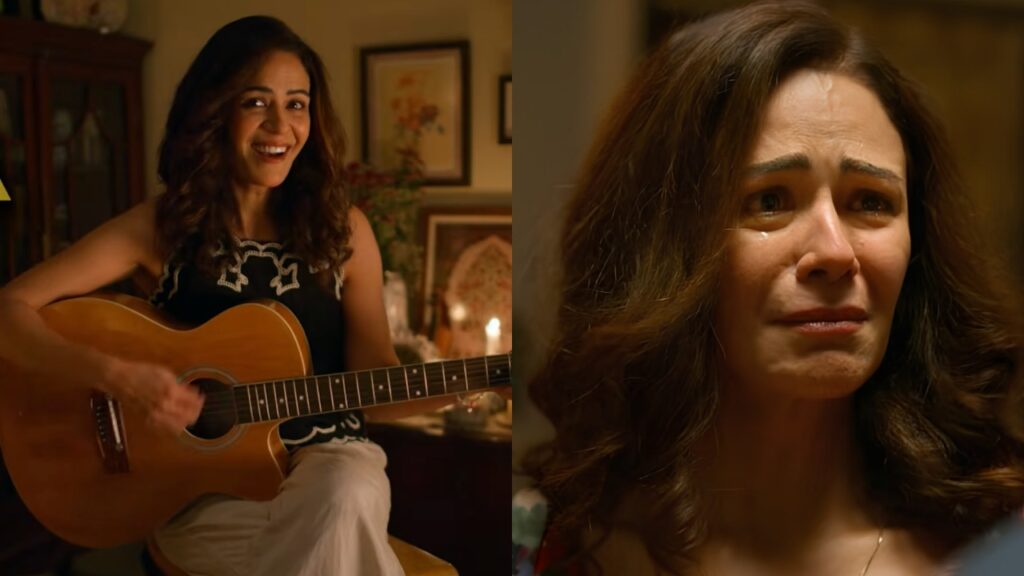
Saba Azad as the younger version of Raj Begum

In brief the storyline traces the life of Saba Azad’s Zeeba Akhtar, a young woman blessed with an extraordinary voice. How she breaks the rigid traditions with the help of supportive men forms the basic arc of the film.

A major strength of the film are the acting performances coupled with the music. Both Saba Azad and Soni Razdan playing Zeeba at different ages are a delight to watch. As a young Zeeba Saba brings the perfect mix of vulnerability and resilience. The journey of Zeeba in navigating the world of patriarchal mindset in spite of a support system is both well written and enacted. Saba conveys the determination and the persistence often times with the slightest expressions, specifically her eyes. A standout sequence involves Zeeba’s conversation with a man, “You are a male, you look for an opportunity to showcase your talent. We women seek excuses to pursue our hobbies.” Saba Azad’s background as a singer also comes in handy during the song portions.

Soni Razdan as the older Noor Begum is also wonderful with her moving portrayal. She becomes an emotional anchor often conveying a lot through silences. Zain Khan Durrani as the oxford educated poet is charm personified. The way he supports Zeeba in spite of the open hostility makes the viewers wish that the world has more men like him. Their love track has some adorable moments.

Sheeba Chadda playing an overbearing mother is also fantastic successfully making the viewers hate her. Shishir Sharma as Zeeba’s master also pitches in a good act. Taaruk Raina as a music student is fairly good too. What also adds to the performances is the perfect local dialect. The songs is another plus for the movie. The compositions of Abhay Sopori are deeply rooted in Kashmiri Folk giving a different flavor. The songs do a fine job in echoing Zeeba’s yearning for freedom.

A major problem with Songs of Paradise is the lack of sufficient dramatic tension. The socio and political turmoil in Kashmir needed to be explored more. The challenges faced by Zeeba specifically the societal backlash and the emotional toll have a rushed nature. There is a certain surface level approach sometimes distancing the viewers.

Final word: In spite of a certain surface level approach Songs of Paradise is a relevant tale of pursuing one’s hobby without giving into the society’s narrow minded thinking.