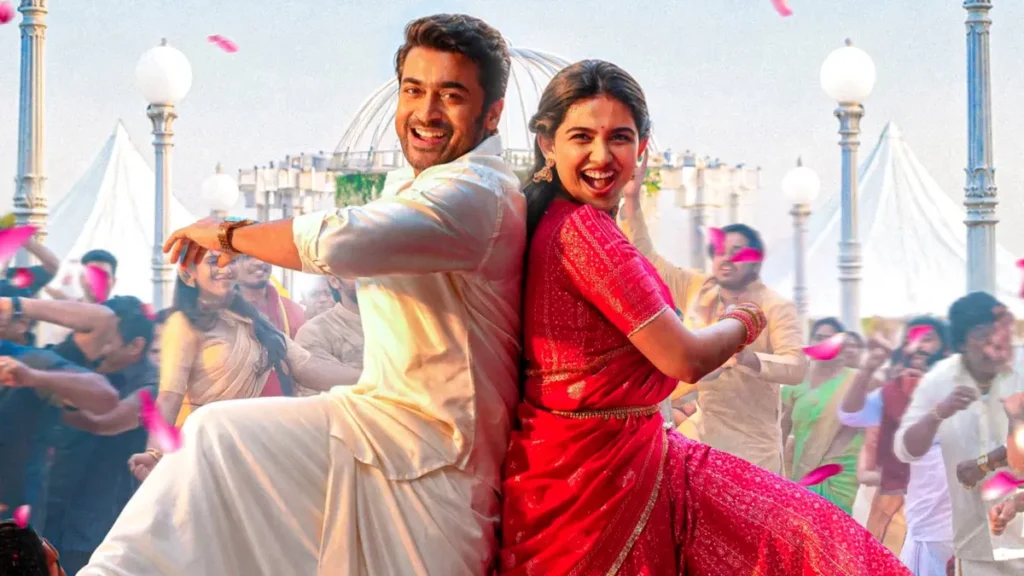
Chand Mera Dil: An intense tale of love and emotional reunion

The lovey Dovey moments are a mixed bag alternating between cute and cringe. But the film finds it feet once it explores the pressure of responsibilities and certain male ego. The best part of CMD is the character graph of Lakshya Lalwani’s Aarav. The repercussions of a violent moment and how he earns back Chandini’s love has been solidly written and enacted. Ananya Pandey as the titular Chandini continues to showcase her evolution with a strong act. The actress especially shines in the scenes of emotional fragility

Starcast: Lakshaya Lalwani, Ananya Pandey and others

Genre: Romance

Writer and director: Vivek Soni

Screenplay: Tushar Paranjape

Music: Sachin Jigar

Cinematography: Debojeet Ray

Producers: Karan Johar, Somen Mishra, Adar Poonawala etc

Production House: Dharma

The beginning portions of Vivek Soni’s Chand Mera Dil feel like a typical assemblage of campus romances. At one point the viewers are reminded of 2 states too mainly because of the engineering campus and a scene of Ananya Pandey’s Chandini entering a male hostel. There is also an undercurrent of Mani Ratnam’s Sakhi in the treatment of life post marriage. The movie feels like your average campus rom com until Chandini gets pregnant. The movie soon switches gears charting into some serious topics like the burden of responsibilities having an impact on relationships among others. The movie begins in US with Aarav finishing off his masters and Chandini congratulating him on a video call. But there is a layer of awkwardness underneath the short conversation, in the car Aarav reminiscences on how the two should have met now rather than the engineering college where everything started. In simple terms the story is about madness of youthful love and how the two become more responsible individuals winning in life as well as reconciling with a fresh start

A strong aspect of Chand Mera Dil is how it looks at the complexities of a marriage. Especially with two students who are trying to find their feet while managing multiple roles. Vivek Soni along with Tushar Paranjape get into a zone which most campus rom coms avoid and do a fine job with an unfiltered approach. The film gives an important message on how love alone isn’t enough to sustain a relationship. Perseverance and discipline is equally paramount to make sure that the relationship doesn’t crumble.

The confrontation scenes between Ananya and Lakshaya have a rawness with zero vanity. The two actors are particularly impressive in these dramatic moments. The characterization of Aarav also deserves a special mention. The man comes across as a chauvinist on a few occasions like the portion where he discourages Chandini from working. Similarly, a certain male ego is clearly visible in his sulking of Chandini getting a better job than him. Before the interval there is a moment where he snaps too showcasing his violent side.

But the film doesn’t justify Aarav’s loss of temper as hyper masculinity. Chandini leaves that night along with the daughter. She is very clear on self-respect being more important than love. Yes, Chandini hasn’t lost love for Aarav completely as she clearly says in a dialogue. At the same time for her a feeling of safety is more important. A subplot of Chandini’s broken family and how that plays a crucial role in her decisions adds emotional heft to the movie. The emotional fragility as well as a strong individuality has been superbly brought out by Ananya. Even the portion of Ananya being adamant on keeping the baby has been written and enacted with good psychological insight.

Coming back to Aarav the happy union feels earned rather than something obligatory. The redemption of the male protagonist has some touching scenes especially the ones with the on-screen daughter. Lakshaya Lalwani is successful in showcasing a different facet of him as an actor whether it’s the initial scenes of care or the darker areas.

As already mentioned in the beginning the lovey Dovey moments are a hit and miss. Aarav wearing the same color clothes as Chandini is interesting to begin with, soon though a tedium sets in with repetitiveness. Also, a 2 States inspired moment doesn’t quite land. It feels more like aping leaving little impact. But the scene of Aarav quitting smoking and his explanation makes for a lovely moment.

The supporting characters needed better fleshing too. The friends for example don’t have much personality. Also, Aarav’s strained equation with his parents needed better writing, having said Vidushi Kaul’s scenes as Aarav’s sister has been well written and enacted. Her honest opinion on Aarav’s actions without letting the sisterly feelings come in the way makes for a good watch. Some abrupt jump cuts also act as a turbulence. The transition of scenes is not always smooth.

Sachin Jigar’s music adds soul to the movie. The title track played on various occasions is excellent both in terms of composition and the colorful visuals. Shreya Ghoshal’s rendition of the title song deserves a special mention. Faheem Abdullah of Saiyaara handles the male voice and he does a competent job too though not on the same level as his last one. Other tunes like Aaitbaar and Khasiyat make for a soothing listen and watch too. Debojeet Ray’s cinematography consists of interesting frames mirroring the turbulent relationship.

Final word: Chand Mera Dil is worth watching for those who like complex love stories

Drishyam 3: An engaging slow burn on guilt and closure

Director and writer Jeetu Joseph takes a big risk with the characterization of Mohanlal’s George Kuttey. Unlike the first two instalments the man is less sure, and the vulnerabilities are layed bare. The emotional guilt of a burdened man gives Drishyam 3 some of its best moments. Mohanlal as expected embodies the weariness giving an immersive performance. Siddiqui as the other family man also makes his presence amply felt

Starcast: Mohanlal, Meena, Ansiba Hasan, Esther Anil, Siddiqui, Murali Gopy, Kalabhavan Shajohn, Asha Sarath and others

Genre: Crime thriller/drama

Writer and director: Jeetu Joseph

Music: Anil Joshon

Cinematography: Satheesh Kurup

Producer: Anthony Perumbuvoor

Production Company: Aashirvad Cinemas

Running time: 2 hours and 39 minutes

Drishyam 3 begins with a brief information on what happened in the first two parts. How George Kuttey’s peaceful life gets disrupted with the entry of a police officer son. A necessary crime which follows and George successfully dogging the law two consecutive times. The third part begins with George Kuttey settling down as a successful film producer. The dust seems to have finally settled down with Ansiba Hasan’s Anju recovering from psychological trauma. However underneath the happy family dynamics there is a certain fear on old skeletons surfacing again especially the central protagonist. How the past catches up with the return of Siddiqui’s Prabhakar with some additional foes forms the main core of Drishyam 3.

A strong aspect of Drishyam 3 are the lived in family dynamics. Like the first two installments Jeetu Joseph takes his own sweet time in setting up the proceedings. For some the slow pace may feel cumbersome, still this is necessary in the larger scheme of things. A special mention must be of how Esther Anil as the younger one has been used. Esther gets a significant amount of screen time more than holding her own opposite Mohanlal and Meena. Whether it’s mocking the mother on double standards or commenting on inter caste marriages the actress is a delight to watch.

Mention must also be made of Meena’s conversations with Mohanlal. The husband-and-wife warmth has come out in a solid manner. Two scenes in particular deserve a mention. One is Rani telling George Kutty on how he should let his guard down somewhat and let the daughter’s fly. Another one involves George Kutty getting emotionally disturbed when a past incident catches up. She tries to soothe him down by saying that he shouldn’t be too hard on himself.

As already mentioned Jeetu Joseph has taken a big risk with the characterization of Mohanlal. This both a plus and a minus depending on how the viewers take it. But the director deserves appreciation for making George Kutty more vulnerable. For a significant chunk of the movie Mohanlal is shown to be anxious particularly the interval block. There is an important conversation too where George Kutty lays bare his emotional state of mind. In this portion he explicitly talks about not knowing from where the attack will come. It is fantastic to see Mohanlal going all guns blazing at this age too. The veteran actor is in splendid form portraying the various emotions in a fantastic manner.

Siddqui as a Prabhakar gets a prominent part in the second half and he makes it count with an arresting act. Yes, it is baffling on how Prabhakar has forgotten the nature of his son’s crime. Having said that Siddqui is first rate in portraying a determined husband who wants to see his partner recover from depression. Asha Sharath has minimal screen time, nevertheless she gives a good account of herself.

Among others Murali Gopy and Kalabhavan are also solid in their respective characters. Murali Gopy plays the part with restraint and a certain wisdom. Whether its cautioning Prabhakar or the dialogue about legal system having more loopholes than solutions the actor makes his presence amply felt. Kalabhavan brings an intimidating physical presence as an old adversary waiting to get his revenge.

A couple of things which don’t work for Drishyam 3 are the subplots of social media and journalism. Both these start of promisingly but go nowhere in the final outcome. Also, the over exposition towards the end with repetitiveness hampers the proceedings. Because of this the culmination doesn’t give you the same high as the previous two installments.

Among the technical departments Satheesh Kurup’s cinematography is of fine standard. He effectively captures the tense moments and the overall emotional suffocation especially off George Kutty. The background score is also effective in building the tension.

Final word: Drishyam 3 is worth watching for those who like emotionally layered thrillers and of course Mohanlal’s fans

Aakhri Sawal: Emotionally volatile but another propaganda

The intense clash between Sanjay Dutt and Namashi Chakraborty has its high points especially the newsroom debate. The back-and-forth arguments have some good dramatic moments. The two male leads are in solid form, but the film eventually becomes a showreel for RSS being a misunderstood organization. For supporters of RSS and Sangh Parivar in general Aakhri Sawal will be a treat to watch.

Starcast: Sanjay Dutt, Namashi Chakraborty, Amit Sadh, Sameera Reddy, Mrinal Kulkarni etc

Genre: Drama

Director: Abhijeet Mohan Warang

Writer: Utkarsh Naithani

Cinematography: Stanley Mudda

Producers: Sanjay Dutt and Nikhil Nanda

Production Companies: Neem Tree Entertainment and Nikhil Nanda Motion Pictures

Running time: 1 hour and 57 minutes

There is a crucial moment in Aakhri Sawal’s second half when Namashi Chakraborty’s Vicky Hedge questions his guru Gopal Nandakarni (Sanjay Dutt in a refreshingly non negative role). It’s about the heated topic of Babri Masjid demolition. Gopal Nandakarni does make a confession on how the then RSS members did some mistakes and how he doesn’t support their actions. At the same Gopal Nandakarni says that RSS didn’t entirely demolish Babari Masjid. He further talks about the encroached land on which the mosque was being built. There is a long-winded explanation giving an insight into the events leading up to that day. After Gopal Nandakarni finishes his talk Vicky hedge says are you justifying their actions with this big speech. This moment amply sums up Abhijeet Mohan Warang’s Aakhri Sawal. The movie wants to explore high intense topics; at the same time, it also wants to play safe. This two-way process eventually makes it just another propaganda rather than an insightful socio-political drama.

The story of Aakhri Sawal begins with the brutal massacre of an RSS worker in Kerala. From here the plot flash forwards to a confrontation between a student and a professor. The student played by an intense Namashi Chakraborty is very upset on his professor rejecting the PHD thesis. The thesis is about RSS controversial history. Sanjay Dutt’s Gopal Nandakarni rejects Vicky’s thesis as he feels it is factually incorrect with a one-sided approach. Things heat up with Gopal Nandakarni slapping his student in a fit of anger. The confrontation and the slap is recorded live by the fellow students. What starts off as a campus debate snowballs into something much bigger. Eventually it becomes a newsroom debate with the student taking on his teacher. Amit Sadh as Aditya Rao is a former student of Gopal Nanakarni and now a journalist. He becomes the moderator for the intense discussion.

A strong aspect of Aakhri Sawal are the impactful performances of the two leads. As already mentioned it’s refreshing to see Sanjay Dutt in a non negative role. The actor does an extremely fine job in capturing the strong fighting of Gopal as well as a certain anguish on how his student has become an opponent. Sanjay Dutt particularly shines in the vulnerable moments with Namashi. Namashi Chakraborty on the other hand also springs a surprise more than holding his own opposite Sanjay Dutt. The final twist with the character does reduce the impact somewhat, having said Namashi is excellent in portraying Vicky’s determination. The confidence with which Namashi takes on Sanjay Dutt gives Aakhri Sawal some of its best moments. The cockiness mixed with a little sarcasm is a delight to watch.

Mention must also be made of how the film doesn’t entirely sidestep RSS controversial history. Whether it’s the death of Mahatma Gandhi shot by a former RSS member Godse, the leaders of RSS writing letters of despair to Indira Gandhi from the jail and of course the Babri Masjid chapter. All these have been explored fairly well with Sanjay Dutt’s role representing RSS Point of view. Yes, the explanations end up in the favor of Sangh Parivar, having said that Abhijeet Mohan Warang and Utkarsh Naithani do deserve credit for not shying away from these burning topics.

The movie also does a fair job in discussing the hypocrisy of media. This particularly comes out in a conversation between Amit Sadh and a colleague played by Neetu Chandra. This is before Gopal Nandakarni is invited for the television debate. Aditya Rao questions the hypocrisy of his colleague by saying you had previously not allowed Nandakarni to come on the show because of his political leanings to RSS, but now you want the same man on your show debating. Amit Sadh delivers a restrained but impactful act; he particularly stands out in the portion of egging his former professor to present his point of view. In the same portion he talks about their different thought processes. Amit Sadh makes a solid impact in these scenes.

A major issue with Aakhri Sawal is the treatment of Sameera Reddy representing the left ideology. The character begins off promisingly but eventually ends being a caricature. In fact the roles written for the non-Sangh Parivar leave something to be desired. More than the eventual propaganda this becomes a major issue.

The film also suffers from thinly written women characters. Sameera Reddy who could have been a formidable opposition is reduced to a rather vampish figure. Similarly, Tridha Choudhary as Vicky’s girlfriend mostly stays on the fridges. Other than being worried for Vicky she has little to do. Mrinal Kulkarni as Nandakarni’s wife is the only female who makes some impact in spite of the role not offering much.

Technically there isn’t much there to praise. The background score as well as the songs function as speed breakers particularly the former with its melodramatic pitch.

Kartavya: Familiar but an important crime thriller/drama

Kartavya written and directed by Pulkit does fall into a tangle with its multiple themes. There is a rushed treatment to the proceedings, nevertheless Kartavya does make for a gripping watch especially the dilemmas faced by Saif Ali Khan’s SHO Pawan Malik. The references to Abhimanyu and Arjuna from Mahabharata does add an interesting dimension.

Starcast: Saif Ali Khan, Sanjay Mishra, Zakir Hussain, Rasika Duggal, Manish Chaudhari, Saurabh Dwivedi etc

Genre: Thriller/drama

Writer and director: Pulkit

Cinematographer: Anil Mehta

Producer: Gauri Khan

Production Company: Red Chillies Entertainment

Running time: 2 hours and 27 minutes

Streaming site: Netflix

The story of Kartavyaa begins on the 40th birthday of Saif Ali Khan’s Pawan Malik. It starts off as a moment of fun camaraderie, a celebration among fellow police men. But soon things take a dramatic turn with the journalist being shot under the vigil of Pawan. This leads to several developments the details of which cannot be revealed here. The movie juggles between the different pressures faced by both Pawan both professionally and personally. Some of the themes explored are caste, abuse of law, the regressive notions of khap panchayat among others

A strong aspect of Kartavyaa are the mythological references. There are numerous dialogues where Pawan compares his situations to Abhimanyu in the Chakravyuh. Later on, there is a parallel to Arjuna’s dilemma’s well. This particularly comes out in connection to the regressive father played by a terrific Zakir Hussain. Harihar is a deeply entranced casteist with fixed notions of so-called societal boundaries. Pawan’s simmering anger and the confrontation scenes with Harihar gives the movie some of its best moments.

The significant role of Khap panchayat’s ideology serving as self-appointed moral custodians has also come out in a disturbing manner. Yes the topic of honor killings has been addressed numerous times in movies but that doesn’t take away its significance in any way. The scenes have a realistic feel sending a chill down the viewers spine.

Rasika Duggal as the homemaker trying to keep things together has a lovely presence. Her scenes with Saif come across as a much-needed breather amidst the tense scenarios. A particular mention must be of the portion where she jokes about Pawan’s smoking while in tension. Some of the other lighter moments include in house references to Shah Rukh Khan as well as Pawan comparing his dad to late Amrish Puri.

Sanjay Mishra as the weary constable is another big asset of the movie. The scenes of on screen friendship between him and Saif has some nice touches. However, an important twist related to his character can be seen from miles.

The corrupt godman and child abuse angle comes with Saurabh Diwidi and Yudhvir Ahlawat. Yudhvir in particular is very effective in the breakdown scenes with Saif. However, Saif Ali Khan is the major glue holding Kartavya together. Saif brings a simmering anger to Pawan, a certain exhaustion both professionally and personally but still a strong fighting spirit has been excellently portrayed by the actor.

As already mentioned Kartavyya does stretch itself a little too far with the themes it wants to explore. As the result there is a sense of incompleteness. A web series along the lines of Sacred Games or Paatal lok would have been a better option.

Also, Kartavyya suffers from a somewhat glossy look. There is a polished feel to the cinematography of Anil Mehta making it a bit distracting.

Final word: Kartavya is worth watching for those who like slow burn thrillers and if you are an admirer of Saif Ali Khan.

The Story of My Assassins: A gripping socio-political thriller about those living on margins

The best part of Tarun Tejpal’s work is the contemporariness of the issues addressed. As a nation we have come a long way still there is much more to do for an equal society. This has come out wonderfully through the stories of the five individuals. The first season of Pataal Lok based on this novel has a few similarities, at the same time it differs too as the web show is from the perspective of Jaideep Ahwalat’s Hathiram

The two seasons of Paatal Lok are easily among the best web shows produced in Indian film industry. The different social themes through an investigative thriller/drama is thoroughly engaging to watch. For those not aware the first season of Paatal Lok was inspired from Tarun Tejpal’s The Story of My Assassins. The novel in brief is about the police stumbling upon five hitmen, they have been hired to assassinate a journalist. This lands as a bombshell forcing the protagonist to reexamine his life. From here the novel shuttles between India’s elite and the hinterland.

An aspect which particularly stands out is how Tarun Tejpal has explored different themes through the five hitmen. Each of them come with a history of generational trauma, persistent abuse and extreme destitution. The readers are forced to confront their own ideas of morality.

The contrast between the protected urban elite and how brutal circumstances creates perpetrators has come out excellently. The theme of institutional failure especially the role of media in today’s society has a lived-in feel. This is majorly thanks to Tarun Tejpal’s vast experience. The soul searching which the protagonist goes through gives the novel some of its best chapters.

The city of Delhi with all its shades has also been well documented. The readers feel that they are travelling with the happenings creating an immersive experience. The different idiosyncrasies has also come out well leading to moments of dry humor.

Among the five hitmen Hathoda Tyagi is definitely the most impactful much like the first season of Paatal lok. There is a quite restraint in the way the man operates. The piercing gaze does more than half of the work. Following is a brilliant paragraph describing Hathoda Tyagi’s character.

The astrologer, his grey hair thick over his ears but gone from the top of his head, said “Oh, don’t start getting worked up. it’s just that, because of his work and strength, he will have powerful foes. You do know mataji that only powerful men have powerful enemies! but it will not be easy to harm him. His stars are like Hiranyakashyap’s. He can only be harmed in a place that has both sunlight and shade; he can only be harmed when he is moving and not still; he can only be harmed when his belly is full; he can only be harmed when he is hidden from view; he can only be harmed by a slain enemy; and he can only be harmed when he is trapped between friends. For all those to come together is a near impossibility. So, you must not worry. Remember, to kill the evil Hiranyakashyap, Lord Vishnu had to appear himself and bend the elements. And as you know gods don’t descend into this country any more.’

Though gripping for a major part The Story of My Assassins has its issues as well. One of them is the women who are mostly presented as an object of violence. They are repeated chapters of them being assaulted. Also, the cop character Hathiram doesn’t have the same impact as the web series.

Keeping aside the deficiencies the novel is an important read especially for those into social thrillers.

Pati Patni Aur Woh Do: A madcap comedy with a misleading title

The one liners coupled with a committed cast especially Ayushmann Khurrana and the stunning Wamiqa Gabbi keep the movie afloat. An interesting aspect of PPAWD is the angle of casteism. Actor and filmmaker Tigmanshu Dhulia plays a regressive politician with certain notions of so-called social boundaries. His role sets the base for the ensuing chaos spilling out of hand.

Starcast: Ayushmann Khurrana, Wamiqa Gabbi, Rakul Preet Singh, Sara Ali Khan, Tigmanshu Dhulia, Ayesha Raza, Vijay Raaz and others

Genre: Comedy

Direction, writing and screenplay: Mudassar Aziz

Additional screenplay: Ravi Kumar

Music: Rochak Kohli, Taniskh Bagchi etc

Cinematography: Jishnu Bhattachatterjee

Producers: Krishan Kumar, Ravi Chopra etc

Production Companies: T- Series Films and BR studios

Running time: 2 hours and 2 minutes

Before dissecting PPAWD it’s necessary to get an important matter out of the way. The film is not about Ayushmann Khurrana’s Prajapati Pandey having an extra marital affair behind the wife’s back. Mudazar Azis steers clear of that angle even though the scenarios are tailor made for a film like Masti franchise. Prajapati Pandey is a green flag husband and a solid friend. In the process of helping Sara Ali Khan’s Chanchal Prajapati’s life turns upside down. The root cause of the chaos is Tigmanshu Dhulia’s Gajraj Tiwari. Gajraj has strict boundaries of what he thinks is acceptable, Chanchal and Gajraj’s son Sunny are in deep love, however things take a dramatic turn thanks to a leaked photo of Sunny with a burqa clad woman. Of course, the one under the burqa is Chanchal and this pic reaches Gajraj. This photo is clicked by no other than Prajapati’s wife Aparna (Wamiqa Gabbi looking absolutely stunning as well as delivering a solid act). Aparna is a journalist with an ambition of opening her own news channel. What follows is a major comedy of chaos with a pile of misunderstandings and a frantic climax.

A strong aspect of PPAWD are the tricky scenarios in which our protagonist finds himself in. There is a scene in the cafe where Prajapati decides to act like Chanchal’s boyfriend to keep her safe from Gajraj and his men. He promises to help Chanchal until her boyfriend makes arrangements for the two to get away. Initially Prajapati plans to take Aparna too in confidence however a crucial revelation lands our protagonist in a messy situation. Still Prajapati goes ahead as Chanchal’s life is in danger. There are portions of Chanchal play acting like a girlfriend and Prajapati feeling hapless but playing along. This leads to numerous entertaining moments.

What elevates these screwball situations is Ayushmann Khurrana’s performance. Ayushmann’s facial expressions itself generate humor. The actor is in solid form playing to the gallery in an uninhibited manner. Apart from the comic situations Ayushmann also does a fine job in the vulnerable moments. An example of the vulnerable portion is Prajapati feeling anxious on hurting Aparna. The scenes of the protagonist’s frustration with his married life spilling out of control has been excellently portrayed by the actor.

A mention must also be made of the caste subplot. Yes, it doesn’t go too deep but the threat of Gajraj Tiwari can be definitely felt especially in an early scene of Chanchal describing her prospective father-in-law. There is an explicit emphasis from Chanchal on her coming from a lower caste and how this a major hurdle. This lifts PPAWD beyond the comedy of errors. There is also a monologue on rumors being perceived as truth when repeated often

Mudassar Aziz also deserves credit for the strong woman characters he has written. Wamiqa Gabbi’s Aparna has the least comical role among the three, but the actress brings in an emotional depth. Whether it’s her journalistic ambitions or the hurt of her husband supposed cheating Wamiqa is very good besides looking breadth takingly beautiful. Rakul Preet Singh plays Aparna and Prajapati’s best friend Nilofer Khan. Rakul is suitably feisty especially in the scene where she warns Prajapati on not hurting her best friend. Her scenes with Ayushmann especially in the one where she mocks him have nice comic touches. The two share a good camaraderie, lastly Sara Ali Khan as Chanchal does a fine job too in bringing out the character’s desperation.

The supporting cast led by Tigmanshu Dhulia and Ayesha Razia also lift the movie. Tigmanshu Dhulia plays the casteist politician with the right amount of authority, Ayesha Raza on the other hand is absolutely hilarious as Chanchal’s Buaji. The way she speaks with the speed of a Rajdhani express with a poker face leads to some chuckles. Vijay Raaz as a corrupt policeman is also competent with his dead pan humor.

Coming to the flaws Pati Patni Aur Woh do does suffer from scenes of excess. The second half in particular feels stretched in spite of the crisp running time. The pile of misunderstandings goes out of control. Also, a dream song featuring Ayushmann and Rakul doesn’t add much value to the proceedings. The songs in itself are a mixed bag with Roop Di Rani being the best of the lot. There is also a rather unnecessary character of an effeminate office boy speaking in a highly theatrical zone.

Final word: Pati Patni Aur Woh Do makes for an engaging screwball comedy especially if you are in the mood for some lighthearted fun.

Godari Gattupaina: A social rom com with the message of inclusivity

The story of Subhash Chandra is as old as hills. Different variations of the plot has already been explored umpteen times. Having said that the setting of Godari with a particular slang makes for a nice viewing. The characterization of Sumanth Prabhas as an honest auto driver without the mass elevations deserves appreciation. A mention must also be made of Jagapathi Babu as the conflicted father.

Starcast: Sumanth Prabhas, Nidhi Pradeep, Jagapathi Babu, Sudharshan, Rajkumar Kasi Reddy, Rajeev Kanakala and others

Genre: Romance

Director and writer: Subhash Chandra

Cinematography: Saai Santhosh

Music: Naga Vamshi

Producer: Abhinav Rao

Production Company: Red Puppet Productions

Running time: 2 hours and 28 minutes

The love story genre is one of the most overused ones across industries. From lighthearted to intense numerous directors have explored love in different ways. All conflict points whether its parental opposition, caste and religion based, internal issues or age gap like in the case of Sai Marthand’s Little Hearts have already been explored. Having said that a lighthearted rom com is always a welcome especially in today’s age of overblown pan India cinema. Godari Gattupaina perfectly fits the category of the above mentioned one. For the most part the tone is breezy aided by the scenic atmospherics. At the same time the movie also touches upon a few societal aspects without getting too preachy.

The story of GGP in simple terms focuses on an auto driver Raju (Sumanth Prabhas) and an engineering student Maya (Nidhi Pradeep). Jagapathi Babu is Sam Babu. Sam is a security guard wanting to give a good life to his daughter. He wants a groom who comes from a better social status. Things take a dramatic turn with Raju falling in love with Maya and the latter reciprocating. The incident of her falling for him is quite problematic, but coming back to the plot Maya’s choice of love creates tension for Sam. How Raju and Maya eventually have a happy ending forms the core essence of GTP.

A strong aspect of GGP is the chosen rural background. The village atmosphere with a particular slang is entertaining to watch. Cinematographer Saai Santhosh does a fine job in capturing the scenic atmospherics through his lens making the film a visual delight. A specific mention must be made of a night sequence post Maya’s dance performance. The scene of the leads having an intimate moment with the twinkling stars is nice to watch. The dramatic moment following that sets a solid base for the second half.

As already mentioned the film comes with the message of social inclusivity. This point has been seamlessly integrated rather than a series of dramatic dialogues. The friendship scenes with Sudharshan playing a Muslim and Rajkumar Kasi Reddy a Christian are solid examples of the inclusivity theme. There is an important passage when Maya is confused on how to go about things. She confesses her inner dilemmas to Raju’s mother. The mother says that belonging to a different religion shouldn’t be a barrier talking about how she is a Muslim while Raju’s dad is a Hindu. She further elaborates on how they have coexisted with neither imposing their individual relief beliefs on each other.

Of course, Sam Babu’s objection regarding Raju isn’t about religion, having said that the conversation between Maya and Raju’s mother has good social undertones. There is another poignant moment when Raju says the following ‘Manchi neeru…uppu neeru… rendu veru veru swabhavalu vunnavi aina… Godavari Sangamam lo entha baga kalisipoyayo kada… alane bhinna swabhavalu vunna manushulu kuda kalisi jivisthw entha baguntundo kada,’

Subhash Chandra also deserves appreciation for his crafting of Jagapathi Babu’s character. Sam Babu is a conflicted dad who alternates between fatherly love mixed with fear. His conversation with Sumanth Prabhas post the daughter’s revelation has been written with nuance. Sam is not a caste or religious bigot; his worry isn’t about what the society will think. Its more about giving his daughter a better social status than the one she has been born into. At no point Sam comes across as a caricatured villain. The dual shades is superbly reflected in the following dialogue ‘ ‘Na kuthuruki jeevithantham morha premani matrame chupinchali anukunna… ne valla naa kopam chupinchela cheyaddu’

Jagapathi Babu does an extremely fine job in showcasing the myriad emotions. His scene with the ever-reliable Rajeev Kankala with Sam’s acceptance of Raju is both well written and enacted. Sumanth Prabhas as Raju acts with good ease. Whether it’s the dialect or the different emotions of heartbreak and love the young actor is very good. Nidhi Pradeep also holds her own with a confident act. Yes, the particular incident in which she falls for Raju is rather problematic, also there are times where the character suffers from a few tonal inconstancies. Having said that Nidhi does an extremely fine job.

Among the friends Sudharshan and Rajkumar Kasi Reddy give good support. The camaraderie has come across well. The music of Naga Vamshi barring one number in mid second half makes for a good listen and watch. Among the tunes Choodu Choodu and Nenu Na Palleturu impress the most.

Coming to the flaws the character of Laila playing Nidhi’s on-screen mother doesn’t add anything substantial. Yes, she does get one important dialogue towards the end indirectly supporting her daughter’s choice, but beyond that she is there more for filing the frame. Also, some of the developments in the second half like Raju going through a false accusation of sexual assault or the scene where the hero puts a deliberate act of insulting Sam only stretches the inevitable ending.

Final word: Godari Gattupaina makes for a perfect viewing for fans of breezy romantic movies. The societal undertones add more flavor elevating the proceedings.

Patriot: A refreshingly different kind of espionage dealing with a contemporary social issue

Patriot written and directed by Mahesh Narayanan is a good example of how to use star power while narrating an important story. Patriot has a dystopian feel especially the works of George Orwell. By nature, the film has a fair amount of technical jargon. Also, it’s not an out an out-star vehicle. But Mahesh Narayan deserves absolute credit for bringing up the importance of questioning the government policies rather than blind patriotism

Starcast: Mammootty, Fahad Fasil, Kunchako Boban, Mohanlal, Revathy, Nayanathara and others

Genre: Action thriller/drama

Director and writer: Mahesh Narayanan

Music: Sushin Shyam

Cinematography: Manush Nandan

Producers: Antono Joseph and KG Anil Kumar

Production Companies: Anto Joseph Film companies, Blue Tigers London etc.

Running time: 3 hours

Ever since its release on May 1 Patriot has seen a diverse range of opinions especially the central subject of surveillance. The different tangents within the main storyline hasn’t worked for everyone. But Patriot is definitely a big screen watch both for the scale and the contemporariness of the issue it handles.

Without giving much away Patriot follows the journey of Dr Daniel James (Mammootty in great form as always). He exposes a mass surveillance conspiracy leading to an exile from India. He flees to London running a popular YouTube channel Vimathan. Through the YouTube channel he continues to question the government policies. However, a situation comes when Daniel gets out of exile leading to multiple developments. Mohanlal in an extended cameo is colonel Rahim Naik. Rahim is Daniel’s best friend. Other important cast members include Fahad Fassil as an ex-army officer and the owner of Shakti corporation, there is also Kunchako Boban in multi shaded role. He starts off as Fahid Fassil’s colleague/partner in crime and then turns into an important subordinate/helper for Daniel James and Rahim Naik.

A strong aspect of Patriot is the central subject of a spy software called Periscope. This reminds us of the current developments with a strong resemblance to Pegasus. This is further enhanced by scenes in the movie talking about the misuse of an individual’s private data. Mass surveillance as a topic isn’t particularly new but what makes the difference is the dystopian touch given by writer and director Mahesh Narayanan. There is a line in the movie with Mammootty talking about the human farm concept. A comparison is drawn with George Orwell’s works to explore a world controlled by algorisms and a certain lack of data autonomy.

The movie also questions citizens attitude in supporting government’s method of surveillance, the character of Mammooty has been excellently used as a voice of dissent raising relevant questions.

What also works for Patriot is the layered plot underneath the topic of mass surveillance. The character dynamics with the past histories also makes the film engaging. A specific mention must be made of a crucial pre climax reveal, it gives a psychological insight into the character of Fahad Fassil.
Mention must also be made of how the women characters have been integrated. Yes, the likes of Revathy, Nayanathara and Darshana have minimal screen time but their integration at different points deserves praise. More importantly they come across as strong women for example Revathy in the first half as the chief minister. An early exchange between her and a politician is a solid example of understated authority, there is no significant raise in the voice, but the formidable nature is palpable. Revathy scenes with Mammooty are very limited but it’s a treat to watch the two veterans together.

Nayanathara appears from mid second half as Daniel’s ex-wife Lathika. Much like Daniel she is also fighting a battle against Fahad Fassil’s Shakti Sundaram. The daredevil nature of the role has come out wonderfully both in the writing as well as acting.

Coming to the reunion of two legends Mammooty and Mohanlal, the timing of the latter’s entry makes for a fantastic scene. This is further added by Fahad Fassil’s dialogue mirroring the legendary status of the veterans. The friendship scenes between Daniel and Rahim has come out in an organic manner with some wonderful punch dialogues. Especially those delivered by Mohanlal. Mohanlal also gets a solid action block in a hospital setting. Its a treat to watch the legendary actor kick some ass even at this age.

Kunchako Boban as already mentioned has a multi shaded role. His relationship dynamics with the effervescent Darshana and how a certain incident leads to shift in equation with Shakti is solidly written and enacted.

Fahad Fassil as the manic villain with daddy issues is deliberately hammy but it works in the context of the movie. Mammooty has the most screen time in Patriot and the actor chews the scenery in his usual style. The fighting spirit of Daniel has been excellently brought out by him.

On the technical front the large scale has been well captured through the lens of Manush Nandan. A specific mention must be made of an intense chase scene amidst Daniel needing urgent treatment. An action sequence in a moving private jet also deserves praise. Sushin Shyam’s music is nicely understated jelling perfectly with the movie’s tonality.

Devil Wears Prada 2: An entertaining take on Journalism’s changing trends

David Frankel does a fine job in exploring the different threads like economic pressures, artistic creativity versus Ai. The treatment may across as hurried given the multiple tangents nevertheless the movie is successful in capturing the current digital spectrum. The movie also raises ample chuckles especially for the ones attuned to journalistic trends. Both Meryl Streep and Annie Hathway successfully take off from the previous installment playing their parts with panache

Starcast: Meryl Streep, Anne Hathway, Emily Blunt, Stanley Tucci etc

Genre: Comedy/drama

Director: David Frankel

Writer: Alline Brosh Mc Kenna

Producer: Wendy Finerman

Production Company: Wendy Finerman production

Running time: 1 hour and 59 minutes

For those who haven’t seen Devil Wears Prada 1 the plot followed the journey of an aspiring journalist Andy Sachs (Anne Hathway). Andy takes up the job of a junior assistant to the hardened taskmaster Miranda priestly (Meryl Streep). Miranda is the chief of runway fashion magazine. Andy has a tough time in adjusting to the professional demands but soon she gets a makeover. Andy becomes successful in career, but it comes with a certain cost in the personal space. The ethical compromises eventually become too much leading Andy to quit. She not only reconciles with the friends but also secures a job in another newspaper. Some of the major themes in Devil Wears Prada 1 are the transformation of identity under an extreme workplace pressure, the conflict of personal values while dealing with professional demands among other things. Now you have part 2 after a huge gap of 20 years. Devil Wears Prada 2 is just as glossy and at the same time more relevant than part one

The second part primarily focuses on Andy Sach’s return back to Runway in a very different position. Andy is given the role of a features editor cum writer. Her major task is restoring Runway’s credibility after a politically incorrect article. Miranda on the other hand is struggling to get a hang of modern digital media and is forced to embrace the culture of online clickbait. Adding to this mix is Emilly Charton (played by Emily Blunt). Emily Charton was Miranda’s former assistant and is now a senior executive of Dior. The dynamics between Miranda and Charton are laced with undertones of tension and a mutual ambition.

A strong aspect of Devil Wears Prada 2 is how both the director and writer have captured the evolution of journalism in the current digital landscape. This is reflected in numerous portions whether its stories shaped by sponsorships or the data indicators playing a major part in editorial decisions. All this feels very relevant especially in today’s clickbait era. The movie also explores Ai and its algorisms both as a threat and necessary adaption to the modern landscape of journalism. A lot of this is conveyed through some sharp humor making the topic an entertaining ride rather than a lecture mode.

Devil Wears Prada 2 also benefits from the dynamics between Meryl Streep and Anne Hathway. Initially Miranda looks at Andy as a more of a chairman’s latest whim who wouldn’t last for long. A certain tone of indifference to Andy’s presence is perfectly reflective of this. Having said that a time comes when the two have to navigate the tricky scenarios together in order to save Runway magazine.

A subtle sisterhood forms between the two. This particularly comes out in the pre climax scene, both Miranda and Andy discuss about how work gives them a sense of purpose. The vulnerable areas of Miranda have also come out well. For example, there is a portion where Miranda worries about her time of a journalist and an editorial head coming to an end. The scene is brilliantly written and also of course wonderfully enacted too by Meryl Streep.

Mention must also be made of how Anne Hathway’s character has evolved. Anne Hathway plays the self-assured journalist with a quiet conviction. The fighting spirit of Andy even things stagnate comes out in a solid manner through the writing as well as Anne Hathway’s performance. Stanley Tucci as Andy’s mentor figure lends in a lot of warmth making the viewers wish that they too had a person like him.

Among the rest Emily Blunt also makes her presence amply felt in a different characterization. The rivalry of Emily Charlton and Miranda has the right bite thoroughly engaging the viewers.

Final word: Devil Wears Prada 2 is an engaging watch for fans of the lead actresses as well as those who are fascinated with the world of modern journalism.

Kara: Familiar tropes but a well staged cat and mouse game

Vignesh Raja’s Kara is two films rolled into one. One a social thriller tackling the issue of financial exploitation and rural debts. The impact of Gulf war set in 1991 forms an important subplot. At the same time the films feature a father and son emotional thread. The latter is melodramatic, but the first one engages the viewers more so in the post interval portions. The grey areas of both Dhanush and Suraj Venjaramoodu is well written and enacted.

Starcast: Dhanush, Suraj Venjaramoodu, Jayaram, Mamita Buiji, K S Ravikumar and others

Genre: Crime/drama

Director and writer: Vignesh Raja

Additional writer: Alfred Prakash

Music: G V Prakash

Cinematography: Theni Eshwar

Producer: Ishari K Ganesh

Production Companies: Vels Film international and Think Studios

Running time: 2 hours and 41 minutes

The proceedings in Vignesh Raja’s Kara has a certain contemporariness though the plot is set in the 90’s. The current fuel crisis because of a global war is a well-known thing. Kara’s timeline features an important subplot along the lines of current war. Here the focus is on the bank exploiting the vulnerable farmers. The movie begins with Dhanush’s Kaarsami along with an associate robbing a house. For Kaarasami it’s his supposed last theft but things go awry after a successful robbery. The protagonist though manages to get away from police clutches. Flash forward he is now a family man with Mamitha Buiji playing the wife Selli. Without revealing much a situation comes when Kaarasami is in desperate need of money for setting up his own food mess. However, that’s easier said than done. Nothing more can be revealed given the different layers

A strong aspect of Kara are the thriller portions. Midway through the first half a scenario comes when Kaarasami also called Kara has to rob a bank going back to his former self. Kaarasami makes two attempts with his associates. One of them is Karunas as an elderly figure. The first attempt turns out to be a disaster though they don’t get caught. The second time around Dhanush and co decide to rob in morning at a particular time. These sequences have a super combination of thrills coupled with humor. There is a scene of Dhanush pretending to be a bank employee and Karunas doing the pretension of filling a form. This is wonderfully written and enacted.

The second half turns into a cat and mouse with the reentry of Suraj Venjaramoodu’s DSP Bharatan. He has a past connected with Kara. Bharatan much like the protagonist comes with his own grey areas. The biggest motivation for Bharatan to catch the thief is having his name splashed in the newspaper. Early on in the movie there is a scene of Bharatan trying to attach his name to an already open and shut case. However, he doesn’t succeed with Kara escaping. Suraj Venjaramoodu’s act of a determined cop and his portions with the sinister bank head (a wonderful Jayaram) gives the movie its best moments.

Dhanush as Kaarasami is expectedly solid. Kaarasami is a layered character coming across as not so likeable in some portions. Dhanush particularly shines in the emotionally vulnerable moments like a heartfelt scene with Mamita Buiji. The subplot of gulf war and its impact on the downtrodden is a character in itself. It gives Kara a contemporary feel moving the viewers emotionally.

A major roadblock of Kara is the underdeveloped love story between Dhanush and Mamita. Mamita as Selli gets a couple of intense moments and the young actress does hold her own. But the writing needed to be much better. Also, the portions featuring KS Ravikumar as Dhanush’s father could have done with less melodrama. The background score does more heavy lifting here than the writing. Finally, Dhanush’s justification of multiple robberies may not work for all.

Technically speaking Theni Eshwar does a fine job in capturing the rural atmospherics through his lens. The production design is on point too; the action sequences have also been well designed. GV Prakash Kumar’s music has its moments. The song Kanamma has a melodious feel making for a soothing listen and watch. The background score on the other amplifies the tense moments successfully.

Final word: Kara is worth watching for the cat and mouse game as well as the social themes it addresses. But tighter writing would have made it a more wholesome experience.