Thamma: Rashmika Mandanna steals the show in this gender bender

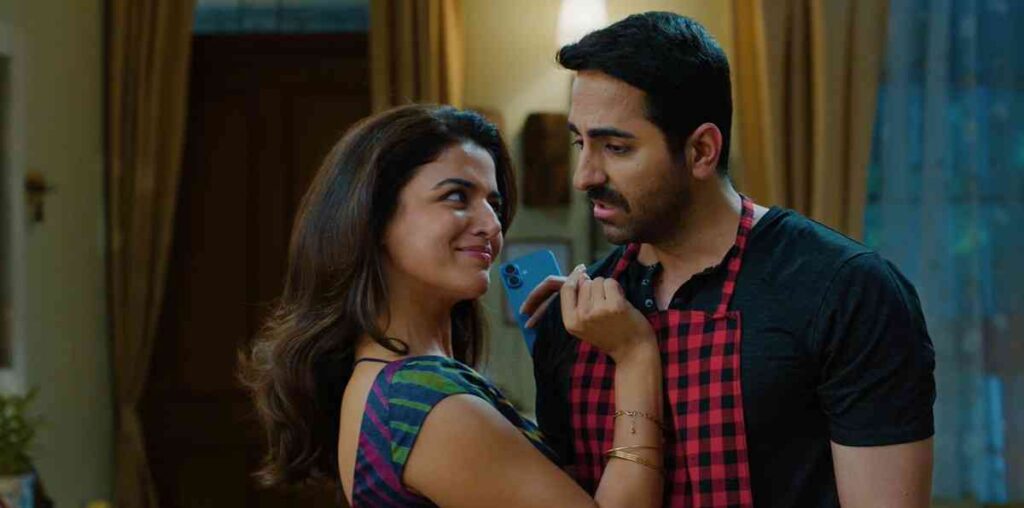
Director Aditya Sarpotdar for most part reverses the knight in shining armor trope with Rashmika’s character of Taraka/Tarika. The role has the perfect mix of vulnerability and fierceness in equal measure. Thamma is a welcome change from the usual Maddock horror comedy even though the concoction of scares and laughs doesn’t hit the high notes of the Stree movies. Ayushmann Khurrana also brings his usual finesse especially in the second half when his character is caught between two worlds

Starcast: Rashmika Mandanna, Ayushmann Khurrana, Paresh Rawal, Nawazuddin Siddiqui, Faisal Malik and others

Director: Aditya Sarpotdar

Writers: Niren Bhatt, Suresh Mathew and Arun Fulara

Producers: Dinesh Vijan and Aamir Kaushik

Production Company: Maddock Films

Cinematography: Saurabh Goswami

Music: Sachin Jigar

Running time: 2 hours and 29 minutes

Genre: Romance/horror

The horror comedy universe for Maddock has been its most successful business venture. The two Stree films along with Munjya have done fantastic numbers at the box office. Even Bhediya did fair business at the box office. This universe is expanding further with newer actors and fresh storylines. Thamma is the latest addition with crossovers from the movies mentioned above. Thamma varies from the previous films of this space as the beating heart is the love story between two people belonging to vastly different worlds. At the same time there is also a set formula in its treatment of horror with laugh out moments. This two way approach doesn’t always work nevertheless Thamma makes for an interesting watch.

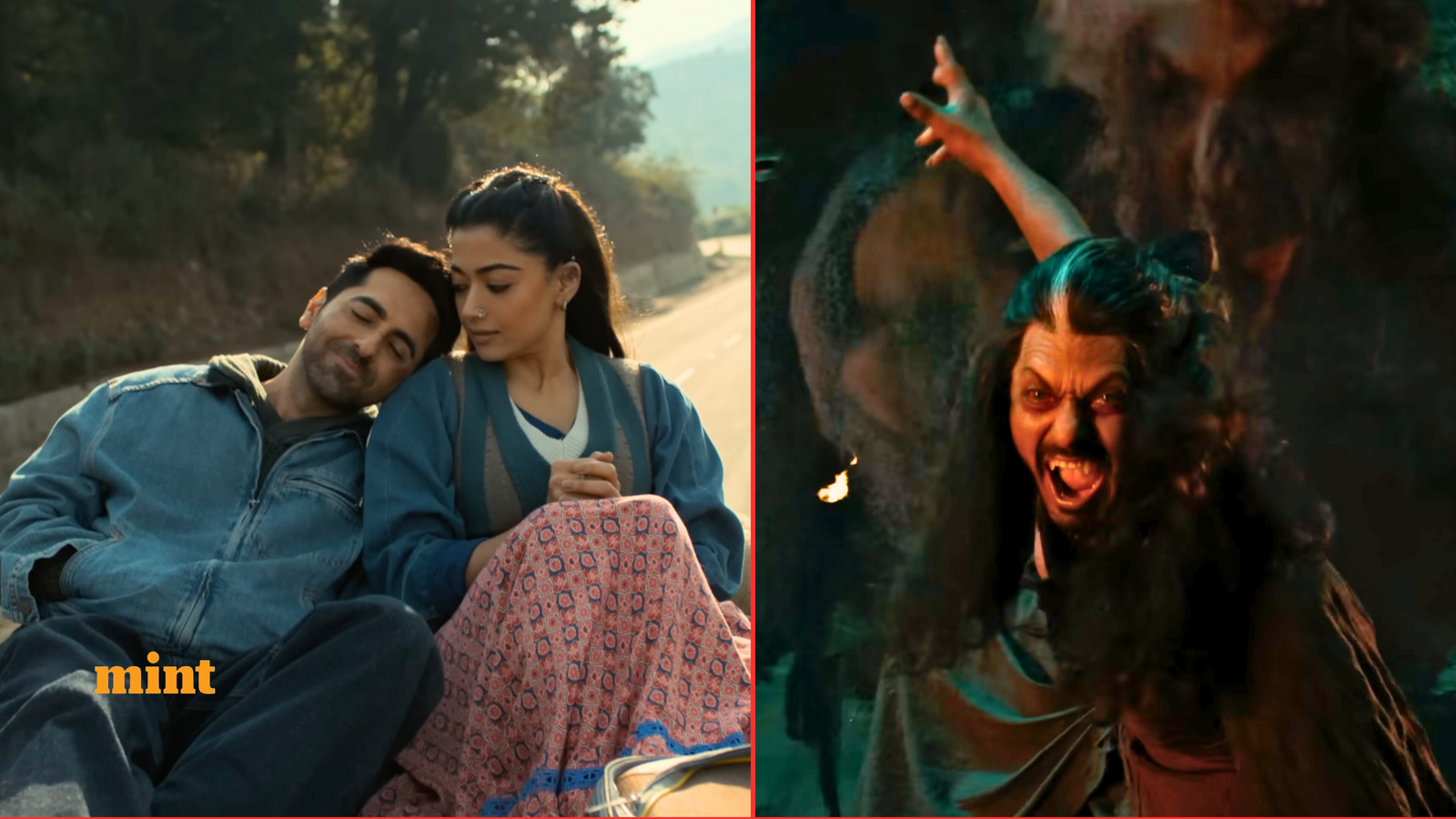
Thamma is essentially the journey of two lovers having to battle many odds. Ayushmann Khurrana is a small-time reporter Alok Goyal. While roaming in the forest Alok is confronted with an animal. A scared Alok runs away and his path crosses with Rashmika Mandanna’s Taraka/Tarika. Taraka is a mysterious woman belonging to a mythical world. A situation comes when Alok is offered as a sacrifice to Nawazuddin Siddqui’s Yakshashan. Yakshashan was once upon a time a leader of the demi humans. Now he is a chained prisoner. Taraka breaks the rules of the tribe by following her heart. She saves Alok and runs away with him. This sets the clash between two opposing worlds.

A strong aspect of Thamma is the love story between Alok and Taraka. It does take a little to warm up but soon the romance gathers momentum. The sweet nature of Alok and how he falls in love with Taraka has been both well written and enacted. The revelation of who Taraka actually is and the origin story comes in at the right juncture. There is a reference to the horrific partition when Taraka talks about a group called betaals. This tribe follows a strict rule which is never kill humans and drink their blood. The reason is they consider the human blood to be poisonous. This happens after they come across a charade of dead bodies with people slaughtering each other in the mayhem of partition.

The biggest strength of Thamma though is the character design of Rashmika Mandanna’s Taraka coupled with her performance. Unlike the Stree movies Rashmika Mandanna here is much more than just a mysterious woman. For a large part of the film Rashmika is the protector of Alok fighting tooth and nail for her love. The character is both ferocious and also tender as the situation demands and Rashmika nails both these shades. The actress also gets to do some action like the sequence with a group of boys chasing Alok and her after a party. In spite of a slightly drunken state Taraka gives a sound beating to the guys.

Ayushmann too comes into his own when Alok turns into a Betaal himself. The actor does a wonderful job in conveying both the initial shock and also accepting the new identity. Paresh Rawal as the scared father raises some chuckles. At the same time the veteran actor also shines in the few emotional sequences. A special mention must be made of the sequence where he encourages Alok to not give up saying that he has accepted Taraka as his daughter in law. However, the reference to late Amrish Puri’s dialogue in DDLJ and an Ayushmann bava feels forced. Nawazuddin Siddqui’s character as the comic villain needed more depth in writing nevertheless Nawazuddin chews the scenery coming up with a wonderfully eccentric act. Faisal Malik as a betaal turned cop is also good.

The crossover characters have also been smartly integrated. Whether its Abhishek Benarjee from the Stree and the Bhediya movies or Satyraaj in Munjya. These roles aren’t confined to filers. They play an important role in connecting the dots. Varun Dhawan as Bhediya gets a roaring entry too. His fight sequence with Ayushmann has been wonderfully choreographed. Saurabh Goswami’s cinematography is of a very good order whether it’s the haunting wilderness or the more tender moments.

Sachin Jigar’s music falls significantly short of Stree 2. The special dance numbers stick out like a sore thumb. But the duo do redeem themselves with Tum Mere Na Hue and Rahien Na Rahien hum.

Final word: Thamma is an interesting addition to the growing Maddock horror universe. Inspite of some bumps the movie makes for an engaging watch.

Dream Girl 2: Ayushmann Khurrana Entertains As Pooja In This Comedy Of Errors

Ayushmann Khurrana effortlessly switches between the roles of Karam and Pooja. He is particularly impressive in the female avatar.

Falters in the second half
Dream Girl 2 (Hindi)
  • Cast: Ayushmann Khurrana, Ananya Panday, Paresh Rawal. Seema Pahwa, Abhishek Banerjee, and Asrani
  • Director: Raj Shaandilyaa
  • Producer: Ektaa R Kapoor, Shobha Kapoor
  • Music: Meet Bros, Tanishk Bagchi, and Arko
  • Runtime: 2 hours 2 minutes

Starting from Vicky Donor (2012), Ayushmann Khurrana has always tried to push the envelope with his on-screen characters. There has always been an effort to do something different, even when he has done films in the slapstick zone.

For example, in Dream Girl (2019), Ayushmann’s Karam has an impressive ability to imitate a female voice. This comes from his experience of playing female characters in plays. In his desperation to find a job, he starts working at a call centre with the name of Pooja.

In Dream Girl 2, writer and director Raaj Shaandiliyaa goes one step ahead with Ayushmann becoming Pooja to the extent of wearing sexy sarees as well.

Synopsis

Dream Girl 2 is none other than Karamveer aka Karam (Ayushmann Khurrana). He and Pari (Ananya Pandey) are deeply in love and want to get married as soon as possible. However, there is a loan that Karam has to clear.

This loan is his father Jagit Singh’s (Annu Kapoor). Karam doesn’t have a stable job. In his desperation to earn money, Karam transforms himself into a bar dancer by the name of Pooja with some persuasion from his dad and best friend Smiley (Manjot Singh).

Pooja impresses everyone with her dance moves. Running parallel to this is the track of a Muslim patriarch, Abbu Saleem (Paresh Rawal). Smiley loves Abbu Saleem’s daughter, and she also reciprocates, but there is a hurdle in the form of Abhishek Banerjee’s Shah Rukh.

Shah Rukh is the son of Abbu Saleem, who has depression problems. Abbu Saleem tells the loving couple that he will agree to their marriage only after his son comes out of depression. Smiley convinces Karam to become a female psychiatrist. However, this only ends up in further complications which can’t be elaborated here.

What follows is an assemblage of funny situations with one thing leading to another.

On the shoulders of Ayushmann Khurrana

Not surprisingly the biggest strength of Dream Girl 2 is Ayushmann Khurrana. The actor effortlessly switches between the roles of Karam and Pooja. He is particularly impressive in the female avatar.

The actor leaves you thoroughly charmed with his body language, make-up and dance moves. The actor’s comic timing also leaves the audience in splits throughout. For example, there is a scene where Abhishek Banerjee tries to seduce Pooja, and the latter’s wig comes off.

Pooja starts shrieking, “Hairfall, hairfall.” The humour in Dream Girl 2 isn’t of the intelligent type but Ayushmann along with the supporting cast keeps the proceedings engaging.

Other performances

Out of the numerous subplots my favorite is the one involving Seema Pahwa’s Jumani. She has been through multiple marriages and is absolutely unapologetic about her desire to find true love. At one point she falls head over heels in love with Karam. Seema Pahwa aces the part with her uninhibited act.

The scenes between Abhishek Banerjee and Ayushmann are also good to watch. Abhishek Banerjee’s role doesn’t have much scope for comedy, but still, both the actors feed off each other well.

The music composed by Meet Bros, Tanishk Bagchi and Arko has a good variety. Special mention must be made of the songs picturised on Ayushmann in the role of Pooja.

Final take

What pulls Dream Girl 2 down is the elongated second half. The comedy of errors runs out of steam as there isn’t much meat left by then.

In the pre-climax, Karam has a monologue with undertones of social commentary about middle-class angst, but this doesn’t gel well with the overall tonality.

(Views expressed here are personal.)

Anek: An Admirable Effort But Lacks Focus

With MulkArticle 15 and Thappad Anubav Sinha has created a strong niche for himself. Each of these three films has covered important socio-political issues. For example, Mulk was about the growing Islamaphobia in the country. Article 15, on the other hand, was about a young police officer who comes upon the horrors of caste discrimination. Lastly, Thappad looked at whether a slap can lead to divorce. All these were powerfully made films that stayed with you for a long time. With his latest Anek, the director shifts his focus to the mostly neglected north east. Omung Kumar’s Mary Kom was also set in the northeast but Anek falls in a very different zone altogether. This is a highly political film which talks about the alienation and lack of opportunities for the youth in northeast. The director focuses his lens on the racial abuse faced by the people of northeast.

There is no denying that Anubav Sinha makes an important statement through Anek, but having said that the script is all over the place. Anubav Sinha jumps from one issue to another. You get the feeling that cramming of too many things is happening. It looks like Anubav Sinha was bombarded with too many ideas.

Anek tells the story of a secret agent Aman (Ayushmann Khurrana) who goes by the name of Joshua. He opens a café in a city somewhere in the northeast. This café becomes the base for his operations. He has been sent by the government to neutralize Tiger Sangha (Loitongbam Dorendra Singh), he is a militant leader who runs a parallel government in the region. The government wants him to fall in line and sign a peace accord. Along with this you also have the track of a boxer Aido (Andrea).  Aido wants to become a part of India’s boxing team. Her reasoning is recognition in sports would give her a platform to highlight the problems of her region.

Her father Wangao (Mipham Otsal) is a revolutionary who believes that independence isn’t necessarily earned through guns. Wangao’s belief is that independence can be won through social reforms as well, interactions with these two changes Joshua. He begins to question the motives of his handler Abhar (Manoj Pahwa). There is also Kumud Mishra playing the wily minister. Last but not the least JD Chakravarthy also makes a comeback to the screen as another agent. What follows is a complex political thriller covering many burning issues.

First and foremost Anubav Sinha deserves credit for how he shows the militancy in northeast. They are never branded as terrorists but as revoluntaries. A lot of effort has gone into understanding what makes these young people take up arms. There is a distinct empathy which comes out. Also the film never goes into the jingoistic zone in spite of the political background.

Some of the conversations strike a definite chord, they make you think. For example, there is an important conversation between Ayushmann Khurrana and JD Chakravarthy about what makes someone an Indian. Is it the place where you come from, the language that you speak etc? The film also dwells into how the idea of peace can be utopian and also be subjective. This particularly comes out through JD Chakravarthy’s character.

Ewan Mulligan’s cinematography is another major plus for Anek. It is perfectly in tone with the requirement of the film. The cinematographer shows both the aesthetic beauty of northeast along with the destructive side. 

One of the factors that pull down Anek is the lack of coherence. This is majorly due to the tone that Anubhav Sinha has adopted. In telling too many things the direction often becomes indulgent. More focus was also needed on developing the characters of common people. A good example of this is the Andrea’s Aido. The character is too sketchily written for you to completely empathize with her.

The half baked romance between Ayushmann and Aido isn’t convincing in any way. It could have been either avoided, or be written in a better manner.

The overtly political nature also alienates the audiences somewhat. The first half in particular has too much of politics.

As expected the performances of the cast are on point. Ayushmann Khurrana is as dependable as ever. He once again shows his versatility as an undercover agent who develops a conscience. Andrea makes a confident debut, some rawness is there in the emotional scenes but there is no denying that Andrea has a bright future. Manoj Pahwa stands out in the supporting cast. He imbibes the necessary ruthlessness. It is also good to see JD Chakravarthy in his role of the field agent. He makes his presence amply felt.

In a nutshell, Anek is a step in the right direction, but more finesse would have made it memorable.

Jayeshbhai Jordaar: A Social Comedy With An Overwhelming Sense Of Familiarity

Divyang Thakkar’s Jayeshbhai Jordaar is what you get if you grind Ayushmann Khurrana’s formula of social films and also some Akshay Kumar ones like Toilet Ek Prem Katha.

The director takes up the issues of female infanticide and superstitions among others, he narrates it through the lens of entertainment. Even when the film moves into a dark zone the narrative style doesn’t lose its core.

Jayeshbhai Jordaar is definitely a breadth of fresh air among the spate of biggies like RRR and KGF 2. However you just wish that the director had paid more focus on the development of some characters, case in point being Shalini Pandey’s Mudra. It looks like the actress had hopped from the sets of Arjun Reddy to this one. Shalini tries very hard but the mostly one- dimensional character coupled with the forced Gujarati accent makes it hard to sympathize with her.

Ranveer Singh and Shalini Pandey play a young couple living under the thumb of the overbearing elders. They have to bow down to whatever the elders say, and this includes a sex determination test too. Jayeshbai’s father is sarpanch Ram Lal (Boman Irani). His character is very reminiscent of those politicians who think that woman wearing short clothes leads to rape. There is a bizarre scene where Ram Lal bans soap to protect the ladies. Siddhi (Jia Vaidhya) is the daughter of Jayesh and Mudra. Ratna Patak Shah plays Boman Irani’s wife. Both Ram Lal and his wife want Mudra to deliver a boy who will carry forward the lineage. There is also a subplot involving a village in Haryana. The people in that village want help as it is an all- men’s village. The sex-ratio is terribly skewed. The rest of the story plays out like a road movie with Jayeshbhai desperately trying to save his wife. The daughter Siddhi is Jayeshbhai’s biggest support.

https://www.youtube.com/embed/fppJtxJ7RWY?feature=oembed The best part of Jayeshbhai Jordaaar is how the director maintains the character of Jayesh. Jayesh is a timid person who cannot oppose his father publicly, but he still stands up for his wife on many occasions making sure that she doesn’t get hurt. There is a scene early on when Jayesh is asked to beat his wife by Ram Lal. The reason being Jayesh’s sister is being abused in her martial home. Mudra’s brother is the husband of Jayesh’s sister. Jayesh closes the door and creates a charade that makes Ram Lal and his wife think that he is beating Mudra severely.

Jayeshbhai is someone who relies on his brains and not fists. At no point Ranveer turns into a Salman Khan of the Tiger series.

Ranveer’s scenes with Jia Vaidhya are the soul of Jayeshbhai Jordaar. Ranveer shares a far better chemistry with Jia than he does with Shalini Pandey. There are occasions where Siddhi behaves more like an adult but it still works. Jia Vaidhya is a definite a fire cracker in her role.

The sub plot involving the Haryana village is also smartly integrated into the narrative. The comic scenes are also quite good. A particular mention must be made of the scene involving the black cat. It is hilarious.

Ranveer Singh has always been one of those actors who brings something new to the table.

As Jayeshbhai the actor delivers another terrific act. His role here is a far cry from the flamboyant Ram that he played in Ram Leela, that was the last time that Ranveer had played a Gujarati.

One big minus of Jayeshbhai is that a majority of the supporting actors are mere gap fillers. Even someone like Ratna Pathak Shah doesn’t get much to do. There is a transformation which happens toward the end, however it is too sketchily written for you to buy it.

Boman Irani is appropriately menacing but the one note characterization gets tiring after a point. His character also gets a makeover eventually, but again it is difficult to buy it.
The hangover of films like Toilet Ek Prem Katha and others are very visible. As a result there is a sense of déjà vu that creeps in.

Musically there is not even one song that you would remember which is sad given that banners like YRF and Dharma are known to deliver popular soundtracks irrespective of the quality of the films. Jayeshbhai Jordaar has an important story to tell but a sense of familiarity plays the spoilsport here.