Amar Singh Chamkila: Imtiaz Ali returns back with a bang

After a series of love stories, Imtiaz Ali takes a welcome detour and delivers a hard-hitting film that goes beyond a biographical drama.
Amar Singh Chamkila (Hindi), 12-04-2024, Biological Drama, 2 hours 26 minutes, U/A, OTT
  • Main Cast: Diljit Dosanjh, Parineeti Chopra, Apinderdeep Singh, Nisha Bano, and Anjum Batra
  • Director: Imtiaz Ali
  • Producer: Imtiaz Ali and Mohit Choudary
  • Music Director: AR Rahman
  • Cinematography: Sylvester Fonseca
  • Rating: 4/5
  • Published in: Southfirst

Imtiaz Ali is a director who is known primarily for making love stories and he has found good success in that genre except for Jab Harry Met Sejal (2017)and Love Aaj Kal (2020).

But one of Imtiaz Ali’s best works to date remains Highway (2014). The director focused his lens on the issue of sexual abuse with the backdrop of Stockholm syndrome.

The film was a major breakthrough for the now national award winner Alia Bhatt. It is also one of Randeep Hooda’s best works.

In the last few years, Imtiaz hasn’t had the best run at the box, both critically and commercially.

Tamasha (2015) did moderate business but Jab Harry Met Sejal along with Love Aaj Kal 2 were damp squibs in more ways than one.

Finally, Imtiaz Ali has broken his dry run with the movie Amar Singh Chamkila.

Synopsis

Amar Singh Chamkila begins with the assassination of the controversial Punjab Pop Singer played by Diljit Dosanjh and his wife Amrajot Kaur (Parineeti Chopra).

Imtiaz Ali’s ‘Amar Singh Chamkila’. (X)

The husband and wife were a popular duo who had sung many songs.

From here the movie goes into non-linear storytelling that talks about the formative years of Chamkila which had a huge influence on his music, and how he goes from a Dalit laborer to a singer who is both admired and criticized in equal measure for the brazen lyrics that are sexual in nature.

At times Amar Singh Chamkila also plays out like a whodunit giving an insight into the groups who had a big issue with how Chamkila didn’t adhere to the social diktats.

One of the things that majorly works for Amar Singh Chamkila is the characterization of the titular role. Diljit Dosanjh’s character is not a rebel by design.

There are scenes in the second half when Chamkila tries to move away from his regular songs and tried devotional, but the audiences want Chamkila to sing what he is famous for.

Chamkila is not someone who is dismissive of what is happening around him, but at the same time he is a man who chooses not to be bullied into submission.

In that way Chamkila’s character proves to be a worthy successor to the previous Imtiaz Ali protagonists whose intent was to live more freely and in the process discover their purpose in life.

Many pertinent questions

In the two hours and 26 minutes running time Imtiaz packs in many themes.

For example who gets to decide what an actual art is? Should an artist endure a lifetime of hate and humiliation for choices that are driven by circumstances? And finally how there is a huge difference between criticizing an art versus wanting to ban something that does not align with our tastes.

Parineeti Chopra in ‘Amar Singh Chamkila’. (X)

There are many powerful moments in Amar Singh Chamkila that stay in the viewers’ minds for a long time.

For example, a journalist comes to meet Chamkila and insists on having a personal interview. Chamkila is reluctant to the extent that he won’t even look into her eyes, the reason being this journalist has worn pants.

This portion works as a hard-hitting statement on how a singer has no issues in writing songs describing women’s sexuality in a raw manner but at the same time, modern clothing is a big problem for this man.

Amar Singh Chamkila also boasts of some hard-hitting dialogues. There is a scene where Chamkila talks about how everyone isn’t blessed with the privilege of thinking about what is right and wrong.

He goes on to add that he certainly is not in that position and makes music to just feel alive.

The film also has some archival footage showing the real Amar Singh Chamkila and the wife Amrajot Kaur, this is juxtaposed with the scenes of Diljit and Parineeti.

Sure this technique becomes distracting on occasions but still the raw footage makes it easier for the audiences to understand why the real Chamkila was considered as a threat by the purists.

Technical aspects

AR Rahman’s music coupled with Irshad Kamil’s lyrics is the backbone of Amar Singh Chamkila. Mohit Chauhan’s “Baaja” sets the tone perfectly capturing the spirit of Chamkila. “Tu Kya Jaane” is another wonderful number celebrating the love between the husband and wife.

The camerawork by Sylvester Fonseca is also first-rate. The cameraman deserves distinction marks for bringing alive the 1970’s and 80’s of Punjab. A particular mention must be made of the scenes where the village girls talk straight to the camera with some hilarious punchlines.

Imtiaz Ali also deserves credit for how he has depicted the impact of insurgency, both for Punjab and Chamkila’s professional life.

Performances

Diljit Dosanj in ‘Amar Singh Chamkila’. (X)

Diljit Dosanjh delivers a rousing performance in the title role. It goes without saying that Diljit’s histrionics is a major asset of the movie.

The actor portrays the vulnerability and the fighting spirit of Chamkila in a stellar manner.

Among the supporting cast, Anjum Batra, as the first musician who collaborated with Chamkila stands out the most.

Parineeti Chopra has her moments like the love ballad “Tu Kya Jaane” where she does a wonderful job in showcasing a love-struck woman but the role of Amarjot needed to be etched better and also deserved a stronger actor.

A film could also have done with a deeper dive into interpersonal relationships. The track of Chamkila’s first marriage before settling with Amarjot also feels patchy.

Verdict

Keeping aside these small niggles Amar Singh Chamkila is a glorious return to form for Imtiaz Ali. Diljit Dosanjh shows why he deserves to play the male lead in Hindi Cinema more often.

Murder Mubarak: A Toothless Whodunit That Fails To Capture The Spirit Of Anuja Chauhan’s Novel ‘Club You To Death’

Director Homi Adajania tries to mix humour with suspense but fails spectacularly. Also, too many characters add to the fatigue.
  • Main Cast: Sara Ali Khan, Karisma Kapoor, Vijay Varma, Dimple Kapadia, Tisca Chopra, Pankaj Tripathi, and Sanjay Kapoor
  • Director: Homi Adajania
  • Producer: Maddock Films
  • Music Director: Sachin-Jigar
  • Cinematography: Linesh Desai
  • Genre: Murder Mystery-Comedy
  • Rating: 2/5
  • Run Time: 2 Hours 21 minutes
  • Published in: Southfirst

Anuja Chauhan’s 2021 novel “Club You To Death” was much more than just a murder mystery. It was a book that looked at discrimination based on class. The novel was a social satire in many ways.

For those who haven’t read Anuja Chauhan’s work, the setting of the movie is the Royal Delhi Club, known for its lavish parties and high-profile guests.

A murder is committed on its premises and ACP Bhavani Singh (Pankaj Tripathi) is given the responsibility of unravelling the mystery.

Bhavani Singh’s character is modelled on British writer Agatha Christie’s hugely popular fictional detective Hercule Poirot.

Also, there is Karisma Kapoor as superstar Shehnaz Noorani.

The lives of these rich people are juxtaposed with the working class.

For example, there is a caretaker with dementia Guppie Ram (Brijendra Kala).

In simple terms, the story is about what led to the death of the Zumba instructor Leo Mathews (Ashim Gulati) along with the various secrets of the suspects.

Analysis

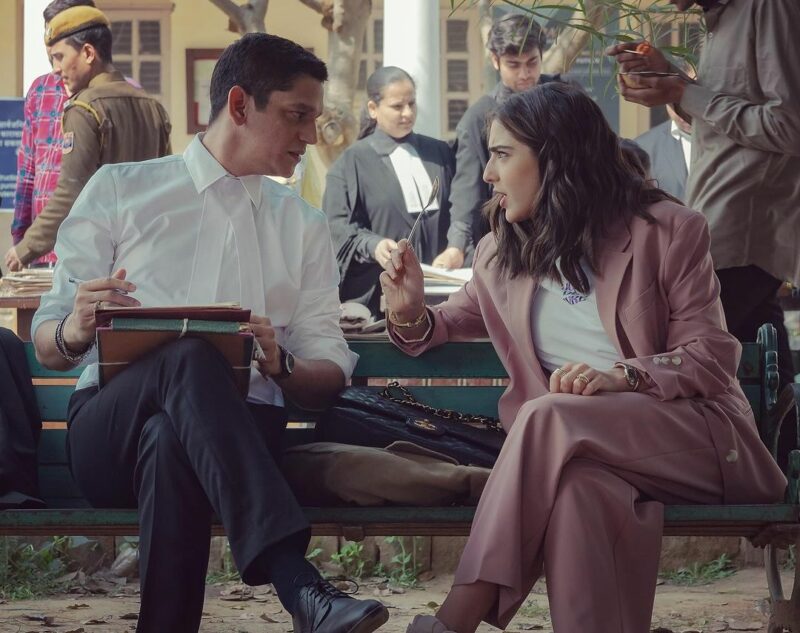
A still from ‘Murder Mubarak’. (X)

What makes Murder Mubarak somewhat tolerable is the basic storyline.

Sure, the narrative style is tedious but the suspense of who the murderer is keeps the viewers going.

Here, director Homi Adjania and the writers must be given credit.

The last 20 minutes of Bhavani Singh solving the case is interesting.

Among the sprawling cast, Pankaj Tripathi has the most fun. The dependable actor brings his charismatic charm and also gets some good lines.

For instance, in a scene, he says “Aaj kal anti-national banne ke liye zyada patishram nahi karna padta hai (These days, it is quite easy to be labelled anti-national).

A big problem with Murder Mubarak is the overindulgence of Homi Adajania. This can be seen in how the director overstretches the narrative.

Most characters have also been poorly etched; a case in point is Vijay Varma and Dimple Kapadia.

In the second half, there is a badly placed love story between Sara Ali Khan and Vijay Varma while they are doing their parallel investigation.

The writing and the chemistry between the actors are weak.

Sara Ali Khan has one important scene in a crucial flashback towards the end. But the actor messes that scene up with her overacting. As a result, the viewers do not feel the emotional turmoil of her role.

Final take

Despite its engaging subject and an interesting set of actors, Murder Mubarak is a major misfire.

Maamla Legal Hai: An Entertaining Legal Satire Led By A Delightful Ravi Kishan

At times the series feels like an OTT version of Subhash Kapoor’s ‘Jolly LLB’. But still, this Rahul Pandey’s directorial is very much its own best.
  • Main Cast: Ravi Kishan, Nidhi Bist, Yashpal Sharma, and Naila Grewal
  • Director: Rahul Pandey
  • Producer: Amit Golani and Biswapati Sarkar
  • Music Director: Nilotpal Bora
  • Cinematography: Milind Jog
  • Genre: Comedy, Drama
  • Rating: 3.5/5
  • Episodes: 8
  • Published in: Southfirst

Subjects revolving around courtrooms and lawyers always make for an interesting subject. Reason: They represent a form of hope for a common man as Saurabh Shukla’s judge Sunderlal Tripathi says at an important juncture in Jolly LLB 2 (2017).

Subhash Kapoor’s Jolly LLB films engaged the audience thoroughly with witty dialogues and touched upon different social topics.

For example, Jolly LLB (2013) was about a hit-and-run case. It was about the death of some labourers who were run over by a land cruiser while sleeping on the footpath.

Jolly LLB 2 was related to a fake encounter. To begin with, in both films, the protagonists are not very likeable advocates. But they grow a conscience as the plot moves along.

Synopsis

Now, you have Maamla Legal Hai set in the district court of Patparganj. The eight episodes portray a variety of eccentric cases inspired by real-life stories.

VD Tyagi (Ravi Kishan) is a street-smart advocate who aspires to become the bar association president. Tyagi excels at finding loopholes in the legal system to win cases.

He has two assistants who are hilariously nicknamed as law and order.

Sujatha (Nidhi Bhist) dreams of having her chamber one day.

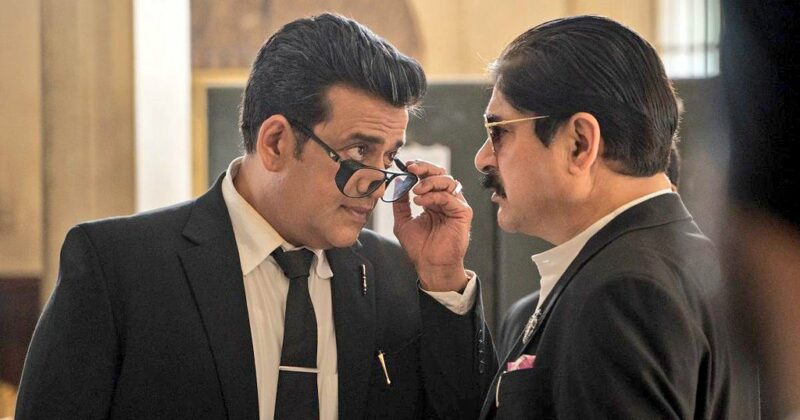
Ravi Kishan in ‘Maamla Legal Hai’. (X)

Vishwas Pandey (Anant V Joshi) is the court manager.

Ananya Shroff (Naila Grewal) is a Harvard-returned advocate with dreams of providing legal aid to the underserved. However, she faces a harsh reality in Patparganj.

In simple terms, the story deals with the wacky nature of the district court and some small-town problems.

Director Rahul Randey deserves distinction marks for how he packages serious issues while maintaining the entertainment quotient.

He touches upon how the strikes of lawyers affect the cases, the connubial rights of prisoners, etc.

Among the many bizarre cases, my favourite one is that of a husband who wants a divorce because his wife does not feel shy during their wedding night.

This may be as unbelievable but at the end of the episode, you have a newspaper clipping showing how this had really happened.

The web series also makes a strong statement on how law and justice are two very different beasts; they should be the same in the ideal world though. This comes out firmly in an episode where Naila Grewal’s character faces a moral predicament while tackling a case.

Well-written characters

Naila Grewal in ‘Maamla Legal Hai’. (X)

The characters have been written with a lot of care. A good example of nuanced writing is Ananya’s constant dilemma regarding her idealism that clashes with pragmatism.

Though she is well-versed in law, there are junctures where the reality sets in and Ananya‘s desire to deliver justice takes a step back.

Similarly, Ravi Kishan’s VD Tyagi may come across as very cunning but he has his humanity, which comes out strongly in a particular episode.

About the performances, Ravi Kishan leads the ensemble with his brilliant performance. The actor does a swell job of portraying the transformation that his character goes through, from being shrewd he comes to understand the power bestowed on him.

However, the complicated relationship of Tyagi with his father needed to be better explored.

At times, the show gets into a melodramatic zone, which doesn’t gel with the overall tonality.

Among the other actors, Nidhi Bisht also makes a big impact with her comic timing and matches up to Ravi Kishan.

Naila Grewal, as an outsider to this bizarre world, also fares well in portraying the existential crisis.

Anant V Joshi’s character is pretty similar to the one in 12th Fail (2023), but he is still fine in what he does.

Verdict

Maamla Legal Hai is a hilarious satire that needs to be watched for its social commentary and striking performances.

Bhakshak: A Hard-Hitting Saga That Makes Pertinent Points On The Power Of Real Journalism

‘Bhakshak’ is not everyone’s cup of tea but it is a must-watch for those who like gritty dramas based on real-life incidents.
  • Main Cast: Bhumi Pednekar, Sanjay Mishra, Sai Tamhankar, Aditya Srivastava, and Surya Sharma
  • Director: Pulkit
  • Producer: Gauri Khan and Gaurav Verma
  • Music Director: Anurag Saikia and Anuj Garg
  • Cinematography: Kumar Sourabh
  • Rating: 3.5
  • Published in: Southfirst

Directed by Pulkit and written by Jyotsana Nath Pulkit, Bhakshak is based on the horrific incidents reported in a shelter home in Muzaffarpur, Bihar.

Several girls were sexually abused in the shelter home run by a politician.

Real-life incidents always make for a gripping cinema, provided they are well-directed. Thankfully, the director along with the writer, has done a brilliant job of keeping the viewers engaged.

The film does meander at places, and there was no real need for the songs. But still, all said and done, Bhakshak is a must-watch.

Synopsis

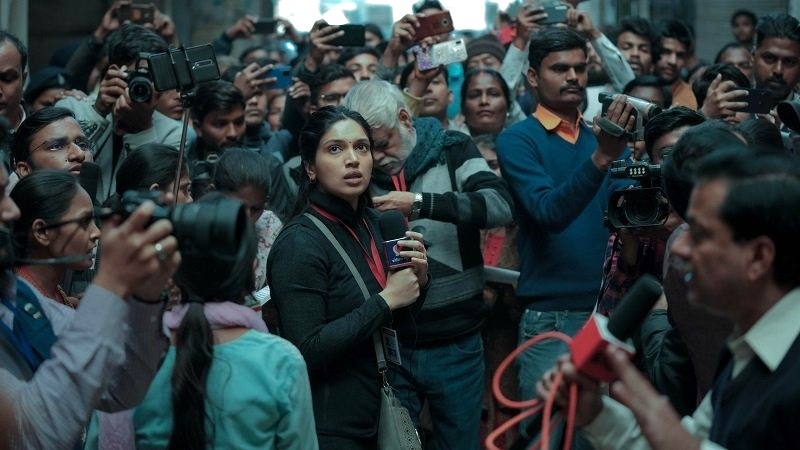
Bhumi Pednekar in a still from ‘Bhakshak’. (X)

Vaishali Singh (Bhumi Pednekar ) is a small-time independent journalist who runs a news channel called “Koshish“. In simple terms, the movie is about her attempts to bring forth the reality of Munnawarpur shelter home.

The man running this shelter home is also a journalist named Bansi Sahu (Aditya Srivastava). Bansi Sahu has strong political connections and has zero remorse about his activities.

So, it becomes an uphill task for Vaishali and her colleague Baskar Sinha (Sanjay Mishra) to expose the truth.

Authentic sans melodrama

‘Bhakshak’ is a thriller that revolves around child sexual abuse. (X)

Director Pulkit does not waste any time in setting up the plot.

Bhakshak starts on a disturbing note that sets the base for the drama to follow.

A strong aspect of the film is how the director shows the struggle of Vaishali in digging for the truth. She faces challenges in both her professional and personal life.

We see Vaishali constantly going out for long hours and this results in problems with her husband (Surya Sharma), who is shown to be frustrated with the erratic timings of his wife.

Additionally, the in-laws feel that Vaishali should soon become a mother.

There are showdowns between the husband and wife. Many working women would relate to Vaishali’s struggles.

The sexual exploitation done in the shelter home has also been portrayed with the required sensitivity. A section of viewers are sure to feel highly emotional.

The director also deserves credit for not taking the melodramatic route and exaggerating scenes for the cause of the effect because the nature of crime is disturbing in itself.

Director Pulkit also deserves credit for how he has portrayed journalism and Journalists.

There is not a single scene of journalists screaming in front of the cinema in a filmy manner. He keeps it authentic.

Pulkit also takes digs at the section of people who unquestioningly believe in WhatsApp forwards.

However, at certain places, the film loses grip with some repetitive writing. The songs are not needed. For example, the song towards the climax.

Mesmerising performances

Aditya Srivastava in ‘Bhakshak’. (X)

Apart from the strong writing. Bhakshak also scores big on the performance front.

Bhumi Pednekar aces her part of a fearless journalist. She does a perfect job of showcasing the mannerisms, and her dialect is also praiseworthy.

Sanjay Mishra is wonderful. He brings in the much-required humour in certain situations. His rapport with Bhumi’s Vaishali is a delight to watch.

Aditya Srivastava makes for a truly despicable villain. The actor makes the viewers hate Bansi Sahu with just his facial expressions. Sai Tamhankar, as SSP Jasmeet Kaut, plays an important role. She brings in a certain gravitas.

Verdict

Bhakshak is the perfect example of how to make a hard-hitting drama. Do take time for it. The film is streaming on Netflix.

(Views expressed here personal.)

Lust Stories 2: An Engrossing Anthology About Love, Sex, And Desire

Much like its predecessor ‘Lust Stories’ (released in 2018), ‘Lust Stories 2’ also offers a fresh perspective on female desires.

Lust Stories (2018) — directed by Zoya Akhtar, Dibakar Banerjee, Anurag Kashyap, and Karan Johar — was a well-made anthology about female desire.

The protagonists in these segments belong to different generations, socio-economic statuses, and upbringings. But the common aspect that bound them was sex and lust.

The standout story in Lust Stories was the short directed by Zoya Akhtar. Her story was about a domestic worker and her boss. Zoya expertly tackled the issue of a class divide through the lens of lust.

Now, after a gap of five years, you have Lust Stories 2. Much like its predecessor, this also offers a fresh perspective on female desire.

Made For Each Other

Lust Stories 2 begins with R Balki short Made For Each Other. This short primarily looks at checking sexual compatibility before marriage. It opens with Veda (Mrunal Thakur) and Arjun (Angad Bedi).

You have both families discussing when their marriage should take place. At that exact moment, Veda’s  daadi (grandmother, played by Neena Gupta) asks Veda whether she and Arjun had pre-marital sex.

As expected, this leads to a complete silence in the room. Daadi also adds that checking sexual compatibility before marriage is as important as doing a test drive before buying a car.

In the hands of a lesser actor, daadi’s dialogue may have sounded awkward. However, Neena Gupta makes the cool daadi work with her natural performance. Her scenes with Mrunal in particular are very good to watch.

Mrunal Thakur and Angad Bedi don’t have a lot to work with. Nevertheless, they make for a good lovey-dovey couple.

The Mirror

The Mirror, directed by Konkana Sen Sharma, is more intense than Balki’s short.

Isheeta (Tillotama Shome) is an individual leading a mundane life. She has repressed sexual desires.

But one day, things take a significant turn when she accidentally sees her domestic help (Amruta Subhash) engaging in a sexual act with her husband in her house (Isheeta’s).

Instead of confronting the domestic help, Isheeta gets drawn to the scene. She gets a lot of pleasure from watching them.

This segment primarily looks at the inner desires of Isheeta and the complexities that arise from her voyeurism. This short also shows that lust knows no caste, colour or gender.

Both Tillotama and Amruta Subhash are in wonderful form with their uninhibited performances. Though it reminds you of Zoya Akhtar’s short in Lust Stories, Konkana adds many more layers.

Sex With Ex

Sujoy Ghosh’s Sex With Ex is a thriller in typical Sujoy Ghosh’s style. This segment of Lust Stories 2 doesn’t completely draw you in, but it isn’t a complete waste either.

David Chauhan (Vijay Varma) is involved in an accident on the outskirts of a town. While searching for a mechanic he visits a hamlet where he runs into his ex-wife Shanti (Tamannaah Bhatia).

Shanti was assumed to be dead for a long time. Expectedly, this reunion brings a flood of memories.

The best part of this segment is the real-life sensuality that Tamannaah and Vijay Varma bring to the table. The twist at the end also takes you by surprise.

Tilchatta

The last chapter of Lust Stories 2 is Tilchatta (Cockroach) directed by Amit Ravindernath Sharma.

It deals with two issues mainly — firstly, it is about an upper-caste man who still feels that he is living in the age of kings; secondly, it is about a woman trying to find her agency in an abusive marriage.

The patriarch here is Kumud Mishra and the married woman is Kajol.

Tilchatta takes place in a sprawling haveli. Amit Ravindernath Sharma does a wonderful job of bringing out the toxicity and suffocation that Chanda (Kajol) and her son are going through in that large space.

There is an affecting subplot concerning sex workers since Chanda was a sex worker before getting into this haveli. This subplot adds more heft to the drama.

Both Kajol and Kumud Mishra bring their A-game. Kumud Mishra shows once again why he is considered a brilliant actor. He is absolutely terrific as the torchbearer of patriarchy. The way he unabashedly gazes at the bodies of women with so much lust makes the viewers hate him.

Kajol, as the woman trying to find her agency, conveys a lot with just her body language. As viewers, you want her to take the bold step which she eventually does, although things don’t go exactly according to the plan.

Verdict

Much like Lust StoriesLust Stories 2 also makes a bold attempt at bringing taboo topics to the forefront through the digital space.

(Views expressed here are personal.)

Scoop: Hansal Mehta Brings Alive Yet Another Real-Life Story

“Scoop” scores full marks in depicting the work of investigative journalists and what effect it has on their lives.

Miss it not!
Scoop (Hindi)
  • Cast: Karishma Tanna, Harman Baweja, Prosenjit Chatterjee, Inayat Sood, and Mohammad Zeeshan Ayub
  • Director: Hansal Mehta
  • Producer: Matchbox Shots
  • Music: Achint Thakur
  • No. of episodes: 6
  • OTT platform: Netfilx

Scoop, the latest Netflix series of Hansal Mehta, is based on the real-life account of journalist Jigna Vora.

Starting from the year 2010, Hansal Mehta has become a filmmaker who is synonymous with making real-life stories.

Irrespective of their commercial success, these films have left a huge impact on the audience’s mind. His latest web show Scoop is another noteworthy addition to this.

Synopsis

Jagruti Pathak (Karishma Tanna) is a senior crime journalist working as deputy bureau chief in the newspaper “Eastern Age”. Since Jagruti has a solid network, she excels in her job.

She shares a good rapport with police officer Harshvardhan Shroff (Harman Baweja) who often tips her about several crimes. She also has the support of her editor-in-chief Imran (Mohammed Zeeshan Ayub).

Here, it has to be mentioned that the characters in Scoop of Imran and Jagruthi are based on real-life persons.

Imran is none other than the well-known investigative journalist Hussain Zaidi. He was the mentor of Jigna Vora on whom Jagruti’s role is based.

The murder of a journalist

There is another investigative journalist in Scoop who gets killed mysteriously. He is Jaideb Sen, played by Prosenjit Chatterjee. He works for the newspaper “News Day”.

One day, Sen is found dead in the middle of the road. Gangster Chhota Rajan is suspected to have a hand in this murder.

Meanwhile, things take a tragic turn for Jagruti. She is arrested based on a phone conversation which makes the police think that Jagruti instigated Chhota Rajan to kill him.

The rest of the story is about what happens to Jagruti and who the real culprits are in this murder case.

Strong points

Scoop scores full marks in depicting the work of investigative journalists and what effect it has on their lives. The show also dwells on the prejudices that female professionals face.

The makers of Scoop should also be appreciated for fearlessly exposing the nexus between Dawood Ibrahim and the police, without any fear of backlash.

Another major reason why Scoop is interesting to watch is because of the way the characters are written.

Hansal Mehta, along with writers Mrunmayee Lagoo Waikul and Mirat Trivedi, sketches the characters that stay for a long time in the viewers’ minds.

The best example of this is Karishma Tanna’s Jagruti.

Jagruti goes from a confident journalist to a dejected woman. Her scenes with the jail inmates are particularly disturbing to watch.

Performances

Karishma Tanna easily delivers her career-best performance. Her performance in Scoop should open new doors for the actress.

Another character who deserves a mention is Harman Baweja’s, Harshvardhan Shroff.

Harshvardhan has a lot of fondness for Jagruti. But, at the same time, he is in a situation where he has to save the skin of both his department and himself.

Harman Baweja springs a pleasant surprise with his acting.

Mohammad Zeeshan Ayub as the editor-in-chief plays a character that is very similar to his real-life ideology. He makes Imran immensely watchable.

Prosenjit Chatterjee as Jaideb has a small part, but the actor is impressive every time he appears on the screen.

Technical aspects

Pratham Mehta’s cinematography blends in with the realistic look of the series — whether it is the newsroom, editorial meetings, or even the shady bars and cafes where the reporters meet their sources.

Achint Thakkar’s music and background score uplift the drama in many places.

Pratham Mehta and Achint Thakkar deserve full appreciation for a job well done.

Weak points

Scoop has its share of shortcomings as well. For example, the extended cameo of Shikha Talsania as the Godwoman isn’t well defined in any way and creates a halt in the proceedings.

Similarly, some of the jail portions could have been trimmed. However, these are minor aberrations.

Final Take

Scoop should be high on your watchlist if you are a sucker for stories centred on investigative journalism.

(Views expressed are personal.)

Rana Naidu: A Gripping Father-Son Saga Bolstered By Real-Life Chacha-Nephew Combo

Venkatesh is the icing on the cake!

Rana Naidu (Hindi)

  • Cast: Rana Daggubati, Venkatesh, Surveen Chawla, Sushant Singh, Abhishek Benarjee, Gaurav Chopra, and Aditya Menon
  • Directors: Suparn Verma and Karan Anshuman
  • OTT platform: Netflix
  • Number of episodes: 10

Over the years, web shows have not just opened doors for newer stories but also given mainstream actors an opportunity to explore a different facet of their acting skills — something which doesn’t always happen on the big screen.

Rana Naidu directed by Karan Anshuman and Suparn Verma feels a little long with its duration of 10 episodes. The use of swear words and also an overdose of sex scenes get bothersome at times.

But still, there is a lot to enjoy here: particularly, the confrontation scenes between Rana Daggubati and Venkatesh.

I must say, Venkatesh has the guts to play a role that is quite different from his onscreen image.

For those who are not aware, Rana Naidu is based on the English web drama Ray Donavan. Since I have not seen the original, this will be a standalone review.

Synopsis

Rana Daggubati plays a fixer called Rana Naidu whose profession is cleaning up the mess of his high-profile clients. He takes his job seriously and successfully solves the problems of his clients.

But, at home, it is an altogether different story. His relationship with his family — wife and two children — is on tense ground. Adding to his woes is Rana Naidu’s estranged father Naga Naidu (Venkatesh).

Naga Naidu comes out of prison after 15 years for a crime that he did not commit. He has two more sons — played by Abhishek Banerjee and Sushant Singh.

Naga wants to fix his relationship with his sons. This is the story in brief.

A gripping drama

The best part of the Rana Naidu web series is how the undercurrent of the drama is maintained throughout.

As the layers peel off, audiences become more and more excited about what will happen next. There are ample twists and turns that shock you.

Another major highlight of Rana Naidu is the drama generated by the protagonist’s profession.

Gaurav Chopra as the Bollywood superstar may come across as a tad dramatic but the character is deliberately designed in that manner. And it works in the favour of the web series.

The directors also dwell on the different psyches of parents through the characters of Rana Naidu and Naga Naidu. They present some fascinating insights into exploring this aspect.

The confrontation scenes between Rana Dagubbati and Venkatesh, though less in number, still pack a punch.

The face-off between this real-life mama and nephew gives the show some of its best solid moments.

Rana and Venkatesh are top-notch

Rana Daggubati is supremely effective in essaying a protagonist who is torn between his high-profile job and his crumbling family.

He is top notch in not just portraying the menace and the intensity required but also shines in the vulnerable moments — whether it is with his wife and children or with his two brothers.

Venkatesh Dagubbati is equally solid as the wronged father who is at loggerheads with his son. The actor brings a certain warmth to his part beneath all the roughness.

The senior actor also brings much-needed humour to this otherwise serious show.

His Hyderabadi Hindi gives the show some of its most amusing moments. He successfully oscillates between being a chilled-out guy, who is desperate to reunite with his family and someone who is thirsting for vengeance.

Abhishek Banerjee nails it

Although the primary focus is on Rana and Venkatesh, the directors give ample space to others as well. Particular mention must be made of Abhishek Banerjee and Sushant Singh.

Abhishek Benarjee’s Jaffa, a recovering alcoholic, gets abused by a swamiji during his childhood. He is severely affected by those scars.

Sushant Singh’s Tej Naidu is a stuntman with Parkinson’s disease.

Suparn Verma and Karan Anshuman handle the complicated back story of Jaffa with the right amount of sensitivity.

Abhishek Banerjee is someone who is known more for his comic roles. But here, he successfully presents a different facet of himself.

The scenes between the three brothers are filled with a lot of warmth. As audiences, we earnestly want them to come out of their childhood scars.

Surveen Chawla and Ashish Vidyarthi stand out

The supporting cast is equally solid in their parts but the ones who stand out are Surveen Chawla and Ashish Vidyarthi.

As the fierce wife, Surveen Chawla more than holds her own opposite — both Rana and Venkatesh. The refreshing aspect of her character is that she is no pushover at any point.

Ashish Vidyarthi makes a surprise entry towards the end and sends chills down the audience’s spine. The coolness with which he goes about things makes him even scarier.

Too much adult content

The technical department starting from the cinematography and the background score also deserves equal credit for creating the right atmospherics.

What pulls down Rana Naidu is the length of the series. Instead of 10 episodes, the makers should have restrained it to seven. This would have made the web show crisper.

Also, there is an overdose of cuss words and uninhibited sex scenes. This becomes a tad too much to digest.

Final take

In a nutshell, Rana Naidu isn’t everyone’s cup of tea, But, if you are in the mood to watch a twisted family drama, then this one is definitely for you.

Mission Majnu: This ‘Raazi’ Redux Lacks The Required Heft

Not a goosebump spy thriller!

Mission Majnu (Hindi)

  • Cast: Sidharth Malhotra, Rashmika Mandanna, Parmeet Sethi, Sharib Hashmi, Mir Sarwar, Kumud Mishra, Arjan Bajwa, Zakir Hussain, and Rajit Kapur
  • Director: Shantanu Bagchi
  • Producers: Ronnie Screwvala, Amar Butala, and Garima Mehta
  • Music: Tanishk Bagchi, Rochak Kohli, and Arko
  • OTT platform: Netflix
  • Runtime: 2 hours 9 minutes

Stories about unsung heroes, both fictional and based on real-life incidents, have become a genre in itself.

If we talk about fictional narratives, we have War, and The Tiger franchise, both produced by the Yash Raj banner. On the other hand, we have Meghana Gulzar’s Raazi and Vishnu Vardhan’s Shershah which are based on real-life events.

Shantanu Bagchi’s Mission Majnu tries to have the heft of Alia Bhatt’s Raazi. At the same time, it tries to be larger than life. This mixed khichdi never takes off.

Sure, the film has its moments but you get the feeling that it could have been so much more.

The timeline of Mission Majnu is set in the 1970s. It narrates the story of a covert spy agent who resides in Pakistan.

In the beginning, audiences are told that India has successfully carried out its first nuclear bomb test which shocks Pakistan. Now, the neighbouring country wants to build a nuclear bomb to destroy India.

Pakistan takes the assistance of a great scientist, Abdul Qadeer Khan (Mir Sarwar), for the job. On learning this, the RAW hires spy agent Tariq alias Amandeep Ajitpal Singh (Siddarth Malhotra) to find out the location of and neutralise the nuclear facility.


Tariq is a tailor working in Pakistan. The rest of the story deals with how he finds the secret location and, in the process, saves India from the evil plan of Pakistan.

There is also the subplot of Nasreen (Rashmika Mandana), a visually impaired woman who has no idea about the real identity of her husband Tariq. Now, this reminds us of both Raazi and also Fanna.

Emotional quotient missing

Mission Majnu begins on a rather slow note with the unnecessary love angle of Tariq and Nasreen. The portion between Siddarth and Rashmika tests the audience’s patience in a big way.

What also doesn’t help the film is the convenient manner in which Tariq goes about his mission. You don’t feel tensed for Tariq which is a big drawback for a film of this genre.

The scenes where Tariq extracts sensitive information from the army brigadier appear too easy. Even random strangers don’t feel anything amiss when Tariq asks for crucial details.

It is only with the entry of Sharib Hashmi that things take a move on.

The scene before the interval takes the audience by surprise with an important twist revealed about the supporting character played by Kumud Mishra.

The scenes featuring the trio are easily the best part of the film. Their camaraderie elevates the film in a big way.

The second half gives some goosebump moments like an important train sequence featuring Sidharth.

Special mention must also be made of the shootout involving the various Indian RAW agents living in Pakistan. It is a sequence that has been well shot and leaves you sad.

Performances & technical crafts

Sidharth Malhotra as Tariq gives his best shot and is somewhat successful in making the audiences empathise with him, in spite of a fractured script.

Kumud Mishra and Sharib Hashmi as the Indian agents are brilliant in their respective parts and their death scenes have a certain poignancy.

Rashmika Mandanna doesn’t bring much depth to her part. Her chemistry with Sid is rather flat. This becomes a major hindrance in audiences empathising with her when Tariq’s secret is out.

The music composed by Tanishk Bagchi, Rochak Kohli, and Arko is quite good. Special mention must be made of the songs sung by Sonu Nigam.

Verdict

In a nutshell, Mission Majnu might not be a goosebump spy thriller but a necessary story to be told.

Trial By Fire: An Unforgettable Story Of Courage And Resilience

The three directors do a brilliant job in making the views root for the real life couple Neelam and Shekhar Krishnamurthy

Trial by Fire (Web series) Hindi:          4 out of 5

Starcast: Abhay Deol, Rajshri Deshpande, Anupam Kher, Ashish Vidyarthi and others

Directors: Prashant Nair, Randeep Jha and Avani Deshpande

Based on: Trial by Fire: The tragic tale of the Uphaar Fire Tragedy

Writers and creators: Prashant Nair and Kevin Luperchio

Producers: Henry Dcunha, Sidharth Jain and others

Production Companies: House of Talkies and Endemol Shine India

No of episodes: 7

Streaming site: Netflix

Stories based on real life incidents can make for an immersive experience whether it is a movie or web series. Prashant Nair and Randeep Jha’s Trial By Fire looks at a fire incident that broke out in Uphaar Cinema hall of Delhi. This fire incident took the lives of 59 innocent people. The movie playing at that time was JP Dutta’s border. However zero accountability was seen from the culprits of this man made tragedy. The major culprits were the Ansal brothers. The Ansal brothers not only owned the Uphaar Cinema but also half of Delhi’s infrastructure in the late nineties. Among the victims the main focus is on Neelam and Shekhar Krishnamurthy (Rajshri Deshpande and Abhay Deol).

Trial By Fire is inspired from a memoir of the same name. The series begins with the day of tragedy and how nothing is going to be the same.  We see how Neelam and Shekhar stand united in spite of a long and uncertain journey for justice. The plot alternates between a personal tragedy and systemic negligence. The first two episodes focus on the pattern of events and the director duo give a clear indication of how this is going to be an uphill task. From the third equal focus is given on the supporting characters that have also lost their loved ones in the fire accident.

First and foremost Trail By Fire is not for those who want escapism. This is a serious subject with no scope for entertainment. The director duo of Prashant Nair and Randeep Jha do a fantastic job of not making it melodramatic at any point. The struggles of Neelam and Krishnamurthy are presented in a realistic manner without resorting to bombastic dialogues. The climax also goes perfectly with the tone of the show.

As audiences you not only root for them as mother and father but also as husband and wife. A major reason for that is the sensitivity with which Prashant and Randeep have portrayed them.

Another good thing about show is the way the parallel storylines have been integrated. One of my favorite subplots is that of a retired army officer (Anupam Kher) and his wife played by Ratna Pathal Shah. Another track worthy of mention is Ashish Vidyarthi who is a dry fruit merchant. All these stories are well woven and find a perfect culmination.

The etching of Neelam and Shekhar is another major plus of the series. As Neelam Rajshri Deshpande often uses silences to convey her grief. On more than one occasion she uses subtle gestures to express frustration. Neelam is a disappointed and broken mother however underneath that a fierce mother is still there. All this has been brought out well by the actress.

As Krishnamurthy Abhay Deol does some of his best work after a long time. He makes for a terrific spouse who stands by his wife through thick and thin. He has his moments of occasional outburst and the actor does complete justice to them.

A scene which has to be particularly mentioned here is when the Krishnamurthy’s visit their relatives after several years. There is a visible pain in the eyes of the couple upon seeing the relatives children all grown up and doing well for themselves. The feeling of how the Krishnamurthy’s could have also had the same joy strikes the audiences in a big way.

The likes of Anupam Kher and Ashish Vidyarthi are veterans who don’t need a specific introduction. They do justice to their parts as expected.

In a nutshell Trial By Fire isn’t an easy watch but this is a show which needs to be seen.  Watch it particularly if you are a fan of realistic storytelling.

CAT: Randeep Hooda Leads This Powerful Concoction Of Militancy And Drugs

Directors Balwinder Singh along with Janjua Rupinder and others present a Punjab that goes much beyond the mustard fields and Bhangra dances

CAT (Hindi Web Series)           4 out of 5

Starcast: Randeep Hooda, Hasleen Kaur, Survinder Vicky and others

Creator, writer and director: Balwinder Singh Janjua

Additional writers: Rupinder Chahal, Anil Rodhan and Jimmy Singh

Additional directors: Rupinder Chahal and Jimmy Singh

Producers: Balwinder Singh Janjua and Panchali Chakraverty

Production companies: Movie Tunnel Production and Jelly Bean Entertainment

Genre: Crime thriller/drama

No of episodes: 8

Streaming site: Netflix

The representation of Punjab in Hindi Cinema so far has been largely about mustard fields, Bhangra dances and families living in big havelis. However there have also been exceptions like Abhishek Chaubey’s Udta Punjab. Udta Punjab was a searing take on the heavy drug abuse and its aftereffects in Punjab. For obvious reasons it faced issues with the censor: however the film eventually came out with flying colors. CAT directed by Balwinder Singh Janjua tackles both militancy and drugs through its protagonist. The past of CAT aka Garry aka Gurnam singh was ravaged by militancy and his future is threatened by drugs.

For those who don’t know the word CAT it refers to people who were roped by the Punjab police to spy against the militants. Certain events force a young Gary to become a CAT. He later quits that line of work and starts leading a peaceful life as a mechanic. However things take a turn when he finds that his younger brother is doing drugs much like many young men of Punjab. This leaves him with no other option other than to become a CAT again, this time the mission is busting a huge drug trafficking run by a political leader Madam Aulakh (Geeta Agarwal).

Randeep Hooda has a vast platform to display his histrionic and the actor does not disappoint.

However, this is just the surface of the story as many things are happening simultaneously. For example there is a sportsman turned drug trafficker Laadi (Dakssh Ajit Singh). Another important character is that of police officer Babita (Hasleen Kaur). In a nutshell the series is about whether Gurman is able to bust drug trafficking and more importantly whether he is being used as a pawn by his superiors.

The best thing about CAT is how the director along with his writers use the backdrop of militancy and drugs. Both are serious issues which need nuance and the team does a mighty good job. All the central characters have got their own back stories and this helps in adding more intrigue. Some of the back stories continue to unfold even in the last episodes but as an audience you don’t complain.

Balwinder Singh also deserves credit for how he intersperses the past and the present of Gurnam. They add to the drama and as an audience you root for Gurnam. Special mention here must be made of Abhishant Rana who plays Randeep’s younger version. Abhishant is terrific in his portrayal of a young man who has lost his parents. There is a scene where Abhishant kills a man in the field and blood splashes all over his face. It is a scene that is going to stay with you for some time.

Another track worth mentioning here is that of Survinder Vicky who plays Gurnam’s handler. The scenes featuring these two give the show some of its best moments.

Balwnder Singh Janjua, director, tackles both militancy and drug menace.

Through the eight episodes the director weaves a narrative that packs in a lot. The nexus between politicians and police, along with the web of doping in sports, gun culture among other aspects could have easily become convoluted.  But thankfully it doesn’t because of the tight direction and writing.

CAT gives Randeep Hooda a vast platform to display his histrionics and the actor doesn’t disappoint. With this performance he shows once again why he is one of the most talented actors around who deserves much more.

He is supremely effective in bringing both the vulnerability and strength of Gurnam. Among the supporting actors Hasleen Kaur does a wonderful job in her de-glam avatar. Survinder Vicky as the handler is brilliant in showcasing the ambition, jealousy and lust for power.

Final word: CAT is a thrilling ride that keeps you invested in the emotional journey of its protagonist. It takes us a step ahead from Udta Punjab. Randeep Hooda is the icing on the cake.