Human: A Show That Is Going To Haunt You For A Long Time

Vipul Amrutal and Mozez Singh’s Human is a deeply disturbing portrait on how the poor become sacrificial lambs at the secret clinical trials. The people in this case are victims who belong to the families of Bhopal gas tragedy. Most of the medical professionals that you meet in the show are manipulators of different kinds with few exceptions. It is true that the show presents a rather bleak picture of the medical community, however, at the same time the underbelly of the pharmaceutical industry is something which cannot be ignored either. The show is not making a statement that all doctors are evil, it only wants to show how some medical professionals lure the poor in order to test the drugs on them.

The story of Human revolves around a pharma giant that is trying to fast track the development of a new drug in spite of fully knowing its side effects. Kriti Kulhari plays Dr Saira Sabharwal. She lands a dream job in Bhopal’s premier hospital under the mentorship of the famous 45- year old Dr Gauri Nath (Shefali Shah). Saira looks up to Gauri as an inspiration, she feels that Gauri is an embodiment of goodness. However, she doesn’t know that Gauri is not what she appears to be on the surface. Saira grows a lot under Gauri’s tutelage as the two women start to form a deep bond. However, her life turns upside down when a shocking discovery throws her life into a chaos. This discovery is intertwined with that of a young migrant worker Mangu (Vishal Jethwa of Maardani 2 fame). Another important character is that of Roma ma (Seema Biswas). Roma and Gauri share a special relationship.

The most striking aspect of Human is the writing of Mozez Singh and Ishani Banerjee. It is not easy to showcase the ills of a profession that is considered very sacred but the writers do a wonderful job in exploring the hierarchy that exists in our society. They don’t confine themselves to just illegal drug tests, they expand the story by showcasing a number of societal evils. There are many times where the audiences will be deeply unsettled but in a good way.

The Bhopal gas tragedy has also been smartly integrated into the plot. It is not used for mere technicality. The directors deserve a huge appreciation for the sensitivity with which they have showcased the plight of the numerous generations which have been effected because of the gas tragedy.

However, it also has to be said that certain subplots don’t quite land. For example, the lesbian track of Saira feels convoluted and doesn’t really serve much purpose. The show could have also done with some trimming. The last few episodes after Saira’s expose of Gauri feel like a drag. Instead of ten, eight episodes would have been better.

The technical team of Human also does a wonderful job in creating the right atmospherics. The cinematography, production design and background score play a major part in the audiences being invested.

Shefali Shah scores the highest marks for her performance as Gauri. We don’t first see Gauri as a villain but as the show progresses several layers come out. By the end the audiences go from ‘Oh so good lady’ to please someone stop her’. The range that she shows is incredible to say the least. On a personal note can’t wait to see Shefali Shah and Alia sharing screen space in Darlings. It will be a pleasure to watch the two dynamite actresses together.

Kirti Kulhari is also in good form as a woman who is working hard to give her life a meaning. There are many emotional moments where the actress makes a striking impression. Vishal Jethwa is another standout performer. It is a far cry from what he played in Mardaani 2. Unlike Mardaani 2’s character, Mangu is vulnerable and helpless here. The actor does a good job in bringing out the nuances.

Watch Human for the performances and the reality it portrays.

83: Expectations Have Come True

Directed by Kabir Khan, starring Ranveer Singh as Kapil Dev, it is bound to be talked about for a long long time. Other prominent cast includes Saqib Saleem as Mohinder Amarnath, Tahir Raj Bhasin as Sunil Gavaskar, Jatin Sarna as the late Yashapal Sharma, Tamil actor Jiva as Krishnamachari Srikanth and Pankaj Tripati as tour manger Man Singh among others. There is also Deepika Padukone who shows up as Kapil Dev’s wife Romi. The victory of 83 was not just about winning the world cup,  it wasmuch more than that. It was about respect and being taken seriously by the cricketing world. There is a dialogue in the film where Pankaj Tripati’s character says that India has won freedom but is still far from gaining respect. 83 world cup win did exactly that. Except for Kapil Dev no one thought that India would go the distance that it did. There were constant humiliations and many obstacles but one man’s desire transformed the entire team.

Not an easy film to make

It is not an easy film to make as a director for two reasons. One, you should be able to transport the audiences back to that era and two, you need to make sure that today’s generation connects with the journey of the then cricket team. Kabir Khan more than lives up to the expectations, he makes a rousing drama with the right dose of lightness and also some moving emotional scenes. The biggest success of Kabir Khan lies in the fact that he never reduces it to a one man show. Yes, Ranveer Singh is the heart of the film but all the cast members have their moments at different junctures of the film. A good example of that is the scene featuring Jiva. He delivers a moving monologue where he praises his captain in front of a British journalist much to the surprise of Kapil himself. It is something that you don’t see coming. Like this there are many scenes at different points in the film. Much like Bajirangi Bhaijaan here also Kabir Khan explores the idea of love triumphing over hate. Here the medium is cricket. This can be seen in the scene where all villagers along with police watch the final match together in an atmosphere of communal tension.

Recreation of action-packed event

The story of 83 is basically a recreation of what transpired between 1st march and June 25th. Director Kabir Khan along with writers Sumit Arora and Vasan Bala take us through the highs and the lows of this incredible real life story. We see India starting off with a bang as they beat West Indies and Zimbabwe but they start faltering in the next couple of games. A point comes where they are completely down and out. At this stage you have the famous innings of Kapil Dev. His score of 175 gave a huge boost to the team, it gave them the self-confidence that they can go far in the world cup. From that point a new Indian cricket team emerges.

Aseem Mishra, one of the strong points

One of the big strengths of 83 is the cinematography of Aseem Mishra. Through his camera lens Aseem Mishra successfully captures the tension of the matches. His cinematography particularly shines in the scenes involving the aggressive bowling of West Indies. The slow motion camera shots are wonderfully done.

Another striking aspect of 83 is the way Kabir Khan maintains the tempo of the film. He makes sure that you are constantly involved till the last minute. As viewers we know that India has won the 83 world cup but that doesn’t stop you from cheering out loud when that moment comes. A major reason for that is Kabir Khan’s direction.


Emotional moments

83 has plenty of moments that are both humorous and also highly emotional. There are lot of fun moments involving the characters of Yashpal Sharma, Krishnamachari Srikanth, Balwinder Sandhu and Man Singh. At the same time the emotional scenes also pack a solid punch. Apart from Jiva’s monologue my other favorite emotional scene is the one involving real Lala Amarnath and his on screen son Mohinder Amarnath. There is a telephonic conversation where Lala Amarnath says to his on screen son that he has made him younger by ten years. What follows will create a lump in your throat. Additionally there is also the footage of the real life players which is smartly used by Kabir Khan.

The music by Pritam is more functional but it still works in the context of the film. The song Lehra Do in particular gives goosebumps.

Cast made the difference

The cast put together by Kabir Khan takes the film to another level. Over the years, Ranveer has shown that he can transform into any character. With his performance as Kapil Dev he shows that he has reached another level. He manages to capture the attitude of Kapil Dev perfectly along with the physical aspect. There is a scene in the press conference where Kapil Dev says that we are here to win, the way Ranveer says it is a perfect example of how he has imbibed the spirit of Kapil Dev. His acting in the emotional scenes also deserves full marks. In short, he deserves all the best actor awards for next year. Pankaj Tripati is also hugely impressive in his role of Man Singh. He and Ranveer share some of the best moments in the film. Among the rest my favorites are Saqib Saleem, Jiva, Jatin Sarna and Tahir Raj Bhasin.

Deepika Padukone has a small role but she is efficient in what she does. It is also a case of clever casting as you already have a shared camaraderie off screen.

In the final tally 83 is a roll coaster of emotions. Yes, it is manipulative but you don’t complain as Kabir Khan gives you plenty of moments to savor. It is the perfect big ticket entertainer to end the year.

Dhamaka: Watch It For Karthik Aryan And The Thrills

In his short career so far Ram Madhvani has proved his worth as a director with works across genres. In both Neerja and Let’s Talk the director made use of the limited space and kept you thoroughly engrossed. He has casted actors against the type and drawn wonderful performances from them. For example Sonam Kapoor delivered her career best performance in Neerja. Similarly Sushmita Sen got a rare author backed role in the web series Aarya, the actress made complete use of that opportunity.

In Dhamaka, Ram Madhvani places his bet on Karthik Aryan. Karthik is someone who is best known for his boy- next door image thanks to films like Luka Chhupi and Pati Patni Aur Woh. Many eyebrows were raised when the announcement came of these two working together. However, after watching Dhamaka it becomes clear that Karthik has reinvented himself as Arjun Pathak. For those who are not aware the film is a remake of the South Korean one Terror Live.

Dhamaka begins on a romantic note with Arjun Pathak recalling the lovely moments that he has spent with his wife Saumya Mehra Pathak (Mrunal Thakur). This sequence sets up the story nicely. As the story progresses we come to know that Arjun Pathak was a prime time anchor on a popular news channel, However, he has now been demoted to a Radio Jockey in the same media house. On the personal front too things aren’t going too well as his marriage is on the brink of divorce. One day a random caller Raghubir Mehata ( Soham Majumdar) calls and threatens to blow up the Mumbai sea link bridge. Arjun Pathak doesn’t take it seriously and thinks that it is a hoax. However, he later realizes that it isn’t a hoax and things start getting out of control. Just like A Wednesday initially we think that the caller is a terrorist but he turns out to be a common man with anger against the government. His father was a construction worker. This is just a summary of the story.

One of the most striking aspects of Dhamaka is how Ram Madhvani uses the location of the newsroom. The story is mostly confined to the newsroom. The director once again shows his ability in capturing the emotions within a confined space.  The multiple cameras set up are used effectively by the director. This can be particularly seen during a breaking news scenario.

Another thing that keeps you engrossed is the dilemmas of Arjun Pathak. He is reporting a terrorist attack from the newsroom and negotiating with a man who is responsible for it. On the other hand, his wife Saumya Mehra is reporting live from the site and is helping hostages. All this keeps you engaged throughout. Mrunal Thakur’s Saumya Mehra is a righteous journalist whose values are different from Arjun. Mrunal has a short role but she serves her purpose well as the moral compass.

Dhamaka tries to tackle many things at once. You have corrupt ministers, the angst of the common man, the business of selling news, the world of TRPS etc. These are too many things to handle and the strain of it eventually shows, but the relevance of these issues can’t be ignored either.


The biggest ace of the film though is Karthik Aryan’s performance. Arjun Pathak is a far departure from the usual Karthik Aryan roles. There are a lot of nuances to the character and Karthik Aryan does absolute justice to it. It is a treat to watch the actor embracing the grey shades of the role.

One of the major flaws of Dhamaka is its inability to sustain after a thrilling start. The film begins off with a high note; it is successful in establishing the story without wasting any time but as the plot progresses a sense of monotony creeps in. Another issue is that the supporting characters are one note types with no nuances. The biggest example of that is the character of Amruta Subhash. She plays an assertive boss who only cares for TRPS. It is a part which comes across as too loud. The supporting characters in Neerja and Aarya were far better than what you see here.

In the final analysis, Karthik Aryan delivers a Dhamaka performance but the same cannot be said about the film.

Sooryavansi: Bollywood Finally Gets Its Big Ticket Entertainer

Out of all the industries Bollywood has been struggling to get a big hit since the revival of theaters. It has been a combination of several factors; you have had films like Chehre with niche content. On the other hand a big film like Radhe couldn’t meet the expectations of masses. Lot of hopes are pinned on Rohit Shetty’s Sooryavansi to revive Bollywood business  and the director doesn’t disappoint. Rohit Shetty’s films have never been about great plots, it is always about delivering entertainment to the masses whether that is Golmaal series or films like Singham and Simmba. Story wise Sooryavansi is pretty straight forward but what makes it click is the director’s treatment and the infectious energy of Akshay Kumar. After the underwhelming Lakshmi and Bell Bottom the actor is back in his elements. The cherry on the cake are the extended cameos of Ajay Devgan and Ranveer Singh. The scenes featuring the trio are a delight to watch. The film also gives a message on communal harmony which I will be talking about later.

Sooryavansi begins after 13 years of the 1993 bomb blasts in Mumbai, when a terrorist group is back in action and is planning another mission. DCP Veer Sooryavanshi (Akshay Kumar) is the head of the Mumbai Anti- Terrorism squad. He is assigned the task of finding their whereabouts and stopping the attacks. Akshay’s character has got a personal connection to the 1993 blasts as his parents had died in it. Director Rohit Shetty adds another personal layer with the character of Riya (An efficient Katrina Kaif). Both of them are on the verge of divorce. Rohit Shetty packs in Sooryavanshi’s personal life and also his camaraderie with the members of his ATS force. He weaves all these elements in a satisfactory way in the climax. Apart from the above mentioned actors, the film features a huge ensemble which consists of Jackie Shroff, Gulshan Grover, Kumud Mishra etc.

What really works for the film is how the director sketches the character of Akshay Kumar. You have elements of both intensity and also quirkiness, the intense part is taken from Ajay Devgan’s Singham and the quirky part is from Ranveer Singh’s Simmba. Akshay Kumar combines both these elements really well in his performance. He is intense when required but is equally adept at evoking laughter in the lighter scenes. A running gag in the film is about how Sooryavanshi keeps forgetting names. While the gag feels overused after a point it still delivers plenty of laughs. The most laughs comes in the climax where there are many in house jokes between the three cops. Both Ranveer and Ajay have a blast in their extended cameos.

The pace of the film is another asset. The tension is built up well and things get more intriguing in the second half. The editing for most part is fine but the climatic portions do feel stretched.

As I earlier said the film touches upon communal harmony. It also talks about Hindu-Muslim unity. The director’s understanding of religious dynamics hasn’t got the nuance which is required but it has to be said that it still makes an impact. There is a song called Hum Hindustani where some Muslims help Hindus in carrying the Ganesh idol. This happens amidst people running away when there is fear of bomb. The song is beautifully shot and is sure to make you emotional.

Actors like Jackie Shroff and Kumud Mishra have small parts but they make an impact in the screen time that they have got.

Sooryavanshi isn’t for those who are looking for something new. It glorifies cops like Singham and Simmba which is problematic. However, if you are looking for some mainstream entertainment you will in all probability like it.

Call My Agent: A Satire Which Needed More Bite

For those who are not aware Shaad Ali’s Call My Agent is a remake of a French show with the same name. Since I haven’t seen the French one I will be looking at the Bollywood version as a standalone one. Call My Agent is a series which had the potential to be a solid satire on how the Filmy universe of Bollywood works. However, what we get instead is a half baked product which never becomes more than the sum of its parts. The series also ends with a hint of season 2 coming, but the makers need to come up with a tighter script next time around.

The Bollywood version of Call My Agent revolves a company called ART and the team of agents headed by Soumyajit Dasgupta (Tinu Anand). Rajat Kapoor plays the senior most agent in the company. He is a hustler by nature; He has a daughter from an undisclosed family in Goa. The daughter is played by Radhika Seth. Soni Razdan is the second senior most agent. Aahana Kumara plays a volatile woman with a colorful love life. Ayush Mehra plays the other important member of ART. There are also a host of cameos from Dia Mirza, Jackie Shroff, Akshara Hasan, Sarika, Nandita Das etc.

The most interesting bits of Call My Agent are the long list of cameos from the stars. My most favorite one is that of Dia Mirza. She plays an actor in 40’s who faces the tough choice of getting cosmetic surgery or losing a Hollywood role. In that episode Shaad Ali covers topics like ageism in the industry. In a non preachy manner the director addresses some important issues.

Another interesting cameo is the one of Lara Dutta. In this episode we see Lara Dutta being in a fix about starring in a multiplex film that requires her to be on the set of the ravines of Chambal.

The chief reasons why these cameos work is because they seemed to have enjoyed playing these parts.

Out of the agents only Ayush Mehra and Aahana Kumara work well in their parts. The chemistry between these two characters is far more believable than Aahana Kumara’s lesbian track. Her lesbian affair with Jasleen ( Anuschka Sawhney) is more awkward than enjoyable.

The biggest flaw of Call My Agent are the characters of Rajat Kapoor and Soni Razdan. Rajat Kapoor is sorely miscast and his body language isn’t appropriate for the role of master negotiator he is supposed to play. Soni Razdan is supposed to be a veteran in the company but we never see her handling any stars. She is mostly restricted to observing and giving advice.

Another problem with Call My Agent is that it stays superficial and never digs deep. You get a huge hangover of Madhur Bhandarkar recent films and that is never a good sign.

In a nutshell Call My Agent is a case of looking glossy from outside but shallow from inside.

Jai Bhim: A Hard-Hitting Drama that Holds A Mirror To Society

Before dissecting Jai Bhim it is necessary to give a huge round of applause to the pair of Surya and Jyotika for producing a film of this sort. Director T.S Gnanvel uses Surya’s role of a firebrand lawyer to talk about the horrors of custodial torture and the deep- seated rot in our criminal system. The role of Surya is based on the real life lawyer Chandru who fought for the downtrodden. The director makes sure that the actor’s star power doesn’t over power the narrative. It also helps that Surya blends in with the narrative. He delivers his lines with absolute conviction and makes you believe that he really believes in them.  The breakthrough performance though comes from Lijo Mol Jose as Sengani.

The film begins off in the year 1994. You have a couple who belong to a tribal community called Irulas, it is a tribal community in Chennai. They are living a life of dignity and have dreams of a successful future. One day theft happens in the president’s house and Sengani’s husband Rajkannu (Manikandan) is framed as a thief. From here on we see the open showcase of police brutality, atrocities and the game of power that crushes the marginalized. The scenes of the police atrocities are blood-curdling but they still need to be watched for the way it showcases the reality. The other important members of the cast include Prakash Raj and Rao Ramesh. Prakash Raj on one hand is the righteous police officer who becomes an ally for Surya later on; Rao Ramesh on the other hand is the lawyer who will go to any lengths to protect the evil police officers.

The best part of Jai Bhim is how the director builds up the characters of the couple. There is no big rush to introduce the character of Surya. As a result you journey with these characters and when tragedy strikes your heart goes out for them. However, the issue here is not confined to the couple only. The bigger picture is how so many men and women of that community are subjected to all this. Their only fault being born as Irulas.

There are many scenes in the film which shake your conscience. A scene which deserves a particular mention is the opening act. You see the police officers literally segregating people based on caste. This scene sets the tone for what is to follow.

Sean Roldan’s music tells a story of its own. The songs are not mere fillers but they move the story forward. The best example of this is the song which is used to establish what the character of Surya stands for.

Jai Bhim has also got some subtle humor. Most of this comes from MS Bhaskar who plays a Brahmin lawyer. His character is of someone who subscribes only to faith and has no ideology. We mostly see him pass comments on the proceedings. Some of his comments raise chuckles.

The cinematographer SR Karthir also deserves appreciation for the way he captures the atmospherics of both the court scenes and also the Irula village.

The biggest achievement of Jai Bhim is how T.J Gnanavel is successful in achieving the balancing act. He is able to do equal justice to the characters of both Sengani and Chandru.

Out of the rest Rao Ramesh makes a meal out of his negative role. He is successful in making you hate him. His scenes with Surya elevate the courtroom proceedings.

By the end of Jai Bhim you will clap for the real life Chandru and want to find out more about him.

Love Story: Naga Chaitanya Shines Bright In This Khichdi Of Highway And Sairat

Sekhar Kammula is a director who has created a niche for himself within a short span of time. Most of his movies have had a touch of feminist streak. For example in Anand, Kamalinee Mukherjee’s character Roopa is a woman with self respect, she is someone who places importance on her freedom and individuality. Roopa walks out of her marriage with a guy called Rahul when she realizes that her freedom and individuality are not being respected by him. In the film Godavari too the female character is a career oriented woman who is determined to become a successful business woman. The above mentioned films along with Fida dealt with these issues in a feel good manner and had immense repeat value. With Love story director Sekhar Kammula takes up a romantic film with serious undertones of caste and gender. While the film is a brave attempt within the format of a mainstream Telugu film but it had the potential to be better. Two things act as a huge deterrent. One is the length, at two hours and forty five minutes, the film feels too long. It could have been easily cut short by twenty to thirty minutes. Another issue is that the narration which reminds you of films like Highway and Sairat.

Sai Pallavi and Naga Chaitanya

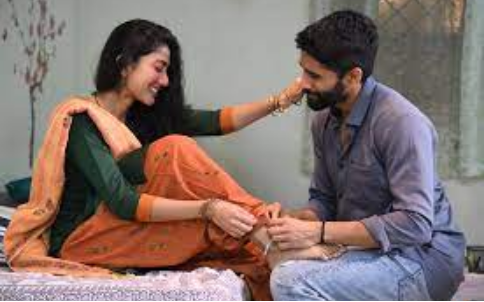
The film begins off with the introduction of Naga Chaitanya’s Revanth, he comes from a lower caste in Armoor, Telangana. He has grown up listening to his mother about how it’s always better to be in a position where you can give financial assistance rather than having to receive it. Revanth is settled in Hyderabad, he runs a small Zumba centre. There are challenges but he is in a position where he can employ someone. Revanth has a dream of expanding the Zumba centre. Sai Pallavi’s Mounica on the other hand is a girl from an upper-caste family. Her family has acres of land but still she has to fight for her rights- financial and otherwise. Mounica finds her wings by partnering with Revanth but she is living in a constant fear, Mounica’s fear is regarding her family and what will they say if they find out about her work. She is particularly scared of her babai (uncle) played by Rajeev Kanakala. Mounica has a condition of trembling if anyone touches her. In fact her condition for joining with Revanth is that two feet distance must always be maintained. This problem has nothing to do with caste as we come to know later on.

Sekhar Kammula is most successful with how he develops the character of Revanth. It has been dealt with utmost sensitivity. Sekhar doesn’t resort to unnecessary commercial elements to prop up the character. Revanth is someone who tries to avoid conflicts as much as possible. He tries to solve problems through peace. There is only one scene towards the end where Revanth feels that enough is enough and decides to fight back. However this action scene works because of the context behind it. It is also refreshing to see Naga Chaintanya come out of his comfort zone playing a character like this. Naga Chaintanya delivers a career defining act. He gets the nuances of the role spot on starting from the accent.

The caste disparities have also been portrayed well. Although these scenes remind you of Sairat they still work. For example there is a scene where Revanth and her mother are looked down upon by the household of Mounica. Revanth is mocked by Mounica’s mother based on his attire and she doesn’t think twice before offering him second- hand shirts.

Sai Pallavi and Naga Chaitanya

Sekhar Kammula also does a good job in portraying Mounica’s psychological condition. The reason why she asks to maintain two feet distance has been well explained.

Lastly the scenes between Naga Chaitanya and Easwari Rao who plays the mother are a delight to watch. Her character is someone who is the moral centre of the film. Their relationship is one of the most satisfying aspects of the film. Eshwari Rao is very good in her role.

The biggest issue with Love Story is that Sekhar Kammula takes too much time in building up the love. There are too many Zumba dances which take half of the screen time. Too much time is also spent on the hero and hero’s introduction. As a result there are times when you feel that some scenes have been added without any purpose.

While Sai Pallavi is good in her role elements of Fida are very glaring. The Telangana accent and the dances are straight out of Fida. The crying scenes towards the end are too melodramatic and it acts as a hindrance for the audiences in completely sympathizing with the character.

Logically also there are some glaring loopholes. Uttej’s character is supposed to be an important role but he disappears when the hero needs him the most. The character of Sai Pallavi’s sister is also left midway. 

The hangover of Sairat and Highway also compound the issues. This hangover will be particularly felt for those who have seen the above mentioned ones.

Love Story isn’t a bad film but it doesn’t have the repeat value of Sekhar Kammula’s AnandGodavari and Fida.

Shershah: An Engaging War Drama Within The Confines Of A Familiar Space

Indian war films do follow a certain template and the challenge as a director is how you make it engaging within that genre. Director Vishnu Vardhan’s biopic on Vikram Batra has all the typical ingredients but to the credit of the director he takes a restrained approach, the result is a very watchable film. It also helps that leading man Siddarth Malhotra is in good form. The film can be a game changer for Siddarth. Shershah was a code name given to Vikram Batra during the war.

For those who are not aware Vikram Batra was an officer of Indian army. He was posthumously awarded with Param Vir Chakra for his actions during the 1999 Kargil war. He led one of the toughest operations in mountain warfare in Indian history.

The film’s narrative arc is quite similar to Jahnvi Kapoor’s Gunjan Saxena which was also produced by Dharma. In the opening scene we see Captain Vikram Batra and his troops in middle of the action while they are on their way to destroy the last Pakistani bunker that would recapture the peak. From here we move to the structure of a flash forward narrative. The story of Vikram Batra is narrated by his twin brother also played by Siddarth Malhotra.

The most interesting aspect of the film is Vikram Batra’s equation with the Kashmiri people during his first posting as a lieutenant. We see him getting along with a lot of ease with the local people. He calls them Chacha, uncle etc. The elders also trust Vikram Batra more than his senior officers.

A good example of that is the scene where an elderly man talks to Vikram Batra regarding his son. The son had joined the militants and now he wants to come out of it. While it is difficult to imagine whether all this happened in reality but nevertheless it makes for an engaging watch.

The film comes alive more in the second half when the action shifts to the war. The cinematography by Kamalijeet Negi effectively captures the atmospherics of war and the action scenes along with V affects combined get you into the mood.

The music by Tanishk Bagchi, B Praak etc is also fine and the songs don’t act as speed breakers. My favourite song is the Ranjha one.

The supporting characters have also been written with certain amount of care. Whether that is Shiv Pandit or Sahil Vaid. These supporting characters add quite a lot to the film. Shiv Pandit is particularly impressive out of the supporting cast. The camaraderie that Vikram Batra shares with these men is quite nice to watch.

The love track between Siddarth Malhotra and Kiara Advani’s character Dimple has its share of moments but it isn’t something memorable. It also doesn’t help that Kiara’s Punjabi accent is all over the place.

A big strength of the film apart from its real life story is Siddarth Malhotra’s performance. The actor looks the part and manages to capture the spirit of the real life Vikram Batra. The part of the twin brother isn’t much but he shines there too.

What pulls down the film is some unnecessary things. For example there is a Madhuri Dixit reference in a middle of a war. It feels quite out of place and could have easily been done away with.

Also the writing will remind you of several other war films like Uri etc. But that has also got a lot to do with a fixed template that lot of filmmakers have been using to narrate these kind of stories. A film like Raazi is an exception.

In a nutshell watch Shershah for the spirit of Vikram Batra.

Grahan: An Impactful Story Handled With Great Sensitivity

It has become common for every web series to have a political background, case in point being Sacred Games, the two seasons of Family ManPaatal Lok and others. Grahan is no different. The series is inspired by the novel Chaurasi written by Satya Vyas. The story traverses two timelines which are set three decades from each other but there is a commonality which binds these two timelines. The eight – episode series packs in many things but still makes a huge impact on the viewer’s mind. The major credit for that goes to director Rajan Chandel and the cast.

Zoya Hussain plays the righteous IPS officer Amrita Singh. Amrita is someone who strongly believes in using her position for betterment of society. She lives with her father in Ranchi played by Pavan Malhotra. Her father Rishi alias Gurusevak wants Amrita to move to Canada with her fiance Karthik( Nandish Sandu). When she tries to solve a case of a honest journalist Amrita is rebuked by top politicians who try to influence her. Tired of all these things she decides to resign from her job. However things take a turn when on old case regarding the Sikh riots in a place called Bokaro comes up. Amrita is asked to take charge of the reinvestigation of that particular incident. Amrita is more than happy to take it up but her world comes crashing down when she finds that her father Gurusevak is the prime suspect in the case.

What follows is a tough battle where Amrita finds herself at the crossroads. She starts questioning her own identity and feels that her entire life is a lie. Her father on the other hand stays silent as Amrita faces the dilemma of whether her father was really a criminal. The other timeline of the story is the love track of Gurusevak when he was young and Manu. These two parts have been played by newcomers Anshuman Pushlar and Wamiqa Gabbi. This is set in the 80’s. They meet in an unlikely sitiuation in Bokaro and fall in love. But the assassination of Indira Gandhi creates an unexpected havoc in their lives. People are seeking vengeance and Rishi heads a team of rioters. However the big question is did he really do it or is there more to this entire thing that meets the eye?

The most striking aspect of Grahan is the parallels that it draws between the 1984 Sikh riots and today’s India. It talks about how people can be quickly incited by WhatsApp forwards and political manipulation. There are scenes in the present timeline which effectively communicate how people easily believe in rumours and turn against each other in spite of living with them for a long time. The underlying message is that issues are the same whether it is 1984 or today.

On the surface, Grahan may look like part investigative drama and part love story but there are subtle references to many of burning issues in our country. These include casteism, sexism, poverty etc. There is a scene where a witness refuses to accept a glass of water from a cop, the reason for that is he (the cop) comes from the lower caste. This scene leaves you with a knot in the stomach.

The series is also effective in giving a psychological insight into the mindset of the people who let themselves be influenced by the situation around them. There is a powerful scene where a rioter sheds tears after 30 years while talking about the people that he killed during the riots. He says that he picked up the gun only to feel powerful and goes on to say how wrong he was.

The 80’s love track gives the series some of its most charming moments. Both the newcomers play their parts with conviction. You root for them to have a happy ending which doesn’t happen.

The cinematography of Kamaljeet Singh also deserves a special mention as he is able to capture the period of 80’s perfectly and make it believable for today’s audiences. The background score is also equally effective particularly in the scenes of the riots.

Another major highlight of the show is the father and the daughter equation and the ups and downs that it goes through the entire process. The emotional scenes between Zoya and Pavan Malhotra will definetly strike a chord in your hearts. It also helps that they deliver brilliant performances.

The only slight issue that I had with the show was the editing of some episodes. It could have been tighter. Also there are certain subplots that take time to unravel.

Grahan is a story with many emotions. Watch it particularly for the sensitive handling of the subject matter.

Haseen Dilruba: An Exploration Of Love And Marriage Under The Guise Of A Thriller

Vinil Mathew’s Haseen Dilruba starts off as an investigation thriller but as the story progresses it turns out to be more than that. Vinil Mathews last film was the romantic comedy Hasse Toh Phasse. This one is a dramatic shift in terms of many things but fortunetly he pulls it off for most part.

Tapsee Pannu plays a middle class girl from Delhi( Rani Kashyap). She has done a beautician course and has certain qualities in mind that she wants in her life partner. Vikrant Massey plays Rishabh Saxena from Jwalapur, he’s an electrical engineer with a government job. His only hobby is repairing electronic items whenever he gets an opportunity. Rishabh is a far cry from the husband that Rani wants but she still ends up in an arranged marriage with him. However the marriage soon starts falling apart. One reason for that is the sexual incompatibility and other reason being the timid nature of Rishabh.

At this point you have the arrival of Neel played by Harshvardhan Rane. Neel is someone who is into adventure sports and it doesn’t take long for Rani to get attracted to Neel. Both of them have a secret relationship and that includes physical too. Things take a huge turn when Rishabh is supposedly dead in a gas explosion and Neel has disappeared. Rani is considered to be the prime suspect for the alleged murder of her husband.

The biggest reason why  Haseen Dilruba works  is due to the way Vinil Mathew portrays the various stages of Rani and Rishabh’s marriage. It swings between Intense disklike and intense love for most part.

Intially Rishabh comes across as a henpecked one but there is a sudden shift in the character when Rani reveals about her having an affair with Neel. The darker tone has been portrayed with subtlety and it never goes over the top. You only have a subtle gesture in terms of the facial features that suggest what is going through Risabh’s mind. Vikrant is good as the timid husband but he is even better when the tonality changes.

The passion that the characters share comes out very palpably and we firmly root for the couple.

The film also looks at how time and circumstances shape our actions and behaviour. There are no heroes and villains here as each character comes out with its own set of flaws. We are ultimately shown how we do crazy things for each other and to each other just because at that time we feel this is the right thing to do.

The film also talks about how men get uncomfortable when women openly choose to express their sexual drive. There are scenes in the beginning  of the marriage when Rani drops her pallu to excite Rishabh but Rishabh feels very uncomfortable.

Like most films of this genre Vinil Mathew employs the technique of going back and forth. The thriller aspect has also been done well since you are constantly guessing about what actually happened.

The thriller format isn’t something new for Tapsee but she still delivers a wonderful performance. She is someone who knows that she has flaws and has a hard time accepting them. However at the same time she has the ability to change as well. Tapsee pulls off all these shades well. Harshvardhan Rane leaves an impact in his small role. He fits the part of the handsome hunk and you can easily understand why Rani falls for Neel.

The only things which stick out are parts of Tapsee’s family. They simply dissapear when the story takes a dark turn and you are not given any proper explanation.

Haseen Dilruba isn’t everyone’s cup of tea but it is worth a watch for the plot and the performances.