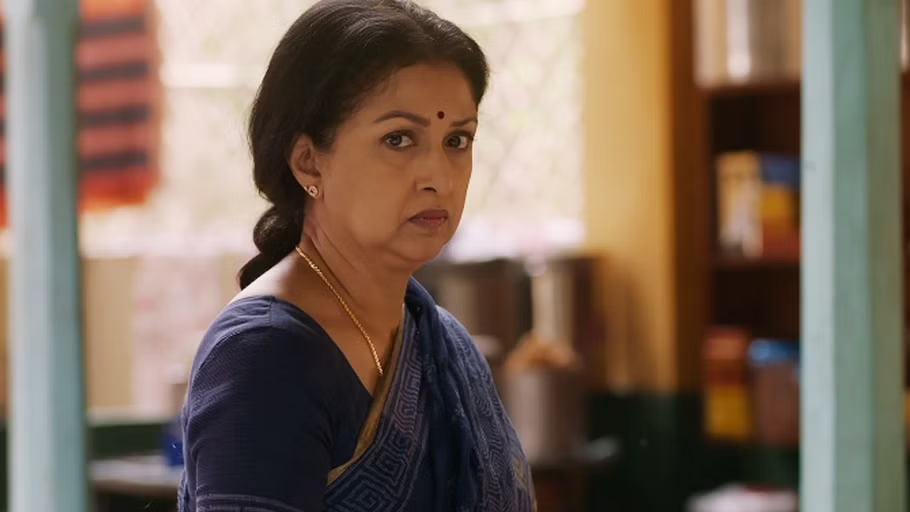
Malli Pelli: An Autobiographical Movie Worth Watching For Its Theme And Performances

After two directorial debacles, MS Raju delivers a much better film. The film is one-dimensional but still, there is a lot to ponder.

Malli Pelli (Telugu)
  • Cast: VK Naresh, Pavitra Lokesh, Vijaykumar, Jayasudha, and late Sarath Babu
  • Director: MS Raju
  • Music composers: Suresh Bobbili and Aruldev
  • Runtime: 2 hours and 10 minutes

MS Raju, as we all know, has produced many blockbusters, including Varsham, Okkadu and Deviputrudu.

In 2008, MS Raju made his directorial debut with the film Vaana; however, true to its title, the film was a washout.

But that didn’t stop the producer from directing films. He made his next film Tuneega, starring his son Sumanth Ashwin. But the result was the same.

Back with Malli Pelli

After staying away from the big screen for some time, Raju is now back with his third big-screen directorial Malli Pelli.

The film has created quite a buzz, thanks mostly to the real-life couple VK Naresh and Pavitra Lokesh. Their real-life relationship has been making headlines for a long time.

A film starring a real-life couple has a different charm about it. Not surprisingly, the biggest strength of Malli Pelli is the chemistry that the lead actors share and the solid emotional moments that the director created.

Narendra (Naresh) is a prominent Telugu actor with a vast amount of wealth and respect. However, his personal life is going through huge turbulence because of a broken marriage.

Soumya Sethupati (Vanitha Vijaykumar) plays Narendra’s psychotic third wife.

One day he meets a Kannada actress Parvathy (Pavitra Lokesh) and develops feelings for her. He communicates the same to her despite knowing fully well that she is a married woman.

Story of two people with broken marriages

Parvathy’s marriage is also on the rocks although she presents a picture of a happily married woman. Parvathy also has feelings for Narendra but she is apprehensive about how society would react, particularly the media.

The rest of the story deals with the complexities of their relationship and how it develops in the end.

First and foremost, the story is designed in such a way that the viewers completely empathise with the couple.

The respective spouses of Narendra and Parvathy are portrayed as one-dimensional, with no redeeming quality. This does get bothersome after a while, particularly in the second half.

But still, the emotional quotient is strong. As a result, you are willing to overlook the soft spots.

The story has been narrated in six chapters, a technique that is well used by MS Raju. This format enhances the drama.

Mix of light and dramatic moments

Malli Pelli has a good mix of light and dramatic moments. The scenes of Narendra flirting with Parvathy do bring a smile to your face. Their romance is treated maturely with no vulgarity.

The concept of an older couple finding solace in each other has been dealt with with the right amount of sensitivity.

Stories like this are always a welcome break given that this genre is mostly associated with younger actors.

Raju is also successful in portraying the moral dilemmas that Narendra and Parvathy go through before they decide the direction in which they should take their relationship.

The flashback portion of Parvathy, though abrupt, has its moments. There is a caste angle that the director added to the spouse of Parvathy.

Performance of the actors

Jayasudha plays a character modelled on Vijay Nirmala, Naresh’s real mother.

Even though her scenes with Naresh are few, there is a lot of warmth in those scenes.

The same applies to the ones featuring Sarath Babu as Superstar Krishna. Watching Sarath Babu on screen evokes a lot of nostalgia given that he passed away recently.

However, it is VK Naresh and Pavitra Lokesh who shoulder the film majorly. He does a swell job of bringing his real-life persona to the character. The senior actor is having a splendid second innings and this is another worthy addition.

Pavitra Lokesh also lends wonderful support. She does a good job of portraying the character’s transition.

Coming to the flaws Vanitha Vijaykumar comes across as very irritating both character-wise and acting-wise. A more nuanced characterisation would have made it more real.

The same applies to the portrayal of the media. It is not only caricaturish but also highly offensive.

A middle-aged romance and Naresh’s performance are the best things about this film.

Dahaad: A Gripping Thriller That Goes Much Beyond The Usual Police Procedural

Zoya Akhtar and Reema Kagti script a serial-killer story that also looks at important social issues plaguing our society.

Dahaad (Hindi)
  • Cast: Sonakshi Sinha, Gulshan Devaiah, Vijay Varma, Sohum Shah and others
  • Directors: Reema Kagti and Ruchika Oberoi
  • Music: Gaurav Raina Tarana Marwah
  • No. of episodes: 8
  • OTT platform: Amazon Prime

Zoya Akhtar has created a niche for herself in the industry with her strong storytelling skills; whether it is stories about the elite (Zindagi Na Milegi Dobara and Dil Dhadakne Do) or the underdogs (Luck By Chance and Gully Boy).

Audiences expect a certain quality when her name is associated with any project.

After co-directing the blockbuster web series Made In Heaven, Zoya delivers another winner, Dahaad.

Though she isn’t the director of this one, she is one of the creators and also has written the additional screenplay.

For those who are not aware, Dahaad is inspired by real-life serial killer Mohan Kumar, also known as Cyanide Mohan.

Synopsis

The story of Dahaad is set in a small town called Mandawa in Rajasthan.

Sonakshi Sinha plays Inspector Anjali Bhaati, an officer who belongs to a backward caste.

She gets the case of a girl who is said to have eloped with a Muslim man taking along cash, jewellery, and other things.

She initiates the investigation with her fellow officers Devilal Singh (Gulshan Devaiah) and Kailash Parghi (Sohum Shah).

During the investigation, the cops discover many similar cases of girls eloping with anonymous partners, which raises the question of whether they were all linked.

Eventually, Anjali finds that all the eloped girls died by consuming cyanide.

Anand Swarnakar (Vijay Varma) is the prime suspect. However, Anjali is not able to gather strong evidence against him.

Meanwhile, Anand plays many tricks with the police and poses as a victim who is being harassed by Anjali.

The rest of the story follows Anjali’s pursuit of the case. Where her suspicions about Anand right? If so, how does she and her team manage to arrest Anand red-handed?

Also. why is the killer attacking girls from only a particular social stratum?

The presentation

The best thing about Dahaad is how the Zoya Akhtar, Reema Kagti, and Ruchika Oberoi team uses the town of Mandawa and Rajasthan.

Both these become a character in themselves, and the social issues have been presented in a hard-hitting manner.

For example, despite being a police officer, on more than one occasion Bhaati is reminded of her lower caste.

Anjali has to fight against both sexism at the workplace along with questions about her lineage.

A scene which deserves particular mention is the one when Anjali lashes out at a wealthy man who doesn’t allow her to enter the house because of her lower caste.

There is also a subplot of how people are used as scapegoats. It is brief but Ruchika Oberoi and Reema Kagti make some important points.

Standout performances

Gulshan Devaiah’s Devilal Singh is a character that stands out the most along with Vijay Varma’s Anand Swarnakar.

We see Devilal Singh not just as a determined police officer but also as a husband and a father who is weathering a storm at home.

He has a progressive outlook on how his daughter shouldn’t confine herself to being a housewife in future. He wants her to be strong and independent.

His wife on the other hand isn’t so progressive and as a result, there are constant tussles.

Devilal Singh is so progressive that he even makes his son understand that curiosity about sex is natural at his age and that there was nothing wrong with that. However, he also tells his son to be careful.

Gulshan Devaiah steals every scene he is in with a magnetic performance.

The antagonist

Vijay Varma is a veteran at playing socially deviant characters; whether it is Pink or last year’s Darlings.

Still, the actor makes a huge impact with his character in this series. Anand is a complex character as he appears to be a do-gooder on the surface.

Apart from being an excellent Hindi professor he also runs a mobile library for the underprivileged but soon enough the viewers can understand how calculative he is.

He spends most of his time outside the home and his equation with his father is not great as there are severe daddy issues.

Vijay Varma is in fantastic form. Both as a middle-class married man struggling to make out ends meet and also as a serial killer who has unresolved issues with his father.

Striking aspect

Another striking aspect of the web series is how it doesn’t paint all men as monsters.

Certain women characters in the web show are equally regressive.

This particularly comes out in the scenes when Anjali talks to the parents of the eloped girls. All of them think that it was good that their daughters eloped instead of being a financial burden at home.

They declare that they had nothing to do with girls.

It must be mentioned that Anand only targets women from the lower strata of society and whose parents were not in a position to pay a big dowry.

He camouflages himself as a different person and seduces them by talking sweetly. Once they fall for him and agree to have sex, he thinks they are loose characters and eliminates them with cyanide.

Slightly off

One of the areas that Dahaad slightly falters is the climax.

After all the cat and mouse game the confrontation between Sonakshi and Vijay could have been more impactful.

Another issue with the web series is the casting of Sonakshi in the role of Anjali Bhaati. Sonakshi is adequately fierce in her demeanour but is rather one-dimensional in how she approaches the character.

The cinematography by Tanay Satmam is of the first order. He does a wonderful job of capturing the rusticness of the terrain. The Rajasthani dialect used is also mostly flawless.

Final verdict

Dahaad is definitely a worthy roar and a noteworthy addition to the career of Zoya Akhtar.

(Views expressed are personal)

Anni Manchi Sakunamule: A Well-Made Entertainer In Typical Nandini Reddy Style

Anni Manchi Sakunamule isn’t high on the story but the director is successful in creating heartwarming moments.

Anni Manchi Sakunamule (Telugu)
  • Cast: Santosh Sobhan, Malvika Nair, Rajendra Prasad, Rao Ramesh, and Naresh
  • Director: B.V Nandini Reddy
  • Producer: Priyanka Dutt
  • Music: Mickey J Meyer
  • Runtime:: 2 hours and 35 minutes

Director Nandini Reddy has emerged as a strong filmmaker with films like Ala Modalaindi (2011), Kalyana Vaibhogame (2016) and her last Oh Baby (2019). An key quality of her films is the entertainment factor. More than the plot, the viewers remember Ala Modalaindi and others because of the director’s treatment.

Her latest Anni Manchi Sakunamule perfectly falls into this category. Though it is a familiar tale of two families who are stuck in a land dispute, what makes the movie rise above the template is how she deviates from the typical tropes that we associate with films of this kind.

Synopsis

The story of Anni Manchi Sakunamule is set in the fictional hillside town of Victoriapuram. There are two families in a legal battle over the ownership of a coffee estate for decades (there is a hilarious origin story to the dispute).

In the present day, there is Sudhakar (VK Naresh), who is modest and likeable, and Prasad (Rajendra Prasad), who is wealthy and money-minded.

On one rainy night, their respective wives are rushed to a hospital for delivery. Here a baby-swapping happens because of an alcoholic doctor Jagadamba (Urvasi), and negligent staff.

This part is reminiscent of the Trivikram blockbuster Ala Vaikuntapuramlo (2020), but thankfully, here you don’t have any jealous employee scheming against his boss.

The leads

Coming back to the story, while Rishi (Santosh Sobhan) is raised by Prasad, Aarya ( Malavika Nair) is brought up by Sudhakar.

Both Rishi and Aarya become high school buddies despite the family dispute. They have contrasting personalities. While Aarya is more ambitious and hard-working, Rishi is more laid back, and his interests lie in cooking, travelling, etc.

Rishi loves Aarya since childhood, but he doesn’t express it as he feels Aarya deserves a better person than him.

Talking about the leads, both Santosh Sobhan and Malavika Nair are in good form, particularly Malavika. She does a splendid job of showcasing the ambitious nature of Aarya. She is successful in portraying both inner strength and also vulnerability.

The rest of the story deals with how the family dispute is solved and whether Rishi will express his love for Aarya. And very importantly, do the families come to know about the swapping of babies and what impact that has on them?

Nandini Reddy’s strengths

The thing which strikes you most about Anni Manchi Sakunamule is how Nandini Reddy has subverted some of the tropes that we associate with this genre. The best example of this is the equation between Rishi and Aarya.

Though there is a generational trauma that both the families carry, that doesn’t stop Rishi and Aarya from becoming friends. Yes, there are moments when the duo are at odds with each other but in general, these moments have nothing to do with their families.

Nandini Reddy does a good job of exploring their relationship
which takes several turns through the film. Rishi and Sudhakar are also cricket buddies who play matches together. There is warmth in the scenes featuring them. Likewise, Prasad also has respect for Aarya’s street-smart nature. At one point he even expresses a wish to adopt Aarya.

Strong female lead

Another striking feature of Anni Manchi Sakunamule is how Nandini Reddy has written the character of Aarya. Malavika Nair’s Aarya is someone who runs the household’s financés with an iron grip. She is also the primary breadwinner. Her scenes with Naresh are a delight to watch. There is also Rishi’s firebrand grandmother (Sowcar Janaki); her feistiness brings a smile to the audience’s face.

Supporting actors

The film has a huge motley of supporting actors, but unlike the big-ticket ventures, here most of them have solid arcs. The best of the lot is Rajendra Prasad and Gautami. Rajendra Prasad has a tricky part, given the money-mindedness of Prasad and also his dissatisfaction with his son, but the senior actor manages to make sure that his role doesn’t become a caricature.

Gautami as the benign mother is a pleasure to watch. There are recurring gags of Gautami’s hearing disability, but at no point does Nandini Reddy use it for crude humour.

Vennela Kishore also brings in many laughs as the annoyingly pleasing son-in-law. Vasuki who plays his wife, makes a comeback after decades but there is nothing significant about her character.

The flaws

Despite its many positives, Anni Manchi Sakunamule also got its share of lags.

For example, there is an unnecessary love
triangle that doesn’t add anything to the story.

There is also a debate where the characters argue about the cuisines of Andhra and Telangana. This is staged in a rather clumsy manner.

Technical aspects

Micky J Meyer’s music is melodious and adds to the proceedings. Sunny Kurapati and Richard Prasad’s camerawork bring alive the beauty of Coonoor.

Final verdict

It is a good entertainer particularly if you enjoy a slice of life dramas and also if you are an admirer of Nandini Reddy’s kind of films.

(Views expressed are personal.)

Newsense: A Web Show That Gives An Insight Into The Nexus Of Media And Rural Politics

Sai Prawin Kumar’s directorial Newsense consists of many threads that sustain the interest of the audiences for the second season also.

Stories centred on politics and journalism make great subjects because both are interconnected pillars of our society.

Newsense is one such show. However, this isn’t an easy genre to crack for a director as a certain authenticity is needed, as well as some political knowledge.

Director Sri Prawin Kumar looks at the nexus between politics and the media in small towns. He creates a web of characters who can’t be slotted as black or white.

He does a wonderful job for the most part. The director is also hugely aided by his cast, starting with Navadeep, who disappears into his part.

Synopsis

The backdrop of Newsense is a small town called Madanapalle in Andhra Pradesh, set in the 1990s and 2000s.

The show primarily explores unethical journalism practised by a set of stringers, along with a few politicians who want to grab power at any cost.

Shiva (Navadeep) is a street-smart journalist who belongs to the same category.

But sometimes, he deviates from the norm by presenting the truth (although not completely), and as a result, he gets into trouble.

For Shiva and his fellow stringers, it is a battle between doing the right thing, and also staying alive. Often we see them accepting covers of money from both political parties.

Newsense deals with several issues like the role of media in society, and the impact of sensationalising news, among other things. It does not hesitate to criticise the media and its corrupt practices.

Though the story is set in the Rayalaseema region, the director thankfully doesn’t resort to over-the-top action sequences that the viewers are forced to see in typical action movies.

Newsense grips the viewers from the start with its multi-layered narrative. As viewers, we empathise with the sufferings of the local people, who are sandwiched between two political parties.

For example, there is a farmer who fights for his land, which has been illegally occupied by miscreants, a woman searching for a missing husband, etc. There is certain believability about the problems they face.

Despite the show’s serious tone, there is also some raw humour which comes as a respite.

The chemistry between the leads

Neela is an aspiring news anchor and Shiva’s love interest.

Through the character of Neela, the director touches upon the perspective of a female journalist in a town that is dominated by male journalists. The interaction between Shiva and Neela has a certain playfulness combined with a local flavour.

This has been both wonderfully written and enacted. The chemistry between the duo is spot on. Newsense’s light moments mostly feature Shiva and Neela (played by Bindu Madhavi).

Talking about the leads, both Navadeep and Bindu Madhavi are in very good form.

Navadeep gets into the skin of his character, starting from the dialect. He embraces the several grey shades of his character with aplomb.

Bindu Madhavi lights up the frame whenever she is on screen. She is supremely natural on her part.

Strong technical aspects

What also adds to the impact are the dialogues of Jayasimha. He does a good job of making the viewers introspect without resorting to rhetoric.

The background music of Suresh Bobbili goes well with the flavour of the series, Newsense. There is only one song in the show— Myneeru Pillagada. This track makes for a soothing watch, both for the ears and the eyes.

Three cinematographers are involved with this web series— Anantnag Kavuri, Vedaraman and Prasanna. They capture the rustic terrain wonderfully through their lens.

Nanda Gopal to rescue

There are some moments where the graph does go down.

But thankfully the show gets back on track with the entry of Sub-Inspector Edwin (Nanda Gopal), in the fifth episode.

Nanda Gopal has an arresting presence which makes the viewers look forward to his portions despite the limited screen time. The rest of the supporting actors also make an impact.

Final verdict

Overall this web show is binge-worthy, particularly if you have a keen interest in politics and media. It shows how lives are ruined because of the unholy relationship between two great pillars.

Custody: A Competent Cop Drama That Keeps The Viewers Invested In Spite Of Its Shortcomings

Venkat Prabhu’s latest directorial takes time to find its feet but eventually gets better as the plot becomes thicker.

Watch it for Aravind Swami and Naga Chaitanya!
Custody (Telugu)
  • Cast: Naga Chaitanya Akkineni, Krithi Shetty, Arvind Swami, Priya Mani, Sarath Kumar, Sampath Raj, Premji Amaren, Vennela Kishore, and Premi Vishwanath
  • Writer-Director: Venkat Prabhu
  • Producer: Srinivasaa Chitturi
  • Music: Ilaiyaraaja and Yuvan Shankar Raja
  • Runtime2 hours 28 minutes

Cop dramas usually have a superhero cop who takes on an army of villains and vigilante justice is delivered. Venkat Prabhu’s Custody belongs to a slightly different space.

Here, Naga Chaitanya’s Shiva has the duty of protecting a goonda (criminal) and making sure that he is produced before the court, without any harm.

Another factor that makes Custody different from other movies of the same genre is the fact that Shiva is a constable, not a higher official. There is an underdog quality about him that makes him endearing.

Synopsis

The movie is set in the 1990s. Its opening shot is a terrible incident where 40 people die in a small town due to a gas cylinder blast. After that, we cut to the constable Shiva.

Shiva is someone who believes that human life is more important than anything else. This is wonderfully established when he rushes to stop the convoy of the Chief Minister (Priya Mani) so that an ambulance can pass.

Revathi (Krithi Shetty) is Shiva’s love interest. They both have a steady relationship for a while but there are some serious obstacles from her parents’ side.

Things take a turn with a car accident when Shiva is on the way to her house to save her from a forced marriage.

After the accident, two men are seen fighting – one is Raju (Aravind Swami) and the other is a CBI official George (Sampath Raj). Shiva ends up arresting both.

On reaching the police station, Shiva learns the true identity of Raju, a well-connected goonda with political backing. He needs to be produced at the Bangalore court in the next 24 hours to testify against some influential people.

Meanwhile, there is an assassination attempt to kill Raju before he reaches court. Shiva makes sure that the assassination attempt is not successful.

He and George escape from the police station with Raju. But IG Natraj (Sarathkumar) is hell-bent on making sure that Raju doesn’t reach the Bangalore court.

Adding to the mayhem, Revathi escapes from her house by making her prospective groom (Vennela Kishore) a bakra.

The rest of the story deals with whether Shiva is successful or not in producing Raju before the court and what happens to him and Revathi later.

Shortcomings & best moments

Custody begins engagingly. As viewers, we instantly connect with Shiva’s honesty and want him to succeed in whatever he does.

But things go haywire with the addition of the love story and also an irritating comedy track featuring Vennala Kishore.

The songs also come as major speed breakers, which is surprising, given that it is the first time that the father-son duo of Ilaiyaraaja and Yuvun Shankar Raja have worked together.

It is a step down from Ilaiyaraaja after a soulful soundtrack in Krishna Vamsi’s Rangamarthanda (2023).

Nevertheless, the plot becomes more engaging with the entry of Aravind Swami. The action set piece in the police station is wonderfully staged. Here, it has to be mentioned that, the background score is much better than the songs.

The cat-and-mouse chase involving Natraj, Raju and Shiva gives the film some of its best moments.

Another action stretch that deserves a mention is the pre-interval block involving an underwater sequence.

We see an unlikely bond developing between Shiva and Raju through the journey. This has been well-etched by Venkat Prabhu.

Impressive show by actors

Aravind Swami does a wonderful job in making sure that Raju, despite being a goonda, comes across as endearing. He also brings in some dry humour that raises many chuckles.

Much like in Sekhar Kammula’s Love Story (2021), here too, Naga Chaitanya plays an underdog and delivers a wonderful performance.

He does justice to the arc of the character which goes from a happy-go-lucky guy in the flashback to a determined young man in the present.

Krithi Shetty alternates between a typically chirpy heroine and a serious woman. She does it quite well in spite of the romantic track coming across as a hurdle.

Sarathkumar as Natraj makes for a formidable opposition.

Final take

Watch Custody for the performances of Naga Chaitanya and Aravind Swami along with some thrills.

Saas Bahu Aur Flamingo: Dimple Kapadia & Co Lead This Formidable Tale Of Badass Women

Director Homi Adajania makes a successful OTT debut with a perfect mix of emotions and thrills.

Leaves you with a solid high!
Saas Bahu Aur Flamingo (Hindi web series)
  • Cast:Dimple Kapadia, Isha Talwar, Radhika Madan, Deepak Dobriyal, Naseeruddin Shah, and Jimit Trivedi
  • Director:Homi Adajania
  • Producer: Dinesh Vijan
  • Music:Sachin Jigar
  • No. of episodes: 8
  • OTT platform: Disney+ Hotstar

It is always refreshing when the stories are headlined by women — whether they are movies or web series. More so, when they are well made.

Homi Adajania’s debut OTT show Saas Bahu Aur Flamingo is one such tale. The director presents four inimitable women who are a treat to watch.

What makes the web series even more refreshing is the saasbahu dynamics avoiding the clichéd tropes that you generally see in Indian television shows.

Synopsis

This web show is set in a remote village called Hastinapur, somewhere in Rajasthan.

Savitri (Dimple Kapadia) runs a company named “Rani Cooperative” which trades in various products. Some of these include jaribooti (herbs), balms and textiles. However, there is also a dark side to this company — drugs.

“Flamingo” is the name of the drug Rani Cooperative deals in.

Savitri operates out of a haveli (mansion) and is surrounded by a team of women, including two daughters-in-law Kajal (Angira Dhar) and Bijliee (Isha Talwar). There is also the rebellious daughter Shanta (Radhika Madan).

These four women together run the business with a firm hand and live life on their terms. They are always ahead of their enemies, including The Monk (Deepak Dobriyal).

Savitri also has two reckless US-returned sons — Harish (Ashish Verma) and Kapil (Varun Mitra). They both have zero knowledge about the nature of their mother’s business. But soon enough, they find out.

Things take a turn when Savitri announces that she would soon name a successor to her company. What follows is a thrilling tale that keeps you invested for the most part.

Engrossing drama

Saas Bahu Aur Flamingo grips the viewers from the start.

There is a spine-chilling scene at the very beginning. Not many details can be revealed here but it sets the stage for an engrossing drama.

There is a certain authenticity to the way the village has been presented and no artificiality in the rustic makeover of the characters.

A major highlight of Saas Bahu Aur Flamingo is how Homi Adajania uses the palatial haveli of Dimple Kapadia’s Savitri. It is a character in itself. This is a palace filled with many secrets.

Brilliant characterisation

The story written by Saurav Dey, Karan Vyas & Co has many moments of tension and unpredictability.

It isn’t just high on thrills but it also packs in some strong emotional moments. The case in point is the characterisation of Dimple Kapadia.

Savitri is extremely brutal and menacing. But at the same time, there is also an emotional gravitas that makes the viewers empathise with her.

Another characterisation worth mentioning here is that of Isha Talwar. Her character has an additional layer of homosexuality which, thankfully, has been dealt with sensitively.

Director Homi Adajania also pays homage to Shekar Kapoor’s Bandit Queen (1994) and Ketan Mehta’s Mirch Masala (1987) with some brilliantly executed action scenes where the women take on Deepak Dobriyal and his henchmen.

Saas Bahu Aur Flamingo also works because of its strong antagonist.

Deepak Dobriyal’s Monk hasn’t got many dialogues but the actor makes a solid impression with his eyes and expressions. He exudes menace without breaking a sweat.

This web series has some laugh-out-loud moments, thanks to Ashish Verma who plays one of Savitri’s sons. He raises many chuckles with his understated humour. His moments of bickering with Kapil are a delight to watch.

Dimple Kapadia stands out

Talking about the women characters, Dimple Kapadia is brilliant in exuding both raw power and the required vulnerability in equal measures. With this power-packed performance, the veteran actor shows that she is only getting better with age.

The other actresses who stand out are Isha Talwar and Angira Dhar. They deliver a class act and more than hold their own opposite Dimple Kapadia.

Radhika Madan’s Shanta isn’t different from what she played earlier but she too makes an impression.

The one slight flaw in the series is the underutilisation of Naseeruddin Shah. Much like his last release Kuttey (Dogs, 2023), here too, the senior actor packs a punch despite his limited screen time. But as viewers, we want to see more of him.

Talking about the music, Sachin Jigar’s score goes perfectly with the tonality of the show. Even his background score enhances the drama by several notches.

Cinematographer Linesh Desai does a spectacular job of capturing the parched and arid land through his lens.

Final take

Overall, this group of women in Saas Bahu Aur Flamingo leaves the viewers with a solid high making you look forward to Season 2

From Urban Love Stories To Village Conflicts, Sukumar’s Protégés Follow His Lead

Buchi Babu Sana, Srikanth Odela, and Karthik Varma Dandu chose rustic tales for their debut films.

Director Sukumar is popular for his films which are usually set in urban scenarios. But he seems to have developed a fantasy for rustic tales now.

Right from his debut film, Allu Arjun’s Arya (2004) to Naga Chaitanya’s 100% Love (2011), Mahesh Babu’s 1: Nenokkadine (I Am the Only One, 2014), and NTR Jr’s Nannaku Prematho (To Father, With Love, 2016), the filmmaker delivered back-to-back hits that had an urban background.

Little did we know then that he would also successfully helm two rustic dramas — Rangasthalam (2018) and Pushpa (2021) — that would make the audience sit up and take notic

Rangasthalam and Pushpa have two mainstream heroes who are not particularly known for their rustiness; more so, Ram Charan. But the director’s gamble paid off in both cases.

Protégés follow in his path

Over the years, Sukumar has also nurtured some young filmmakers. Interestingly, three of them — Buchi Babu Sana (Uppena, 2021), Srikanth Odela (Dasara, 2023), and Karthik Varma Dandu (Virupaksha, 2023) — made their debut films in rustic scenarios with village issues.

Caste might not have been mentioned explicitly in their films, but it is obvious that the heroes in these movies are from lower castes. Only in Uppena (Tiday Surge), the protagonist’s caste is specifically mentioned. Viasshnav Tej plays a Dalit Christian belonging to the fishermen’s community.

In Virupaksha, Sai Dharam Tej plays an outsider who visits his ancestral village and tries to address the local issues.

But first, let us look into Sukumar’s Rangasthalam and Pushpa.

Rangasthalam

The story of Rangasthalam is set in a village of the same name. The theme is exploitation and feudalism.

A ruthless president runs the village like a tyrant. The concept of a landlord/village president treating villagers as slaves is of course not new.  There are many films with that theme.

One of Chiranjeevi’s (Ram Charan‘s father) earlier films, Ma Voori Pandavulu (1978), also dealt with the struggles against the feudal system.

However, Sukumar’s treatment made Rangasthalam much more engaging, particularly for the new generation audience.

Ramcharan as Chitti Babu

Ram Charan’s character (Chitti Babu) in Rangasthalam not only comes from a lower caste but is also partially deaf.

Sukumar dealt with this disability in a sensitive manner. He never used it to generate crude comedy.

Ram Charan Tej as Chitti Babu was adorable right from the first frame.

Rough and rustic is not something that the viewers associate with the actor. But under the guidance of Sukumar, the actor delivered his career-best performance.

The actor also got the nuances of Chitti Babu spot on, both in his body language and accent.

Pushpa

Following the success of Rangasthalam, Sukumar once again teamed with his Allu Arjun. But this time, in a very different zone.

Just like RangasthalamPushpa also featured a protagonist who is not only rustic but also an underdog.

In Pushpa, Sukumar majorly looked at the entire syndicate of the red Sandalwood business and the politics involved. It also briefly touched upon the dangers faced by the coolies from the police.

Allu Arjun as Pushpa

Chief among them is Pushpa’s characterisation and how Allu Arjun performed it.

Pushpa is one of the many coolies in the Seshachalam area, hired to chop down red sandalwood trees illegally. He is also an illegitimate son.

Despite being a coolie, there is an inherent swag in Pushpa which comes from his determination to climb up the social ladder to get over that stigma.

Beneath all the roughness, there is vulnerability whenever he is reminded of his birth status, which is brought up at various points in the film. Allu Arjun particularly shined in these moments.

He previously played a non-urban character in Gunasekhar’s Rudramdevi (2015), but that was a warrior role.

Pathbreaking films

These two films are significant in many ways.

After a long time, the viewer is taken back to the villages not to see the natural beauty or innocence of the people, the love or conflict among joint families, and the faction-based stories of Rayalaseema. But, the audience got to see some real conflict themes and exploitation in different forms.

The story of Rangasthalam might look a little outdated in comparison to Pushpa because the subject in the latter is an ongoing problem.

But as a hero, Ram Charan’s Chitti Babu is more relatable than Allu Arjun’s Pushpa because his macho image keeps growing every minute.

Now let’s look at some of the films made by Sukumar’s protégés who have also directed hinterland stories.

Uppena by Buchi Babu Sana 

A protégé of Sukumar, Buchi Babu Sana took the route of his master.

In Uppena, Vaisshnav Tej’s character (Aasi) belongs to the fishermen’s community. Here, the caste of Aasi is directly mentioned as Dalit Christian.

Buchi Babu needs to be credited for making a film like Uppena with a debutant; Vaisshnav Tej comes from the Mega (actor Chiranjeevi’s family) family though.

The first-time director did a wonderful job of exploring the bond that a fisherman shares with the sea.

Vaisshnav Tej’s Aasi also suffers from a stuttering problem. He cannot pronounce the heroine’s name properly however much he tries. Instead of Sangeetha, he calls her Santha.

However, this disability is also dealt with with a certain amount of sensitivity by Buchi Babu Sana, just like Ram Charan’s partial deafness in Rangasthalam.

Vaisshnav Tej also deserves appreciation for how he portrayed the rusticness and vulnerability of Aasi.

Dasara by Srikanth Odela 

Dasara is set against the backdrop of Singareni Coal Mines.

Nani’s Dharani is a ruffian who steals coal for a living. The influence of Sukumar is pretty visible in terms of how Srikanth Odela builds up the village’s atmospherics.

The caste politics are quite reminiscent of Rangasthalam. However, there is no denying that Srikanth has his voice, too. This can be seen in how the director built up the character of Nani.

Nani’s Dharani is timid when he doesn’t consume alcohol. But when on a high, he is altogether a different person. This trait was well used by Srikanth Odela, particularly in the later portions when Dharani decides to get over his alcoholism.

There is a local bar called Silk Bar which has a looming presence throughout the film. The director used this bar to highlight the caste dynamics, as the liquor here is reserved for upper-class men.

Virupaksha by Karthik Varma Dandu 

Much like Dasara and UppenaVirupaksha is also directed by a first-time filmmaker, Karthik Varma Dandu who assisted Sukumar.

Sukumar himself wrote the screenplay for this film.

Virupaksha is a paranormal thriller set in the fictional village of Rudravaram. The director, along with writer Sukumar, made some valid arguments against prejudices and superstitious beliefs that stem from ignorance.

Unlike the heroes in the above-mentioned films, Sai Dharam Tej’s Surya is an outsider to Rudravaram. However, the issues addressed in the film are much rooted.

Nevertheless, if we compare the above-mentioned movies to the Tamil ones, there is a significant difference in how the issue of caste is portrayed.

There it is not just about the protagonist being rustic in overall demeanour; in Tamil movies, filmmakers like Vetri Maraan and Pa Ranjith are not afraid to take the name of the caste. Asuran (2019) and Kaala (2018) are the best examples.

Having said that, for Telugu audiences, the likes of Rangasthalam and others are a definite step forward in the genre of caste-based films.

https://thesouthfirst.com/entertainment/urban-love-stories-to-village-class-conflicts-sukumars-proteges-follow-his-lead/

Kerala Story: This Adah Sharma Starrer Is A Poignant Watch In Spite Of Its Melodramatic Tone And Questionable Politics

Director Sudipto Sen is successful in making you root his primary protagonist

Kerala Files (Hindi)                     3 out of 5

Starcast: Adah Sharma, Yogita Bihani, Sonia Balani and others

Director and writer: Sudipto Sen

Additional writers: Suryapal Singh and Vipul Amrutlal Shah

Producer: Vipul Amrutlal Shah

Production Company: Sunshine pictures

Music directors: Viresh Sreevalsa and Bishak Jyoti

Genre: Drama

Running time: 2 hours and 3 minutes

Vivek Agnihotri’s Kashmir Files has opened up a new genre of films where traumatic real life incidents are taken and made into films with a particular agenda against one community. Sudipto Sen’s Kerala Story has more than one similarity with this 2022 blockbuster. Much like Kashmir Files Kerala Story is also based on horrific true incidents. In this case it is brainwashing girls of other religions and converting them into Muslims by the ISIS. Another similarity is the devilish portrayal of Muslims. In this film most of the Muslim characters are dubious.

But keeping aside these aspects there is no denying the significance of the topics that Kerala Story uncovers. The film is successful in making you root for its primary lead character Shalini who undergoes a religious conversion later.

The movie Kerala Story begins in an interrogation room where a young mother Shalini (Adah Sharma) is revealing the details of her horrific past and why she is in the current situation. Her past involves a friendship with her roommates in a Nursing School of Kerala in a place called Kasargod. The movie is narrated from the perspective of Shalini. Her roommates are Gitanjali (Siddhi Idani), Nimah (Yogita Bihani) and Asifa (Sonia Balani). The other three are not aware of Asifa’s secret agenda which involves converting them to Muslims. There are also some male associates from outside. With the help of these associates Asifa is successful in radicalizing Shalini and Gitanjali. These people also use hallucinogenic drugs to make sure that their mission is successful. Shalini falls in love with one of the men and gets pregnant before marriage. Just before the marriage happens the person in question disappears without a trace. As a result she is compelled to marry someone else. After marriage she embarks on a long journey to Syria via Pakistan and Afghanistan. What follows is a hard hitting story with plenty of Islamophobia.

Before getting into the problematic portrayal of Muslims it is necessary to highlight the positives as well. Director Sudipto Sen is successful in creating moments that evoke a sense of uneasiness in the viewers appropriate to the storyline. The scenes which deserve a particular mention are the ones where Asifa successfully poisons the minds of Shalini and Gitanjali with her persuasiveness.

There are also some hard hitting dialogues through the character of Nimah. Nimah is someone who refuses to buy into the propaganda of Asifa. As a result drugs are mixed in her drink by one of the Muslim men and she is repeatedly raped in her drugged state but she somehow manages to escape. Nimah starts investigating on this entire thing and comes up with very disturbing information. Her emotional breakdown in the police station gives the film some of its best moments. Yogita Bihani who played Nimah does a brilliant job in this scene.

By the very nature of its story there aren’t many light moments in the movie. But some of the initial hostel portions do bring a smile on the audience’s face. The friendship between Shalini, Gitanjali and Nimah has been established well.

Sudipto Sen also touches upon how these girls are used as sex slaves in ISIS camps in Syria and Afghanistan. These scenes are presented without any sugarcoating and very moving.

As mentioned above most of the Muslims in this film come across as devilish with zero redeeming qualities starting from Asifa. This aspect does start bothering after a while particularly if you are a rational viewer. The amount of Islamophobia presented in the film is definitely dangerous.

The film also gets melodramatic at certain places which hinders the viewing experience. There are some scenes where Sudipto Sen tries to make the audiences emotional by manipulating them and they are definitely in bad taste.

Performances-wise Adah Sharma does a brilliant job. Her journey from Shalini to Fatima has been powerfully written and her performance makes it even more arresting. Sonia Balani as Asifa evokes the hatred required for the character. Siddhi Idnani is also competent in her performance.

Cinematographer Prasanthu Mohapatra is successful in capturing both the scenic beauty of Kerala and also the harsh terrain of Afghanistan through his lens. The music by Viresh Sreevalsa and Bikshah Jyoti has a nice mix of songs.

Watch Kerala Story for its ‘powerful’ story though one sided and also if you like the Kashmir Files brand of cinema.

PS-2: A More Focused Film Than Part 1

In spite of the flaws director Mani Ratnam deserves credit for bringing alive a relatively unknown part of history

PS 2(Tamil) 3 out of 5

  • Starcast: Vikram, Jayam Ravi, Karthi, Aishwarya Rai Bachchan, Jayaram, Rehman, Trisha and others
  • Direction and screenplay: Mani Ratnam
  • Additional screenplay: B. Jeyamohan and Elango Kumaravel
  • Story: Kalki Krishnamurthy
  • Based on: Ponniyin Selvan by Kalki Krishnamurthy
  • Producers: Mani Ratnam and Subaskaran Allirajah
  • Production companies: Madras Talkies and Lyca productions
  • Genre: Historical drama
  • Running time: 2 hours and 45 minutes

Kalki Krishnamurthy’s novel on the Chola dynasty is considered to be a significant part of Tamil literature. The novel Ponniyin Selvan was also serialized in the weekly editions of a Tamil magazine. PS-1 (Ponniyin Selvan) was Mani Ratnam’s dream project which finally came alive in 2022. Not surprisingly PS-1 worked more in the Tamil belt given the nativity factor. The film had a mixed response in other languages particularly the Hindi market.

It did decently well in Telugu also but in Hindi the film didn’t attract many eyeballs. A big shortcoming of PS-1 was its convoluted screenplay coupled with the addition of too many subplots. There were also some editing lags.

Hence the anticipation around PS-2 was not the same as SS Rajamouli’s Bahubaali 2. However a Mani Ratnam directorial always garners attention even though the director has not been in his best form of late.

The second part begins at the exact point where the first part ended. The Cholas led by Arunmozhi Varman aka Ponniyin Selvan (Jayam Ravi), brother of Chola king Aditya Karikaludu and Vallavaraiyan Vandhiyadevudu (Karthi) are fighting with Pandyas in the sea. While fighting they fall into the waters. Fortunately, they are saved by a mute woman Mandakini (Aishwarya Rai Bachchan in a double role). Later Arunmozhi gets treated by the Buddha monks in Sri Lanka. At the same time a conspiracy is taking place. Nandini (again Aishwarya Rai Bachchan) along with the Pandyas is planning to eradicate the Chola dynasty. There are also some Chola chieftains who want to make Madhuranthakudu (Rehman) the Chola king by dethroning Aditya Karikaludu (Vikram).

The rest of the film deals with how the power struggle maps out. And also who is Mandakini and what is her connection with Nandini? Do Arunmozhi and Vallavaraiyan Vandhiyadevudu return to the Chola kingdom? And lastly, who gains the upper hand- Cholas or Pandyas?

First and foremost – the screenplay of PS-2 is a definite improvement over the first part. Mani Ratnam does a good job in connecting all the loose ends and coming up with satisfactory answers.

Some of the twists and turns do catch the viewers unaware. A particular mention must be made of the Nandini’s back story.

The dramatic scenes in PS-2 have also been far better written. A good example of that is the love hate relation between Aditya Karikaludu and Nandini. Vikram and Aishwarya don’t have many scenes together, but the intensity is very much palpable in the brief encounters that they have. There is an important sequence late in the second half featuring the two. This scene does pierce the audience’s heart thanks to the direction and also the performances of Vikram and Aishwarya. Vikram in particular is brilliant with certain unhingedness.

Vikram and Aishwarya do not have many scenes together, but the intensity is very much palpable

As Nandini Aishwarya does a good job in bringing out the dilemmas that her character goes through. Nandini isn’t very likeable person but at the same time you don’t hate her completely either. It also does help that Nandini has a certain charm about her which Aishwarya portrays effortlessly. As Mandakini though she does fall short majorly due to the way the character has been written.

As Nandini Aishwarya Rai Bachchan does a very good job in bringing out the dilemmas that her character goes through.

The romantic scenes between Karthi and Trisha’s Kundavai have a classic Mani Ratnam stamp. There is a scene in the island where Karthi’s character is blindfolded, and subtle romance follows between the two.

Karthi and Trisha romance

As Vandhiyadevudu Karthi continues from where he left off in the first part. He not only provides entertainment with his antics, but also shows his all-round capability in the more emotional scenes. Jayam Ravi brings out the required authority. He commands our attention with his mere presence.

As Vandhiyadevudu Karthi successfully takes off from where he left in the first part
Jayaram Ravi brings out the required authority

Technically PS- 2 is as rich as the first one. The production design by Aparna Thota Tharani is fantastic. The production design enhances the work of the cinematographer Ravi Varma. He does a good job in showcasing the scale of the film through his lens. The VFX department also does a fair job.

Coming to the shortcomings PS 2 feels super stretchy as the first part. The run time of 2 hours and 50 minutes does feel quite long more so with the severely underwhelming battle scenes. The battle scenes have been rather clumsily staged and doesn’t provide the viewers with any high.

The portions featuring Jayaram is reduced to a stock comic character. Even the likes of Prakash Raj and Sarath Kumar suffer on the account of ineffective characterizations.

The film has also got some unnecessary slow mo. moments and close up shots that end up irritating the audiences more than giving an extra edge.

In spite of these flaws Maniratnam deserves credit for exploring a relatively unknown part of history on pan India screen. And in this he is aided by some good performances along with the technical team.

Agent: A Moderately Engaging Spy Thriller That Needs More Sharpness

The biggest takeaway is the impressive makeover of Akhil. His scenes with Mammootty are easily the best part of the film.

Surender Reddy fails to deliver an entertainer!
Agent (Telugu)
  • Cast: Akhil Akkineni, Mammootty, Sakshi Vaidya, Dino Morea, Sampath Raj, and Denzil Smith
  • Director: Surender Reddy
  • Producer:Anil Sunkara and Sunkara Ramabrahmam
  • Music Director: Hiphop Tamizha
  • RunTime 2 hours 36 minutes

Surender Reddy’s Agent, starring Akhil Akkineni, is closer to the space of Shah Rukh Khan’s recently-released Pathaan. The antagonist (Dino Morea)’s character in Agent is pretty similar to that of the one (John Abraham) in the Shah Rukh-starrer.

There is no denying that Akhil’s latest outing is a lavish film. There is plenty of style in how the actor has been presented along with the action set pieces.

But the movie doesn’t quite turn out to be the popcorn entertainer that it ideally should have been.

The main reason for that is the meandering screenplay. It also doesn’t help that the songs coupled with the romantic angle turn out to be major speed breakers.

Synopsis

P Ramakrishna aka Ricky (Akhil) is a hyperactive youngster with dreams of becoming a spy. However, he is rejected three times by the RAW. So, he decides to hack the system of the RAW chief Mahadev aka The Devil (Mammootty) to get noticed by him.

After some persuasion, Mahadev gives Ricky an assignment (anybody else would have thrown him out though). He also appoints him on a mission to find out what “God” (Dino Morea) is up to (God has some big plans to destroy India).

The rest of the story is about who “God” is and why he has turned into a villain. And more importantly, would Ricky succeed in his ambitions?

Akhil finally sheds his inhibitions

First and foremost, Surender Reddy deserves appreciation for presenting Akhil differently. There is certain unpredictability to Ricky in how he goes about things.

Akhil delivers his most uninhibited performance so far. There is also nimbleness to his dance moves.

Two scenes deserve a mention here – one is when he interacts with Minister Jayadev (Sampath Raj) and the other is the fight sequence before the interval. Akhil is too good in both of these sequences.

Mammootty’s Mahadev is a more serious character in comparison. This contrast works well for the scenes where they are together.

There is certain ruthlessness to Mahadev which Mammootty pulls off with his signature gravitas. In fact, at one point, audiences even feel he left Ricky to his fate in a dangerous situation.

Dino Morea as the villain gets a powerful presence, but his backstory does not have the emotional resonance of John Abraham in Pathaan. Nevertheless, the actor does make for a striking antagonist.

The supporting cast features the usual suspects comprising Sampath Raj and Murali Sharma. But none of them have anything worthwhile to do. They only increase the runtime of the film.

The drawbacks

As earlier said, Agent has a rich look. The action scenes have been designed well. Some of the action blocks are quite power packed.

For example, there is an intense chase sequence in Kashmir where Akhil is on the run.

One major disappointment with Agent is how the romantic track has been integrated into the storyline.

Sakshi Vaidhya plays an aspiring pilot and there is no place for love in her life. But later, she falls for Ricky. Her character could have been so much more, but Surender Reddy reduces her to a single-tone character as the film progresses.

The songs composed by Hiphop Tamizha are also a major downer despite Akhil’s graceful dance moves. The songs come in situations when the story least requires them.

Another problem with Agent is the backstory of Dino Morea. His reasons for going rogue aren’t one bit convincing. As a result, the audience doesn’t feel any sympathy for him when he bursts out in anger regarding Mahadev to Ricky.

Final take

Overall, Akhil Akkineni makes for a striking Agent but Surender Reddy fails to deliver a big-pole entertainer.